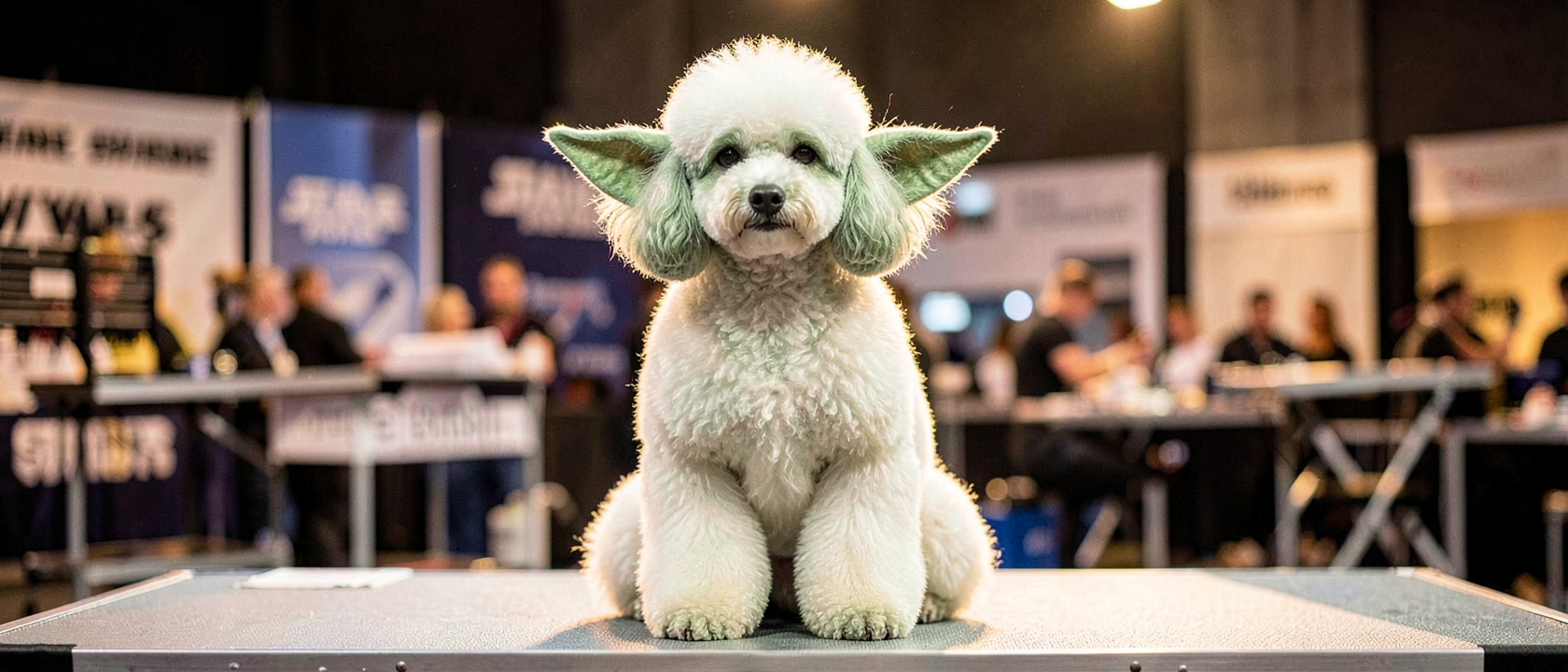
The Dog That Walked In as a Dog and Left as Yoda
Picture a competition stage in Hershey, Pennsylvania. A poodle walks on, looking completely unremarkable. Two hours later, the same dog walks off as Yoda from Star Wars, full-color, three-dimensional, instantly recognizable. No costume, no props. Just the dog’s own coat, cut and colored during the session itself. The green skin is dyed fur. The oversized ears are shaped from the dog’s actual hair, clipped and teased into position.
How does any of that happen in two hours?
Wait, Dragons? Elephants? Sesame Street Characters?
Yoda is not the outlier. At creative grooming competitions across the United States, finished entries have included tigers, lions, dragons, elephants, robots, Disney characters, and Sesame Street characters, each one built from the coat of a living dog, completed inside a window of roughly two hours, though some extreme creative classes allow up to two and a half to three hours.
The level of color and three-dimensional shaping looks as though it demands weeks of studio time. That impression is understandable, because what the audience sees on stage is only the final step. Almost everything important happened long before.
Months of Preparation, Two Hours of Performance
Groomers start working toward a competition design many months in advance. The coat has to grow first, owners deliberately let the dog’s fur reach the specific length and volume the design calls for. By competition day, the dog arrives bathed, dried, and already carrying months of carefully tended coat. The groomer, meanwhile, has been rehearsing shearing patterns, dye placement, and the precise sequence of steps throughout the year. What looks like an afternoon’s work to the audience is actually a year’s worth of training made visible in a single session.
Competitors work with equipment such as Blo-pens, colored artist’s chalk, and temporary hair color spray, products formulated to be safe for animals. Human hair dye is a different matter. Products containing ammonia, peroxide, resorcinol, or PPD are toxic to dogs. Some U.S. states take it further and prohibit dyeing dogs’ coats outright.
Why It’s Almost Always a Poodle
Browse competition photos and one breed dominates: poodles, almost everywhere. A poodle’s fur is dense, tightly curled, and holds its shape after clipping, allowing a groomer to build upright, stable three-dimensional forms that stay in place rather than drooping. Many other breeds have coats that lie flat or simply lack the volume required. Mixed breeds with thick, curly coats can also compete, as can the Bichon Frise, but the poodle provides the most reliable raw material for sculptural work.
This Is a Judged Sport With a Traveling Photographer
Ren Netherland, a photographer based in Clearwater, Florida, operates under the business name Animal Photography and spends roughly eight months of each year traveling the United States to document these competitions. His circuit has taken him through Florida, South Dakota, Wisconsin, Illinois, Ohio, Texas, Pennsylvania, New Jersey, New York, Massachusetts, and Oklahoma, among other states, covering events in cities including Hershey, Secaucus, Las Vegas, Atlanta, and Sturbridge. Netherland founded Animal Photography in January 1986 and has appeared on Animal Planet and the show “Groomer Has It.” Winners can earn prizes of over $5,000.
Netherland has said he never witnessed a groomer harm their dog and that the animals appeared comfortable, his personal observation, not a veterinary assessment. The logic is plain: a groomer spends an entire year working with the same dog, refining a design that the dog’s own coat will eventually become. The audience just never sees that part.