One Woman, One Outfit, Eleven Faces
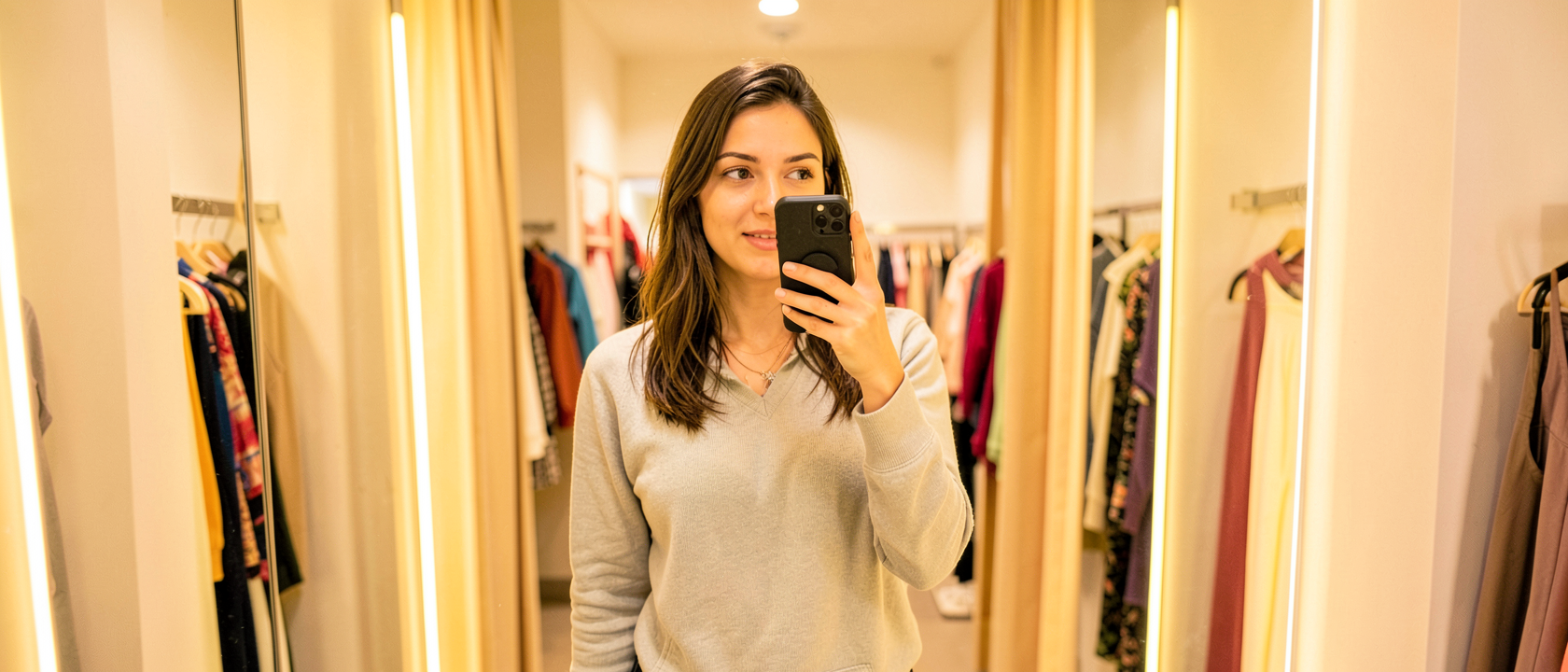
A Russian blogger named Inna had an idea most of us have thought about but never actually tested: does a dressing room mirror tell the truth, or does it have an agenda? To find out, she put on one outfit, grabbed her phone, and walked into eleven different store fitting rooms, among them H&M, Mango, and Zara.
She started at home, snapping a baseline selfie under her own bathroom lighting. Then came eleven more photos, same clothes, same phone, same face. Lined up side by side, the results don’t look like eleven photos of one person. They look like a casting call. In some, she’s glowing. In others, she looks drained, grayish, almost like a different woman borrowed her outfit for the day.
So What Actually Changed?
Here’s the part that makes this more than just a funny photo set: nothing about Inna changed between shots. Not her face, not her posture, not her clothes, not the device capturing the image. Those were the exact things she held constant on purpose.
So cross them off the list. It wasn’t a better camera, a flattering angle she’d learned to find, or a lucky hair day in store number seven. Something else in each of those eleven rooms was doing the heavy lifting, quietly deciding whether she looked like the best version of herself or the worst.
It Was the Room All Along
The variable left standing is the environment itself: how bright the bulbs were, what kind of light they gave off, and what colors surrounded her on the walls and curtains. That’s it. That’s the whole trick.
Light isn’t neutral. Before it reaches your eyes, or a camera lens, it has already bounced off every surface in the room, picking up a tint from whatever it touched. Warm yellow bulbs push everything toward orange and gold. Cool white or bluish bulbs push the opposite way, toward gray and flat. A reddish or pink wall behind you reflects warmth back onto your skin; a dull gray or greenish one reflects dullness. None of this is a filter or an edit. It’s just light physically carrying color with it and depositing that color on your face before the photo is even taken.
That’s why the same outfit, on the same person, holding the same phone, can look like two completely different outfits depending on which cubicle she stepped into.
Why Stores Light Rooms the Way They Do
Stores don’t land on a lighting setup by accident, even if the exact reasoning behind each one isn’t always spelled out. Brighter, more even lighting tends to read as flattering and energizing; it photographs well and makes clothes look crisp. Dim or uneven lighting does the opposite: it makes skin look sallow and can sour a shopper’s mood before they’ve even decided whether to buy anything.
Color plays the same game. Warm red or pink tones in the walls or bulbs tend to make skin look like it’s “popping,” rosier and more alive. Cool, blue-white light can flatten a complexion into something closer to the color of the wall behind it. Whether every retailer has engineered this on purpose or simply inherited a lighting setup that happens to work in its favor, the effect is real, and it shapes how shoppers feel about the thing they’re holding up to the mirror.
Not a Lab, But Still Telling You Something True
This wasn’t a controlled experiment, and it’s fair to say so. Inna didn’t bring a lux meter to measure brightness or a color-temperature tool to clock the bulbs in degrees Kelvin. There’s no record of whether she stood the same distance from each mirror, and nobody has confirmed her exact angle or makeup stayed identical across all eleven stops. As a piece of science, this doesn’t hold up.
As a demonstration of something real, though, it holds up fine. The underlying idea, that ambient light and surrounding color change how a person appears, isn’t in dispute. Inna’s photos just happen to make that idea impossible to unsee.
Why Your New Shirt Looks Different at Home
Everyone has lived a version of this story: an outfit looks great under the store’s lights, and by the time you’re home under your bathroom bulb, it looks like something else entirely. Inna’s eleven photos, shared online in February 2017 as a before-and-after slider, put a picture to a feeling most people never had words for.
Her own takeaway was simple: brighter lighting tends to flatter, red tones used well can make you stand out, and a dark dressing room can sink an otherwise good shopping trip, no matter what you’re actually wearing. The mirror in that cubicle was never a neutral judge. It was reflecting the store’s design choices right alongside your reflection, and most people walk out never knowing which one talked them into buying the shirt.