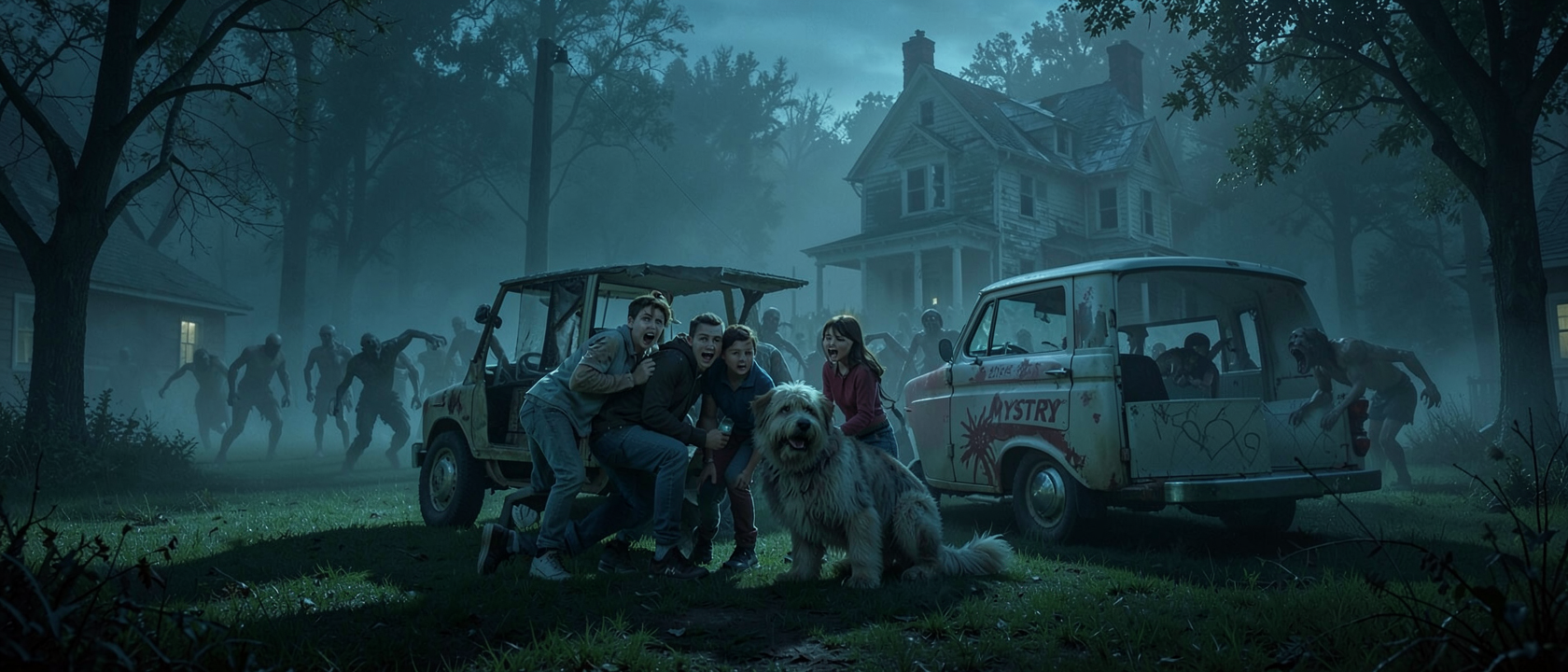
The One Rule Scooby-Doo Never Breaks, Until It Does
Every Scooby-Doo episode, across every incarnation since the show first aired on September 13, 1969, ends the same way. The monster turns out to be a person in a rubber mask, a disgruntled caretaker, a greedy landowner, a rival running a con. The gang’s entire function is to expose that deception. Scooby and Shaggy run from things that aren’t real. Fred, Daphne, and Velma prove that no one is.
An independent illustrator working under the name Warbucks Design took that expectation and quietly broke it. The design, titled “Zoinks … They’re Zombies!” and sold through indie marketplace NeatoShop, drops Mystery Inc. into a scenario the franchise’s formula was never built to handle: actual, maskless, undead monsters. No trick, no caretaker, no satisfying reveal. The punchline is the absence of one.
What Makes That Funny
The humor runs on incongruity resolution. Two mental frames collide, the warm, cowardly, everything-is-fake world of Scooby-Doo and the grim survival grammar of zombie fiction, and the brain scrambles to reconcile them. When it finds the connection (these characters are completely unequipped for this), the tension resolves as a laugh.
The joke only works if you already carry both frames. Someone fluent in Scooby-Doo knows that “Zoinks!” is Shaggy’s exclamation of fear, coined for the show and voiced by Casey Kasem from 1969 until 2009. They know “Ruh-roh” is Scooby’s rhotacized version of “uh-oh.” They know the gang’s unshakeable optimism drives every episode. Strip that background away and the image is just a cartoon character standing near some zombies. Shaggy was designed around the beatnik subculture of the late 1950s and early 1960s, according to character designer Iwao Takamoto, built to be anxious and reluctant. Put him in a genuine zombie apocalypse and the game disappears entirely; the goalposts aren’t moved, they’re gone.
The Platform Behind the Punchline
Warbucks Design is an independent illustrator with no disclosed connection to Warner Bros. Entertainment, which owns the Scooby-Doo franchise. The design appeared on NeatoShop, a retail marketplace connected to the curiosity blog Neatorama, founded by Alex Santoso in 2005. Indie artists uploaded designs, earned royalties per sale, and gained exposure through Neatorama’s readership. By August 27, 2013, when the article promoting the shirt was published, the platform carried over 100,000 designs from around 1,300 independent artists. Warbucks Design also had other titles on the platform, “Mount Doom,” “You’re A Zombie, Chuck!” “Shmowzow,” and “Misbehave”, suggesting an ongoing practice of pop-culture mash-up work rather than a single novelty piece.
Why 2013 Was the Right Moment
By mid-2013, the zombie genre had completed its migration from niche horror into mainstream cultural shorthand. Audiences were already fluent in the vocabulary of survival and undead behavior, exactly what parody requires. The humor amplifies when the source material is specifically wholesome: the more a franchise relies on reassuring viewers that monsters aren’t real, the funnier it becomes to place those characters into a world where they absolutely are. Across indie marketplaces, artists were actively hunting for beloved, safe properties to contrast against horror scenarios, and landing the joke in a culture already fluent in zombie grammar meant the incongruity hit immediately, without setup.
Fan Art, Parody, or Unlicensed Merchandise?
The Neatorama article made no claim of any licensing arrangement and asked no questions about one. The categories carry real legal distinctions. Fan art for personal use sits differently than commercially sold merchandise featuring someone else’s intellectual property. Parody can qualify for fair use protection under U.S. copyright law, but courts have consistently found the line between parody and infringement is not self-evident. The indie marketplace boom of the early 2010s produced thousands of designs living somewhere between these categories, with legal status frequently unresolved. The available facts don’t support a verdict on “Zoinks … They’re Zombies!” in either direction, only a clearer picture of the landscape: an independent artist, a platform built on fan creativity, a franchise owned by a major studio, and a question the original promotional article didn’t think to raise.