A Corpse, a Crowd, and a Bottle of Smelling Salts
On September 3, 1840, Marie Lafarge walked into a courtroom in Tulle, France, dressed in mourning black, accused of poisoning her husband Charles, a foundry owner. The case became one of the first trials the public followed almost in real time, through daily newspaper reports.
What made it different wasn’t the gossip but the evidence. The court stopped wanting to hear a chemist describe lab results and instead wanted the chemistry performed live, using the remains of the man himself. A corpse, in effect, became a witness in its own murder case.
Why did a room full of judges, jurors, and spectators need to watch a chemical reaction happen, instead of trusting experts who said they’d already run it? That question is less about arsenic and more about what it actually takes to make a scientific result believable.
Why Arsenic Got Away With It for Centuries
Arsenic trioxide, “white arsenic,” was long the poison of choice for anyone looking to get rid of an inconvenient relative. Odorless and nearly tasteless, it dissolved easily into food or wine. In France it was nicknamed poudre de succession, “inheritance powder,” for how often it preceded an inheritance.
Its real trick was what happened afterward: symptoms like vomiting, cramping, and slow decline looked like cholera or ordinary food poisoning, both common killers. With no way to test for the poison, doctors had little reason to suspect murder, and death certificates read “natural causes.” Before chemistry caught up, arsenic was about as close to an untraceable murder weapon as existed.
A Test Existed. Nobody Believed It.
By the 1830s, chemists already had a way to look for arsenic in a body. In 1832, British chemist James Marsh tested a cup of coffee in a case where John Bodle stood accused of poisoning his grandfather. Marsh found a yellow precipitate, a telltale sign of arsenic, but by trial the evidence had degraded under scrutiny, and Bodle walked free.
The problem wasn’t the chemistry but trust: no one fully believed a result they couldn’t watch happen. A finding read off a page, days after the fact, felt more like opinion than fact. Forensic science needed something sturdier than a chemist’s word.
Enter the Marsh Test
Stung by that loss, Marsh refined his method, and in 1836 published a more reliable version: heat a sample with acid and zinc, and any arsenic converts into arsine gas, which can be collected and turned into a visible metallic mirror of pure arsenic. It was sensitive, specific, and produced something you could point to.
At the Lafarge trial, local chemists first used older methods and found arsenic in food and drink Marie had allegedly handled, but tests on Charles’s exhumed body came up empty, troubling the prosecution. The defense seized on the gap and brought in Mathieu Orfila, dean of the Paris Faculty of Medicine and the era’s most prominent medical expert, who argued only the newer Marsh method could settle the question.
Why the Test Had to Be Public
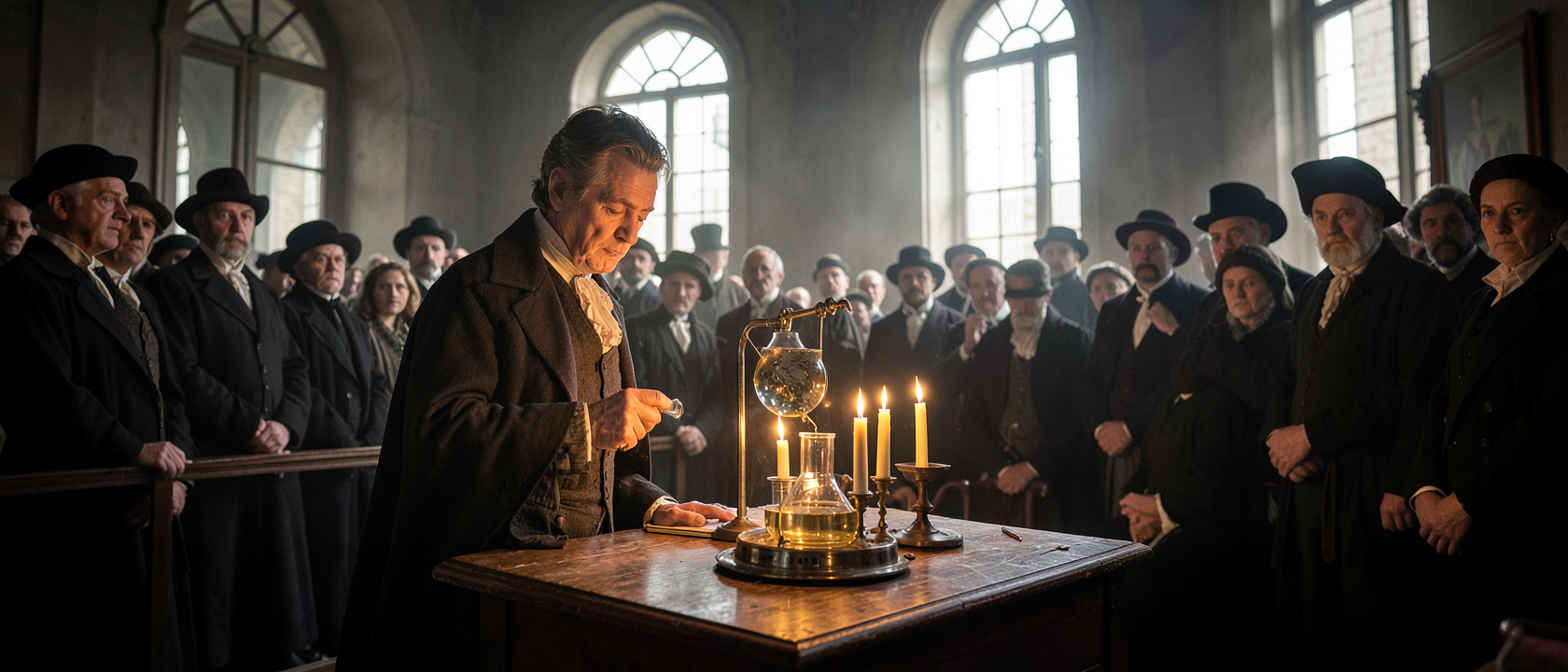
Orfila didn’t file a quiet rebuttal. He repeated the test himself before the judges and jury, showing the earlier failure was due to chemists carrying it out incorrectly, not the method itself. Using the Marsh test on the remains in question, he produced a thin metallic mirror of arsenic that anyone in the room could examine.
Forensic science in 1840 had no public track record; a result from behind closed doors carried little weight. By running the procedure where jury and spectators could watch, Orfila turned an invisible chemical process into something the whole room had personally witnessed.
What the Spectacle Can’t Tell You
Marie Lafarge was found guilty; accounts differ on the exact length of her sentence, and that detail, along with the precise chemistry of how arsine gas becomes a metal mirror, is worth chasing down on its own.
The trial shows that being right and being believed are two different achievements. The Marsh test worked as well, chemically, in 1832 as in 1840, what changed was whether people could watch it happen. The Marsh test itself stayed in forensic use, with refinements, into the 1970s.