The Flag on the Tailgate
Anyone who has hauled plywood home from the lumberyard knows the ritual. A standard sheet of plywood runs 8 feet long, and on plenty of pickups that’s enough to leave it sticking out past the tailgate. Someone zip-ties a red flag to the corner, and the drive home happens at a crawl.
On April 17, 2014, automotive writer Jason Torchinsky proposed a way around that in a piece for Jalopnik, later picked up by Neatorama on April 18, 2014. His fix wasn’t a longer truck, but one shaped differently enough that length stopped being the limiting factor at all.
The Space You Can’t Get Back
Stretch the bed and you stretch the whole truck, and a longer truck turns worse, parks worse, and is miserable in a tight driveway. Shrink the cab the obvious way, front to back, and you steal legroom or engine space. Neither trade gets you more cargo room without a bigger, clumsier vehicle.
Torchinsky’s gripe was more specific: standard pickups waste too much length on the hood. If a cabover layout, with no hood at all, wasn’t going to happen, some other fix had to exist. So where do you find several extra feet of bed without adding several feet of truck?
Cutting the Cab in Half, Sideways
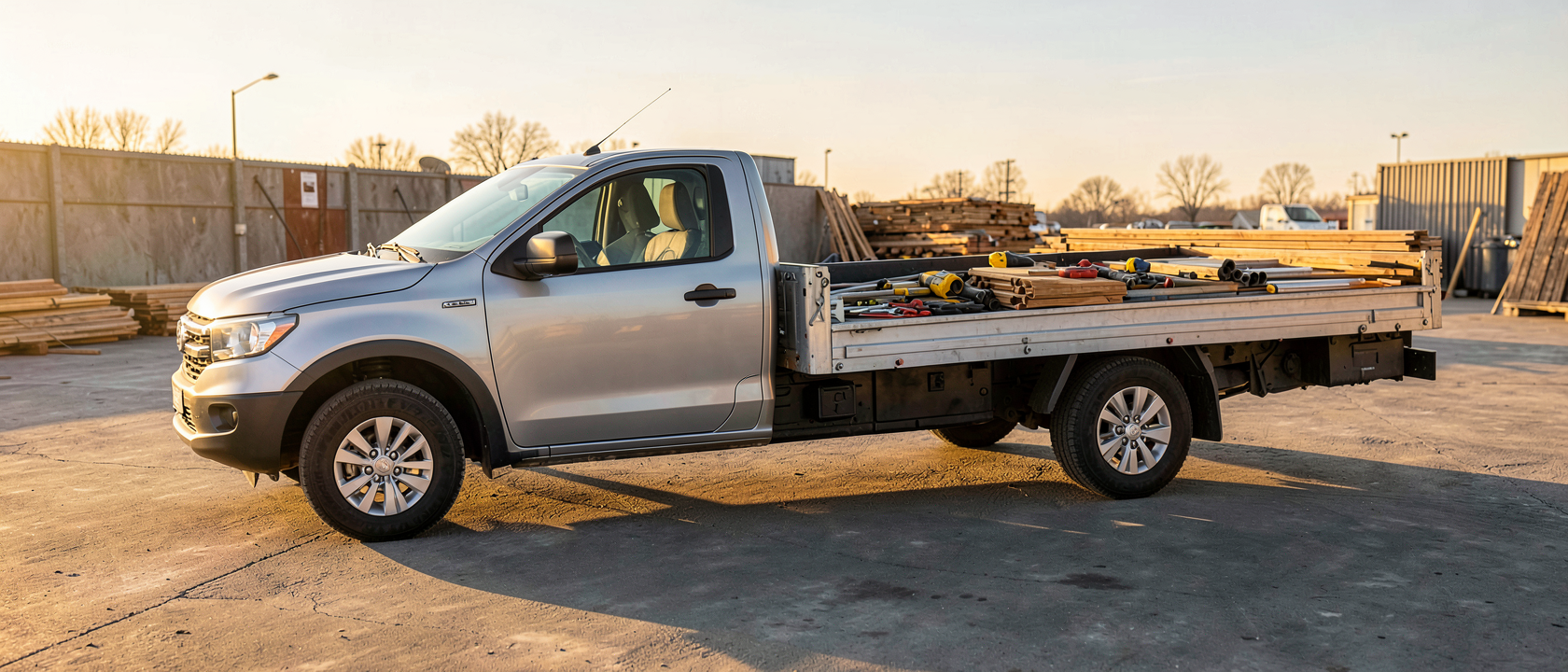
Instead of shortening the cab front to back, his concept narrows it to roughly half the width of a normal one. The seating goes tandem, one person up front and one behind, with both doors on the same side. That frees a strip along the other side, where the bed can run nearly the full length of the vehicle instead of stopping behind a full-width cab.
One version has the bed bend into an L-shape, with an extra cargo pocket tucked behind the narrowed cab. To make up for storage lost to the slimmer cab, the design adds a lockable trunk built into the cab’s side wall. Length was never the only dimension on the table, width just hadn’t been used yet.
The Engine Has to Shrink Too
Narrowing the cab doesn’t stop there. The engine bay sits right in front of it, and if the whole front end slims down to match, a wide V6 or V8 probably won’t fit. Torchinsky’s reasoning points toward an inline-4 or inline-6 instead, since those engines are built narrow rather than wide.
This is a knock-on effect of the design, not a confirmed spec, nobody has built the truck, so nobody has chosen an engine. Still, it shows how one decision about a body panel can reach into an entirely different system under the hood.
Who’d Actually Want This
The obvious audience is anyone who works with materials longer than a truck bed: plumbers moving pipe, welders carrying steel stock, carpenters with lumber, gardeners hauling fence posts or rails. For them, an 8-foot sheet is the everyday problem they keep hitting, and the red-flag routine is less a quirky tradition than a recurring hassle. A bed running almost the length of the truck means fewer overhangs, fewer flags, and fewer slow drives hoping the load doesn’t shift.
Still Just an Idea
None of this exists outside the sketch. There’s no prototype, no released dimensions, no manufacturer attached, just a concept Torchinsky laid out in 2014 (he’d floated a related idea, the “double-bed pickup,” on December 20, 2013). Readers of the Neatorama piece raised fair questions: how comfortable is tandem seating, and does an L-shaped bed complicate loading versus a plain rectangle? Some flagged the asymmetric weight distribution and visibility around a load stacked beside the cab; others just liked it for carrying long boards and trim. That’s opinion and speculation, not engineering data.
The Kind of Thinking Worth Noticing
What makes this concept worth remembering isn’t a new material or bigger engine. It’s that it refuses the usual trade-off between “longer truck” and “shorter bed” by asking which dimension is even allowed to change. Once width becomes fair game instead of just length, the whole problem opens up.
That’s a pattern worth spotting well beyond trucks: often the fix for a stuck problem isn’t pushing harder on the same lever, it’s noticing which constraint nobody actually checked.