The Most Unlikely Album of the Nineties
Picture the pitch meeting: we’d like punk and alternative rock acts to record children’s cartoon theme songs. Not as parody. Not as a joke B-side. As a fully produced, 19-track album on a major label.
That album exists. MCA Records released Saturday Morning: Cartoons’ Greatest Hits on December 5, 1995, and the roster reads like an alt-rock festival that got its wires crossed with a Saturday morning TV guide. The Ramones covered the Spider-Man theme. Helmet took on “Gigantor.” Liz Phair, working with Material Issue, handled “The Tra La La Song” from The Banana Splits Adventure Hour. Juliana Hatfield and Tanya Donelly recorded “Josie and the Pussycats.” The Butthole Surfers covered “Underdog.” These were artists at the center of 1990s alternative rock, lending their sound to melodies most of them had last heard before they could drive.
Why Cartoon Theme Songs Never Leave You
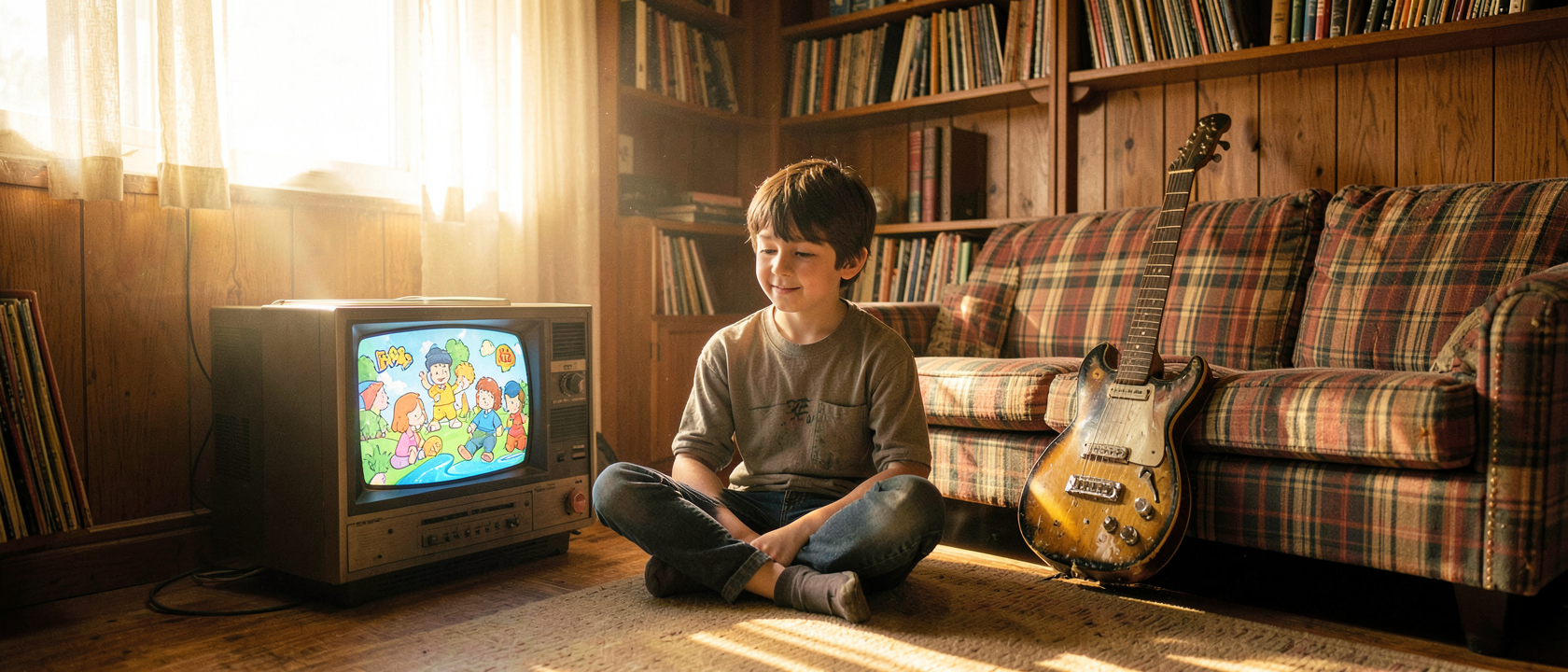
Cartoon themes heard in early childhood enter memory differently than music encountered later in life. Young brains have not yet built the filtering mechanisms adults use to half-ignore new sounds. Music arrives whole, bundled with the physical moment: cereal going soggy, Saturday light through a window, nothing to do until lunch. The melody files itself away permanently, tied to the texture of that morning, which is exactly the psychological foundation the album was built on.
What Happens When Punk Plays Your Childhood
When a deeply encoded melody appears in an unfamiliar sonic context, the familiar structure provides an anchor while the new arrangement provides friction. That combination is what makes reinterpretation compelling rather than disorienting.
Different artists filtered the same raw material through entirely different identities. Matthew Sweet’s take on “Scooby-Doo, Where Are You?” carries his signature guitar-pop warmth. Reverend Horton Heat brought rockabilly energy to a medley of the “Jonny Quest” and “Stop the Pigeon” themes. The Ramones playing the Spider-Man theme is, on paper, absurd; in practice, the chord structures sit close enough to classic Ramones territory that the cover feels almost inevitable.
The total runtime is 65 minutes and 29 seconds, these were not rushed recordings. Produced by Ralph Sall and covering originals mostly from the 1960s and 1970s, the album charted on the Billboard 200, peaking at number 67 during the week of January 28 through February 3, 1996, and held a spot for 16 weeks.
Drew Barrymore, a VHS, and a Cultural Statement
The album did not arrive alone. MCA Home Video released a VHS featuring music videos for every track, hosted by Drew Barrymore, who appeared alongside friends reacting to each video between performances. She was not there to add musical credibility; she was there to frame the project generationally, a face her generation recognized, watching the same bands they listened to take apart the same shows they grew up with. MCA also partnered with Marvel Comics on a tie-in comic book, signaling that the label understood it was working with material that had cultural range well beyond any single format.
Why People Are Still Talking About It
An article revisiting the album appeared on October 22, 2016, more than two decades after release. Most novelty projects are forgotten within a year; this one kept generating conversation. The cartoon themes are indestructible on their own, and the artists, The Ramones, Collective Soul, Helmet, and others, have only grown in canonical standing since 1995. On November 29, 2019, the album received a limited vinyl reissue for Record Store Day Black Friday: 4,000 copies on translucent blue and green double LP. That a physical reissue was considered commercially worthwhile 24 years later answers the question of why it lasted.
A familiar melody belongs to everyone who ever heard it. The artists here were not covering something foreign, they were covering something already theirs, waiting to be played in their own key.