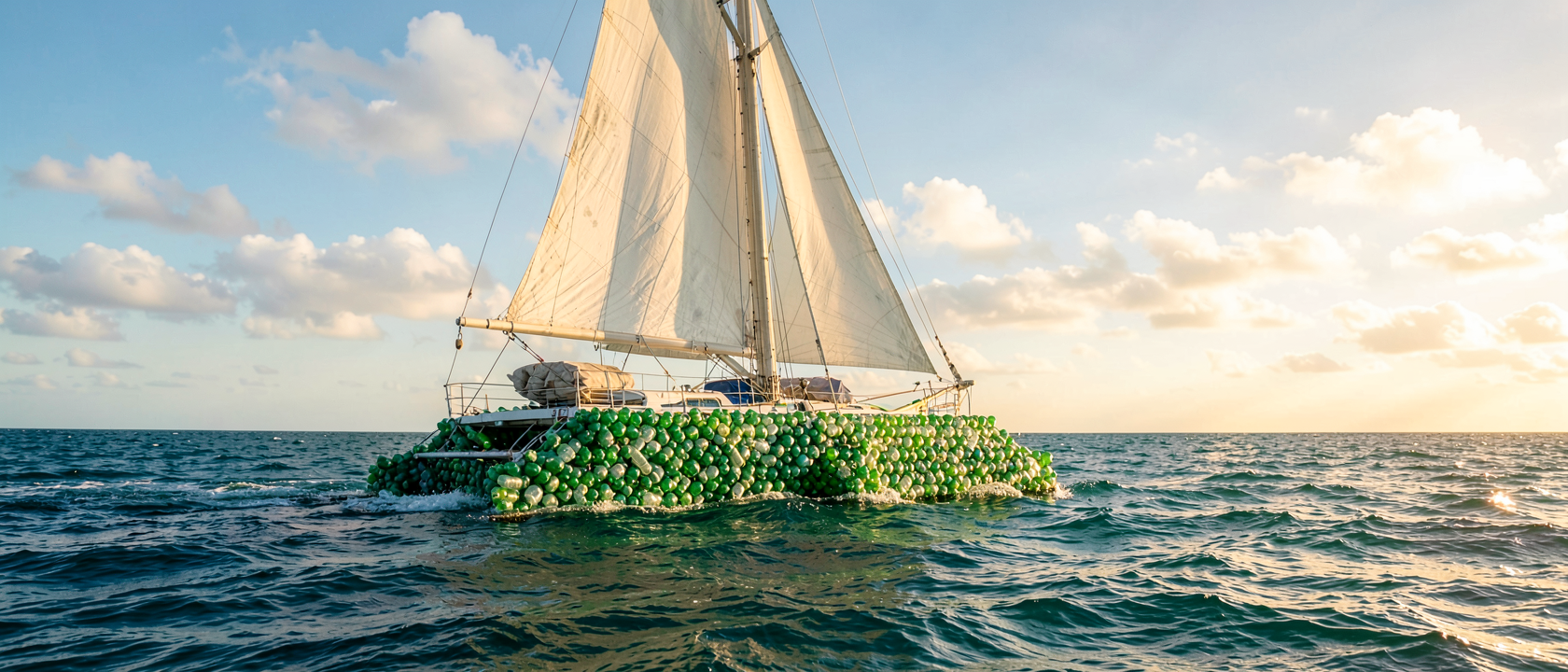
A Hull Built from the Recycling Bin
On March 20, 2010, a 60-foot catamaran named Plastiki left Sausalito, California and set a course for Australia. The crossing covered roughly 8,000 nautical miles, and the boat docked at Sydney Harbour on July 26, 2010, about 128 to 130 days later. What made the voyage unusual wasn’t the distance, it was the hulls: 12,500 reclaimed 2-liter plastic bottles. No vessel built that way had crossed an ocean before.
Wait, Plastic Bottles Float. But Can They Sail?
A hull has to resist compression from waves, flex without fracturing through swells, and hold its shape over months at sea. A disposable drinks container meets almost none of those criteria by design, which is precisely why the engineering behind Plastiki deserves a close look.
Why the Bottles Actually Hold
Each of the 12,500 bottles was loaded with dry-ice powder before resealing. As the dry ice sublimated, CO₂ built up pressure inside, a pressurized bottle is considerably stiffer than an empty one, much like an inflated bicycle tire versus a flat one. Those stiffened bottles were bonded with an adhesive made from cashew-nut oil and sugar cane, keeping construction largely free of petrochemical glues.
The main hull material was srPET, self-reinforcing polyethylene terephthalate, made by weaving PET plastic fibers so they align and brace each other, producing a composite comparable in strength to fiberglass but made entirely from recyclable plastic. Australian naval architect Andrew Dovell designed the structure. Roughly 90% of Plastiki‘s construction was recycled or recyclable, and the pressurized bottles provided about 68% of total flotation.
Two Hulls, Two Masts, One Backup Engine
Plastiki was rigged as a ketch, with a main mast and a shorter mizzen mast, both made from recycled aluminum irrigation pipe, allowing the crew to adjust sail area across multiple weather systems. The sails were hand-sewn from recycled PET cloth. The twin-hull catamaran format gave stability without a deep keel, useful for a vessel whose structural properties were partly unproven at ocean scale. Electricity came from wind turbines, solar panels, trailing propeller turbines, and bicycle generators as a further backup.
San Francisco Bay as a Test Lab
Construction ran through 2009 at Pier 31 on the San Francisco waterfront, with finishing work in Sausalito. The team then tested extensively on San Francisco Bay, a demanding environment of strong tidal currents, unpredictable winds, and short steep chop. The project had started around 2006 to 2007, after expedition leader David Mayer de Rothschild read a UN Environment Programme report on plastic accumulation in the world’s oceans. De Rothschild, a British environmentalist who had previously become the youngest Briton to reach both the North and South Poles, was 31 at departure and organized the project through his non-profit, Adventure Ecology.
Why Kon-Tiki Matters Here
The name echoes Kon-Tiki, the balsa-wood raft on which Norwegian explorer Thor Heyerdahl and five companions crossed the Pacific in 1947 to show that a voyage the academic mainstream thought impossible was achievable with materials already at hand. De Rothschild’s argument runs along the same lines but points at something different: that plastic accumulating in the ocean could be turned into something seaworthy. The crew included Olav Heyerdahl, Thor Heyerdahl’s grandson, giving the homage a human face. The argument wasn’t made in a press release, it was made by sailing 8,000 nautical miles and docking outside the Australian National Maritime Museum. Time Magazine later named Plastiki one of its 50 best inventions of 2010.