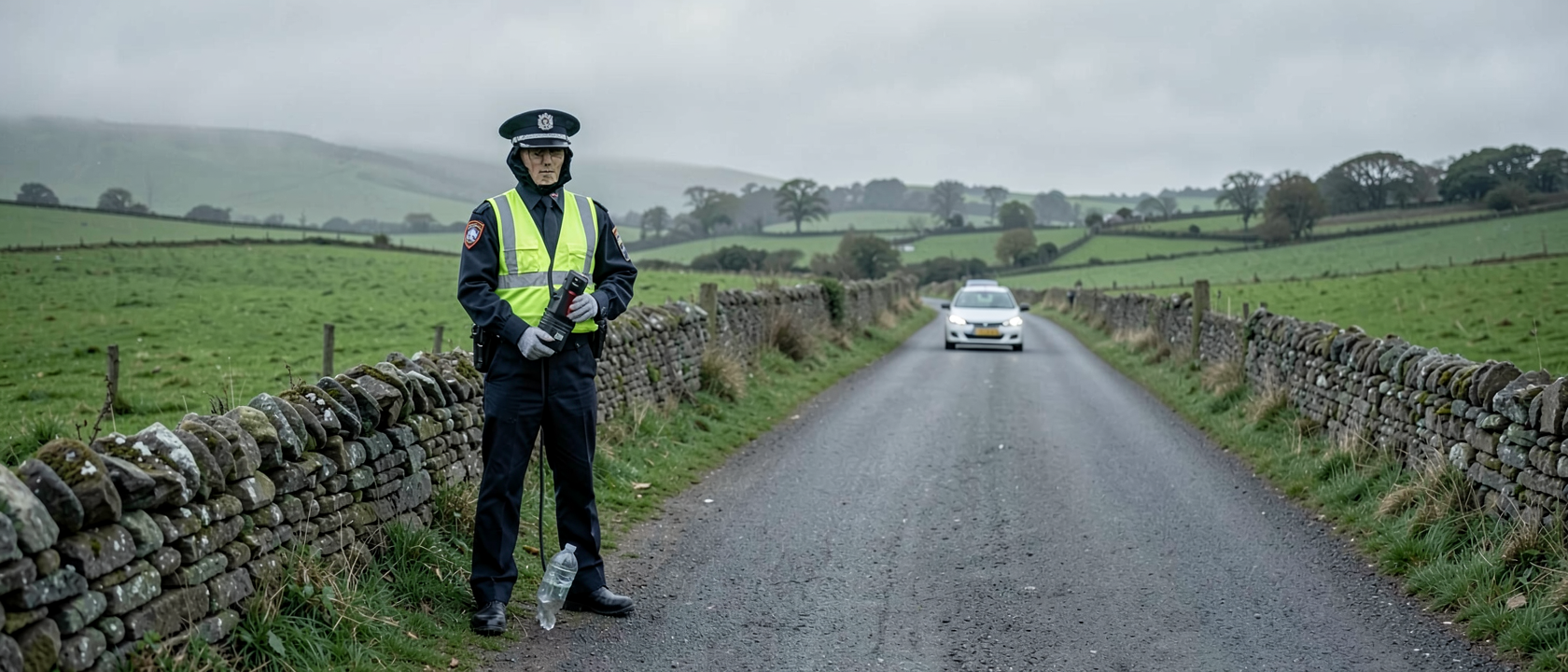
A Water Bottle, Some Old Clothes, and a Speed Problem
Crosby-on-Eden is actually two small villages, High Crosby and Low Crosby, sharing one name and sitting beside the River Eden northeast of Carlisle in Cumbria. The road running through it carries enough through-traffic to be a problem, and local residents, tired of watching cars move through faster than was safe or welcome, found that official traffic enforcement was not reliably available.
So they made their own. Someone dressed a human-shaped frame in a high-visibility jacket, stood it at the roadside, and placed a water bottle in its outstretched hand to serve as a prop radar gun. Resident David Sowden, who watched what happened next, noted that from a normal driving distance the figure looked convincingly like a genuine police officer. The effect on traffic was immediate. By the accounts of those watching, speeds dropped sharply, one observer described drivers as nosediving when they caught sight of it.
Signs and road markings have a habit of becoming invisible through familiarity. A stuffed jacket holding a water bottle, apparently, does not.
You Can’t Be Fined by a Stuffed Jacket
The stranger part is this: a water bottle cannot measure your speed. A jacket on a frame cannot read your plate, radio it in, or generate a penalty notice. There is no legal consequence waiting on the other side of driving past it without slowing down. Any driver who thought it through for three seconds would arrive at that conclusion without difficulty.
And yet they slowed down anyway.
That gap, between what the figure actually is and how drivers responded to it, is worth sitting with. Something is happening in the interval between spotting the roadside figure and moving your foot. The question is what, exactly, is doing the work.
Your Brain Votes Before You Do
The answer sits in how the brain handles uncertain situations where one of the possible outcomes is costly. Passing a real speed enforcement officer at well over the limit carries serious consequences. Slowing down for a fake one costs you a few seconds. Those two errors are not equivalent, and the brain, operating at driving speed, does not wait around to resolve the uncertainty before acting.
What it does instead is pattern-match: it recognizes a human silhouette, a high-visibility jacket, and an object that has the rough shape of a detection device, and it fires an association, “officer running speed checks”, fast enough that the foot comes off the gas before any conscious verification process has started. The skepticism, if it arrives at all, comes afterward.
This is not the brain failing. In the vast majority of real encounters, the figure with the jacket and the device actually is an officer. The shortcut is usually right. The scarecrow works by inserting itself into a pattern that exists for good reasons, drawing on the instinctive caution built up across thousands of genuine roadside encounters.
The Trick Only Works While the Doubt Lasts
A visitor to Crosby-on-Eden proposed a logical follow-up: run the scarecrow for one week, replace it with a real officer carrying a functioning speed gun the next week, then repeat the rotation. Drivers, never knowing which version they would encounter, would have no safe reason to gamble.
The proposal also identified, without quite stating it, the scheme’s core vulnerability. A driver who passes the same motionless figure at the same spot every morning, week after week, without ever experiencing any consequence, will eventually update their mental model. The figure that once read as “possible officer” gets reclassified as “that prop again,” and the caution dissolves. Repeated exposure to something that never produces a result tends to strip away the response it once triggered. Whether the alternating-officer experiment was ever carried out in Crosby-on-Eden is not on record.
What is on record, loosely, is that this idea has surfaced independently in multiple places: communities in Merseyside, Northumberland, near Saltburn, and in British Columbia and Alberta have all tried variations of the same tactic at various points. Each one operates on the same mechanism, and each one is quietly racing against the moment familiarity wins.