The Photograph That Shouldn’t Exist
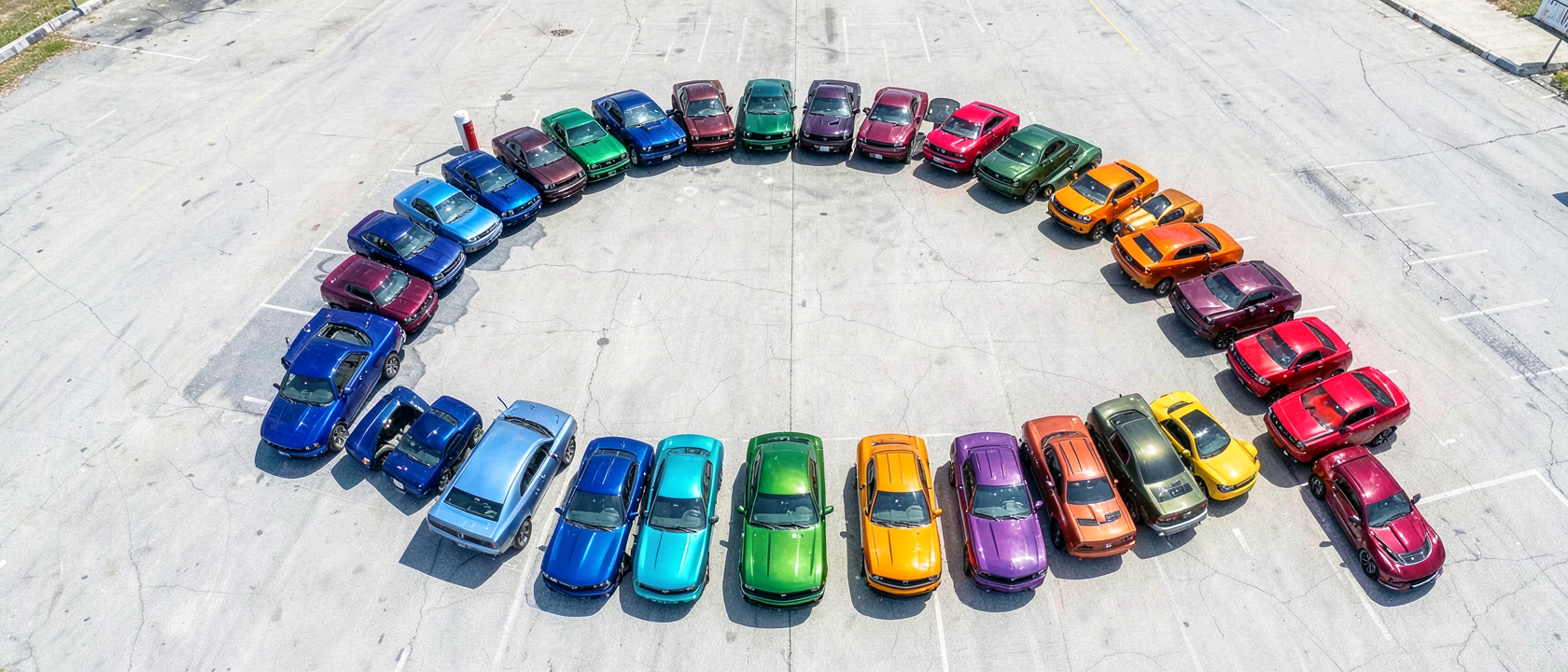
Picture a single line of muscle cars stretching across a Georgia fairground, ordered from deep red at one end through orange, yellow-green, blue, and purple at the other. Seventy-six Dodge Challengers, each a different factory color, forming something that looks less like a parking lot and more like a paint-chip display scaled to full size.
The Peach State Challengers, an Atlanta-area owners’ club, staged this in August 2016. Deldrick Ellsberry photographed the line from ground level while Chris Robbins captured the full sweep from the air by drone. When Reddit user Ghawblin posted the aerial shot, it reached people who had never heard of the club and probably hadn’t thought about car colors in years. Most of us wouldn’t guess a single model line could fill an entire visible spectrum.
Walk Any Parking Lot. Notice Anything?
White, silver, gray, black. An iSeeCars analysis of 22 million vehicles covering model years 1996 through 2025 found those four colors now account for 80.4 percent of the US automotive market, up from 47.3 percent in 1996. Gray alone climbed from 3.6 percent to 22.9 percent. Red and green combined fell from 33.5 percent to 9.2 percent. The shift crept in one model year at a time, which is why most buyers never consciously noticed it, until a photograph of 76 brightly colored muscle cars looked almost implausible.
Why the Palette Shrank
No single person decided cars should be gray. Resale value is the biggest factor: white, gray, and black appeal to the widest pool of future buyers, so fleet operators and leasing companies systematically favor neutrals. Specialty pigments cost more per vehicle, and manufacturers under margin pressure trim wherever they can. Repair economics push the same way, matching an unusual color on a damaged panel costs noticeably more than matching a standard gray. Every one of those pressures points the same direction; neutrals end up winning at every stage, from the factory floor to the used-car lot.
What the Challenger’s Color List Actually Looked Like
The Dodge Challenger, built from 2008 through 2023, carried one of the broadest factory color catalogs of any modern production car, including 17 heritage colors as a callback to its first-generation ancestor, which ran from 1970 to 1974. Chrysler had launched its High Impact Paint options in the summer of 1969, Plum Crazy, Go Mango, Hemi Orange, designed to be visible from a distance. By 1973–74 those colors were quietly dropped in favor of earth tones. The modern Challenger reversed course, restoring Sublime Green, B5 Blue, and Plum Crazy to the regular order sheet. Every car in the Georgia photograph was a factory original: no custom paint, no resprays.
The Imperfect Ending
The rainbow wasn’t flawless. A cluster of white cars ended up at the rear rather than integrated into the gradient, one account suggests those owners may have deliberately avoided anchoring the sequence in white, though this is the more plausible interpretation, not a confirmed fact. The irony is hard to miss: a community gathered to celebrate chromatic variety still found white among the most common colors in their own lineup.
Yellow is also conspicuously absent. The club had two Yellow Jacket Challengers, but both owners were unavailable on the day of the shoot, a small gap pointing to something the rainbow almost conceals: even among enthusiasts, certain factory colors were always at the edge of what buyers would actually commit to.
After the photos spread, the club received 10 to 15 new membership requests. Now that Challenger production has ended, the cars already on the road are the only ones that will ever be in that photograph.