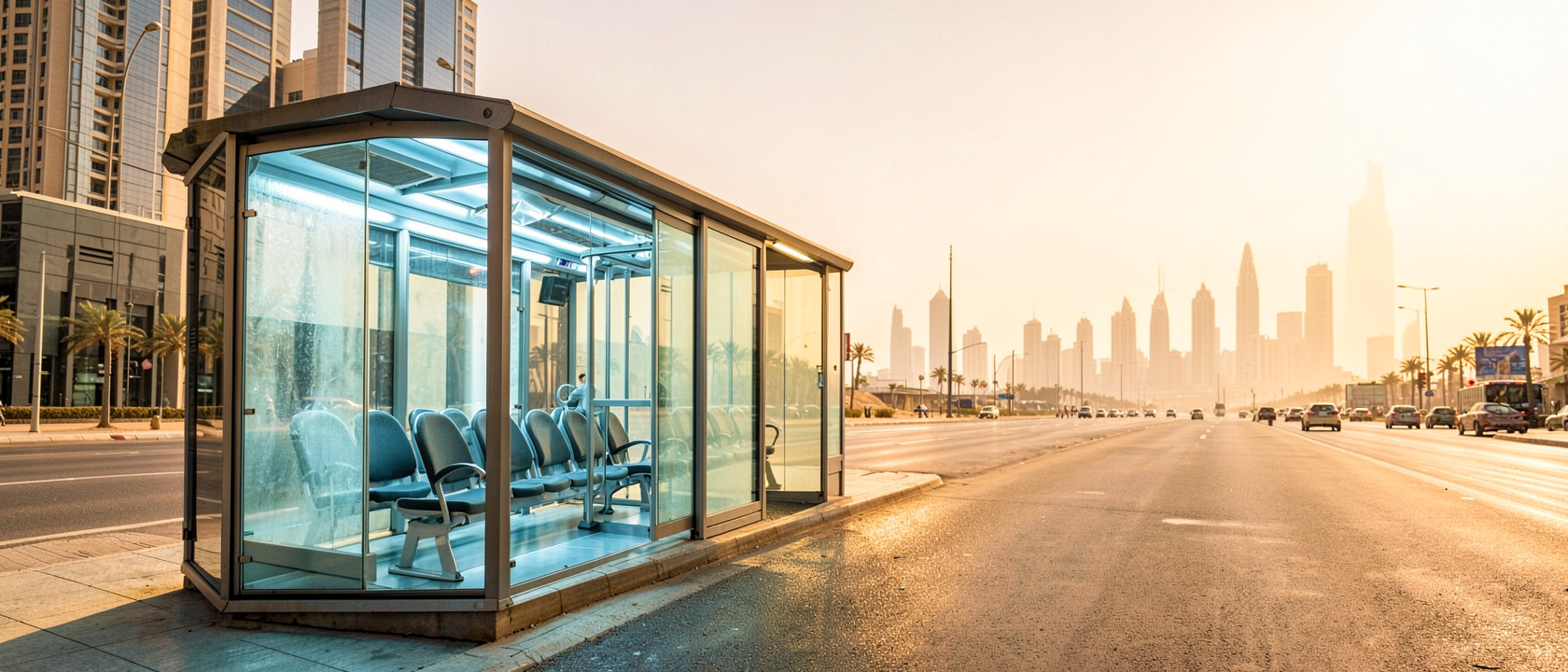
The Bus Stop That Beats the Heat
A photograph that circulated online in August 2008 showed something that took a second to process: a fully enclosed, air-conditioned public bus stop, reportedly somewhere in Dubai. No open sides. No gap for the wind to pass through. Just a sealed box with seats inside and chilled air. The kind of climate control you’d expect in an office lobby, installed at a bus stop on a public sidewalk.
Bus stops, in virtually every city on the planet, provide two things: a roof and a bench. Occasionally there is a printed schedule on the wall. Air conditioning does not feature anywhere on that list. So the image spread, and people had questions.
The Detail That Sharpened the Oddity
The original article placed the stop somewhere near the Burj Al Arab hotel, though the word it actually used was “presumably.” The location was never confirmed. But that detail was hard to ignore regardless. The 56-story, 1,053-foot-tall (321 m) hotel, designed by architect Tom Wright to echo the sail of a dhow (a traditional Arabian sailing vessel), opened on December 1, 1999, on an artificial island 919 feet (280 m) off Jumeirah Beach. A night’s stay was running around US$1,000 in 2008.
The contrast writes itself. A bus stop is, by definition, for people who are not arriving by private helicopter or chauffeured car. So the question of who was meant to wait in an air-conditioned shelter in that vicinity, tourists on foot, hotel employees, residents of nearby neighborhoods, was left entirely open by the available information.
What the Story Left Out
The 2008 image came without much explanation: no technical detail about the cooling system, no clarification on whether the stop was part of a city-wide rollout or a one-off installation. It arrived as a photograph and a caption, and the curiosity spread on the strength of the visual alone.
What that story did not mention is that Dubai had already been building air-conditioned bus stops since 2007, under a program run by its Roads and Transport Authority (RTA). The design is more straightforward than it might sound: an enclosed shelter with 8 to 10 seats, cooled during the warmer months by a standard indoor air handling unit with an external fan coil unit, the same basic technology found in offices and apartment buildings. By 2025, the RTA had 893 of these shelters in operation across 22 key locations in the emirate. Some include vending machines and ATMs. The RTA’s broader network covers more than 2,000 bus stops across Dubai and neighboring emirates.
When 106°F Is a Routine July Afternoon
To understand the engineering logic here, consider the actual conditions. Dubai’s average daily high in July sits around 106°F (41°C). Recorded extremes have reached 120°F (49°C). The climate is subtropical desert, and high humidity means the felt temperature can push well beyond what the thermometer shows. Standing at an outdoor bus stop for ten minutes under those numbers is genuinely unpleasant. For elderly passengers or anyone with a heart or respiratory condition, it can be medically significant.
The RTA has stated plainly that one goal of the air-conditioned stops is to encourage more people to use public transport. That framing makes sense. If the alternative to a hot, exposed bus shelter is an air-conditioned private car, many people who could take the bus will drive instead. Providing a cooled waiting environment shifts that calculation.
Framed that way, the image that circulated in August 2008 was less a monument to excess and more a snapshot of a city adapting its infrastructure to an environment most of the world does not live in. Whether that particular stop was actually near the Burj Al Arab, nobody confirmed. What is clear is that the city had a straightforward reason for building these shelters, and that reason was 106°F in the shade.