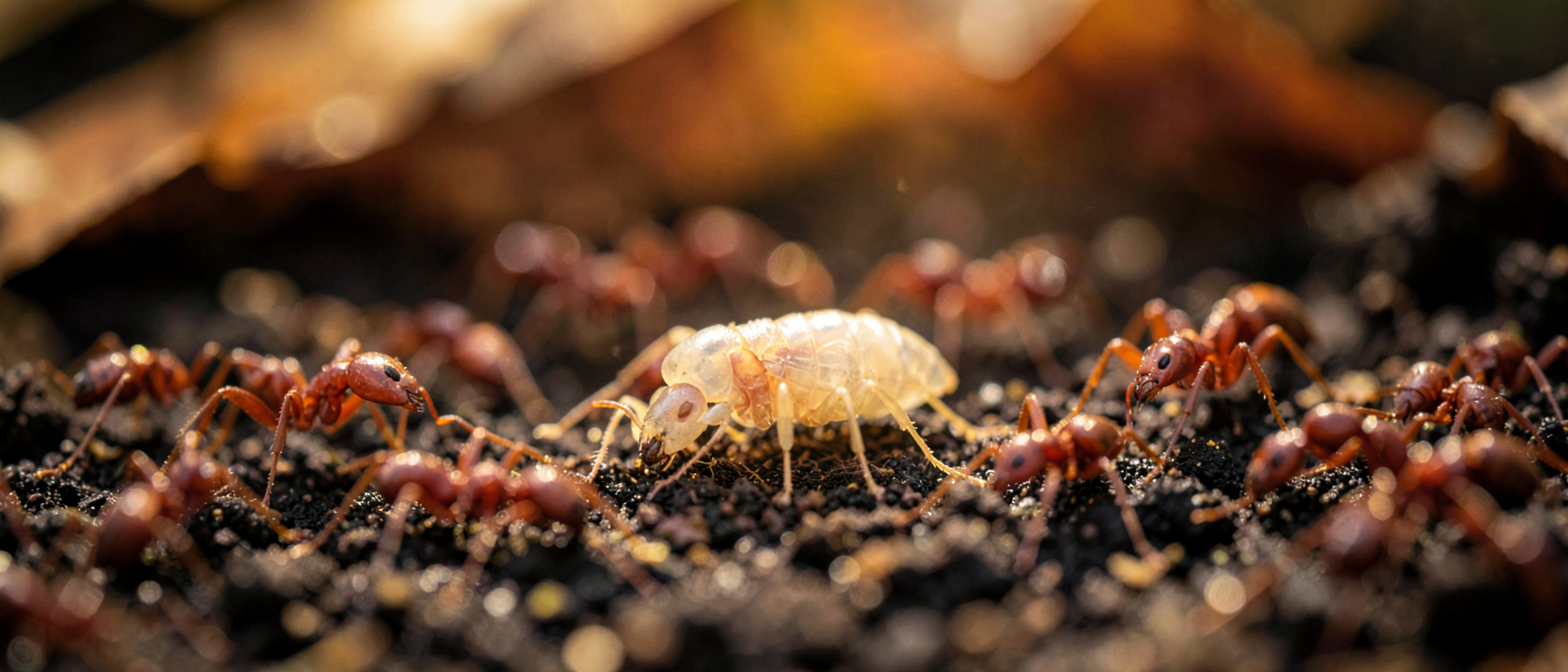
The Ant That Chose Not to Fight
Solenopsis invicta, the red imported fire ant, is colonial, territorial, and equipped with a sting that sends larger animals retreating. So the last thing you would expect from a young fire ant, confronted by a rival worker, is absolutely nothing. Yet that is precisely what happens. The juvenile curls its legs beneath its body, goes rigid, and lies still while the attacker sniffs and prods it, then loses interest. A few moments later, the “dead” ant uncurls and walks away.
Hidden in Plain Sight for Decades
Fire ants are among the most studied insects in North America, yet nobody had written this behavior down until Dr. Deby L. Cassill, an evolutionary biologist at the University of South Florida St. Petersburg, was watching close-up footage with undergraduate students Kim Vo and Brandie Becker. One ant appeared to be killed by another, then got up and walked away.
The reason it went unnoticed for so long is almost obvious in retrospect. Most ant observation focuses on foragers and soldiers. The youngest workers rarely leave the colony, so they rarely ended up in front of a camera. The behavior has a name: thanatosis, from the Greek word for death. It had already been documented in mammals, birds, amphibians, lizards, dragonflies, and beetles before 2008, but never in an ant. Cassill’s paper, published in Naturwissenschaften in July 2008, was the first.
Age Is Everything: Three Ants in One Lifetime
The behavior does not describe fire ants as a species, it describes them at one specific point in their lives, part of a sequence of three. Days-old workers feign death when attacked. Weeks-old workers flee. Months-old workers stand their ground and fight, biting and stinging in the way the species is famous for. Three different responses to the same threat, from the same individual, across a lifetime Cassill’s research puts at approximately six months to one year.
The logic is physical. Young fire ant workers have soft, underdeveloped exoskeletons and stingers not yet hardened enough to function as weapons. Playing dead costs almost nothing and keeps the juvenile out of a fight it cannot win, days-old workers that feigned death were four times more likely to survive an attack than older workers that fled or fought back. As the body hardens, the calculation shifts: a weeks-old ant can run, and by the oldest stage, full exoskeleton, complete muscle development, fighting is both feasible and the lowest-cost option remaining.
What the Enemy Ant Actually Sees
Ants navigate primarily through pheromones and physical contact. An ant that moves and reacts to contact reads as a live threat. One curled motionless on the ground produces none of those signals and registers, as far as the attacker is concerned, as already dead. The attacker investigates, finds nothing worth engaging, and moves on. Cassill’s research suggests the behavior is likely inherited rather than learned, a response encoded into the animal that exploits precisely how rival ants process information.
Playing Dead Is Not the Weak Option
Thanatosis is easy to file under “last resort of the helpless,” but the fire ant complicates that picture. Finding it in Solenopsis invicta, a species that sits firmly at the aggressive end of the insect spectrum, suggests the behavior belongs to a wider range of creatures than anyone had reason to assume before 2008. Survival strategies are not a hierarchy with fighting at the top; they are options, and the most effective one depends on what the animal can physically do at a given moment. A fire ant that picks a fight on day three of its life dies. Months later, the same ant does not hesitate. In between, it runs. One animal, three answers to the same problem.