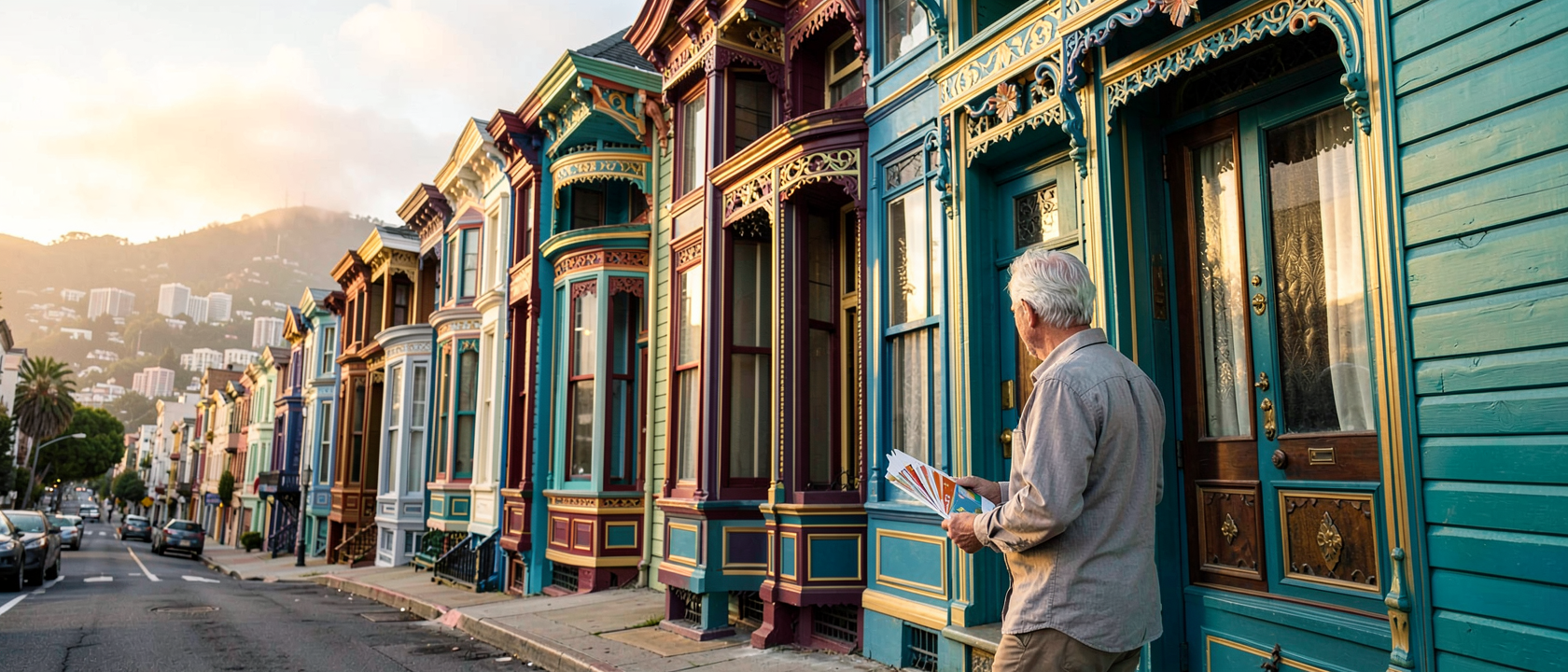
The City Whose Colors Belong to One Man
Most people who photograph San Francisco’s Victorian streetscapes assume they’re looking at something that evolved gradually, a happy accident of neighborhood taste accumulated over generations. The vivid corals and sage greens, the gold trim, the contrasting window frames: surely these color combinations grew out of the Victorian era itself.
They didn’t. A remarkable share of those palettes traces directly to one person. His name is Bob Buckter. He grew up in San Francisco’s Excelsior and Outer Sunset districts, started out as a house painter in 1970, and eventually shaped the color choices on roughly 15,000 building exteriors across the city. In San Francisco, people know him as “Dr. Color.”
What Even Is an “Architectural Colorist”?
When Buckter began his career, the job didn’t exist. An architectural colorist advises property owners on exterior paint palettes: which colors go on which elements of a facade, how shades interact across a block, how afternoon light changes the way a color reads. For decades, that thinking had been bundled silently into the painter’s craft, or skipped entirely. Nobody was charging a dedicated fee just to decide what colors to use. Buckter demonstrated the gap between “good enough” and “clearly better,” building by building, until clients were willing to pay specifically for the advice.
How Buckter Built the Profession
Buckter graduated from San Francisco State University in 1969 with a degree in social sciences, then went straight into painting. His first Victorian painting project, in 1970, was a house at 1908 17th Street. He ran a company called Bob Buckter & Friends.
The buildings he finished looked different from others on the block in a way neighbors noticed. Recognizing he had an unusual instinct for color, he began offering consultations separately from the painting work, a service people weren’t yet asking for, but sometimes agreed to try. By around 1977 he had done well enough to retire at roughly 30, spent about a year sailing, then returned and devoted himself entirely to color consulting.
His choices come from experience and instinct rather than formula. He considers a building’s architecture, its relationship to neighboring structures, and even, by his own account, the personality and clothing of the owner. One frequently cited project is a house at 1153 Oak Street, painted in the 1970s using a palette drawn from a client’s necktie: blue, silver, gold, and burgundy, what he calls his most iconic job. He also chose the colors for 573 Castro Street in the late 1970s, with Harvey Milk’s approval.
Finished buildings receive a small blue plaque reading “Bob Buckter, Color Consultant.” At the height of his career he was completing more than 600 consulting jobs per year, with fees running up to $1,200 per consultation.
15,000 Buildings, and That’s Only the Ones He Was Hired For
By 2016, Buckter estimated he had directly advised on roughly 15,000 San Francisco exteriors; figures from 2025 put the city total around 18,000, with broader Bay Area work approaching 25,000. These are self-reported estimates that vary across sources, so treat them as approximate. Even so, the scale is significant: five decades of work, one palette at a time, concentrated in a single city.
That count excludes the buildings he never consulted on at all. Property owners regularly copied palettes from neighboring buildings without knowing their origin, extending his visual footprint through informal propagation impossible to quantify.
A “Victorian Tradition” That’s Younger Than Your Parents
San Francisco’s reputation for exuberantly multicolored Victorian homes is not a survival from the Victorian era. Historically, those exteriors were painted in far more muted, earthy tones. The vivid palettes that define the city’s visual identity are largely a product of the 1960s and 1970s, when artists and colorists began experimenting with bold colors, reversing decades of neglect.
The term “Painted Ladies,” which now feels as though it belongs to the 19th century, was coined in a 1978 book titled Painted Ladies: San Francisco’s Resplendent Victorians, throughout which Buckter’s work is featured. What reads as historical continuity is a consciously curated aesthetic created by living people in living memory. In 2025, at 79 years old, Buckter published a career retrospective documenting more than 120 projects, written by historian Ben Zotto with photography by Anson Moran. The small blue plaques keep going up.