Excuse Me, That’s the Art
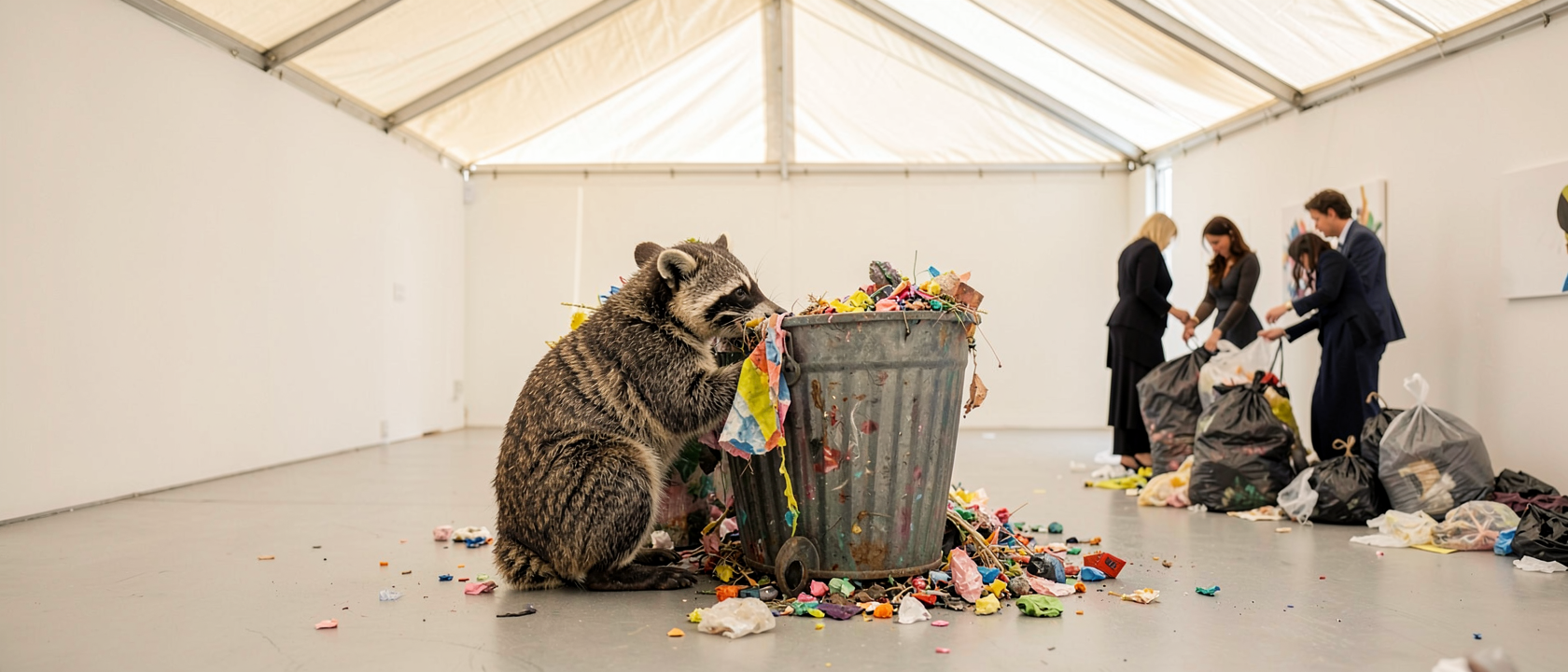
At Art Southampton in July 2016, a sculpture sat waiting for the VIP preview at Nova’s Ark Project in Bridgehampton, New York. It depicted a large, overflowing trash can beside a sculpted raccoon, brightly colored rubbish spilling over the rim, priced at $8,000. Its actual title was “Keep America Great Again.” Before a single collector walked through the door, a member of the janitorial crew found it, assessed it by every available measure, and emptied it.
But the Crew Was Trained for Exactly This
Art Southampton was not a neighborhood flea market. It was a high-end art fair, and its cleanup crew was specifically briefed to identify artworks and leave them alone. Nick Korniloff, the fair’s founder, later described the crew as maintaining a very high standard of cleanliness. That thoroughness, as it turned out, was precisely the problem.
The training that protects a five-figure work assumes some visual cue separates the artwork from everything else: a plinth, a label, a pedestal. Artist Will Kurtz’s sculpture offered none. A trash can overflowing with rubbish, in a venue being readied for an opening, looks in every functional sense like a trash can someone forgot to deal with. The crew’s prior instruction had a blind spot, and the sculpture sat squarely inside it.
Why the Raccoon Survived
One detail clarifies the whole incident: the raccoon figure was left completely untouched. Only the trash-can contents were removed.
That asymmetry explains a great deal. A hyper-realistic raccoon sculpture is visually strange in an exhibition hall because raccoons do not ordinarily perch motionless indoors, it reads as deliberate. The spilling rubbish had no such flag. Brightly colored trash in a space being cleaned before an opening is exactly what cleaning staff exist to remove. The raccoon identified itself as art by being a raccoon in an unusual place. The trash identified itself as trash by being trash in exactly the place trash appears. The error was not inattention. It was the opposite.
Brooke Shields, Elbow-Deep in Real Garbage
Brooke Shields arrived for the VIP preview on July 7, 2016, and caught the problem before it became permanent. She was co-curating the exhibition “Call of the Wild” alongside David Kratz, president of the New York Academy of Art, in her curatorial debut. She and Kurtz went through the real trash, recovering sculptural components piece by piece. The work was reassembled before collectors arrived, and “Keep America Great Again” remained on display through the fair’s close on July 11, 2016. Whether every component was fully recovered is not confirmed in the record.
A Long Tradition of Art That Refuses to Look Like Art
Kurtz’s practice centers on life-sized mixed-media sculptures made from recycled materials, so a work that fools the eye is not accidental to his method. Art Southampton 2016 answered the question of what remains when you strip away gallery context in an unexpectedly literal way. The confusion did not happen in a collector’s mind during a deliberation about value. It happened in the hands of a trained professional doing their job correctly, with real consequences.
This was not even the first time. In 2001, a cleaner discarded a Damien Hirst installation at a London gallery, another case where an artwork was indistinguishable, to a working eye, from material that needed clearing out. The pattern across both incidents is less about carelessness than about what art made from ordinary-looking material demands of the people around it: a sustained, context-dependent suspicion that is hard to maintain when you are trying to get a room ready. Kurtz’s raccoon sat motionless and untouched while the rest of the piece was bagged up and taken away.