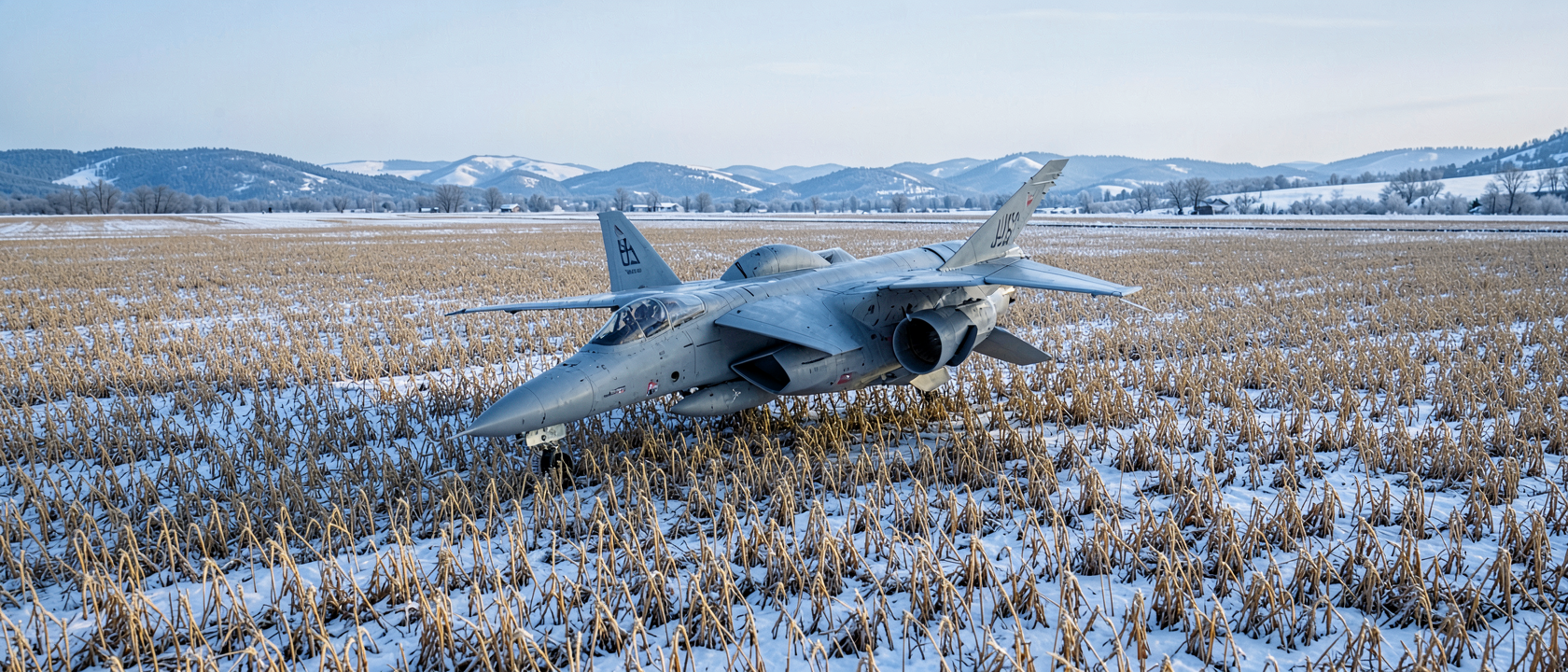
The Plane That Landed Itself
On February 2, 1970, a U.S. Air Force F-106 Delta Dart touched down in a snow-covered wheat field near Big Sandy, Montana. Gear up, engine still running, the airframe largely intact. There was no pilot inside. No autopilot had been engaged. Nobody on the ground had guided it in. A 70-foot (21-meter) supersonic interceptor had flown itself to a landing and stopped.
When local law enforcement arrived, the engine was still turning. It kept running until the fuel ran out, shutting down at around 12:15 p.m.
The Spin That Should Have Killed Everything
Before the landing, the aircraft had entered a flat spin. A flat spin is not the steep nose-down spiral most people picture when they imagine a plane going down. Instead, the aircraft rotates roughly horizontally, like a top spinning on a table, with the nose sitting level with the horizon rather than pointing at the ground. The plane loses altitude the whole time, but the spinning airflow defeats the control surfaces, the very things a pilot uses to recover. Standard recovery inputs stop working. The spin locks itself in.
For a large delta-winged jet like the F-106, a flat spin was considered essentially unrecoverable. The pilot, Gary Foust of the 71st Fighter-Interceptor Squadron out of Malmstrom Air Force Base, had already run through his anti-spin procedures: controls set to take-off trim, throttle pulled to idle. Nothing had broken the rotation. Somewhere below 15,000 feet, he fired his ejection seat and left the aircraft.
The Ejection That Fixed the Plane
Two things happened at the moment Foust ejected, and together they accidentally broke the spin.
First, the explosive charge that launched the seat clear of the cockpit pushed briefly against the aircraft, nudging the nose downward, below the angle at which the wings stall and stop generating lift. Second, Foust himself was gone. His body weight had been sitting forward in the cockpit, ahead of the aircraft’s natural balance point. The moment he left, the center of gravity shifted rearward. The nose dropped further.
A nose-down attitude is recoverable in a way that a flat spin is not. As the nose fell and airspeed built back up, the control surfaces regained authority, the rotation stopped, and the aircraft settled into a descending glide. The take-off trim Foust had pre-set likely helped hold that glide stable. The plane covered roughly 50 miles (about 80 km) before settling, gear-up, into the Montana snow.
No single person designed this sequence. The exact dynamics are complex enough that sources still disagree on whether the ejection blast or the weight shift was the primary driver. Both probably mattered, and the pre-configured controls almost certainly helped.
The Pilot Who Watched His Own Plane Land
Foust descended under his parachute while the aircraft recovered below him. His fellow pilot, Major James Lowe, radioed: “Gary, you’d better get back in it.” The jet landed first. Foust drifted into the Bear Paw Mountains and waited in winter conditions until local residents reached him by snowmobile.
The aircraft had only minor damage. It was repaired and returned to service, flying for roughly another 16 years. About nine years after the incident, while stationed at Tyndall Air Force Base in Florida, Foust flew the same jet again, serial number 58-0787. It was finally retired to the National Museum of the United States Air Force at Wright-Patterson Air Force Base in Dayton, Ohio, in August 1986, where it remains on display in the Cold War gallery.
Why “Cornfield Bomber” Is Wrong Twice
The aircraft is almost universally known as the “Cornfield Bomber.” The field was wheat, not corn. The F-106 was an interceptor designed to destroy incoming enemy aircraft, not to deliver ordnance to the ground, so “bomber” is wrong on both counts. Foust himself preferred the term “Wheatfield Fighter.” The 49th Fighter-Interceptor Squadron, which later operated the aircraft, called it the “Gray Ghost.”
Neither of those names spread the way “Cornfield Bomber” did, because “Cornfield Bomber” has a rhythm and a mental image that accuracy simply cannot compete with. The museum in Dayton displays both the nickname and the real history side by side. The wrong name got there first and made itself comfortable.