A Beach You Almost Cannot See
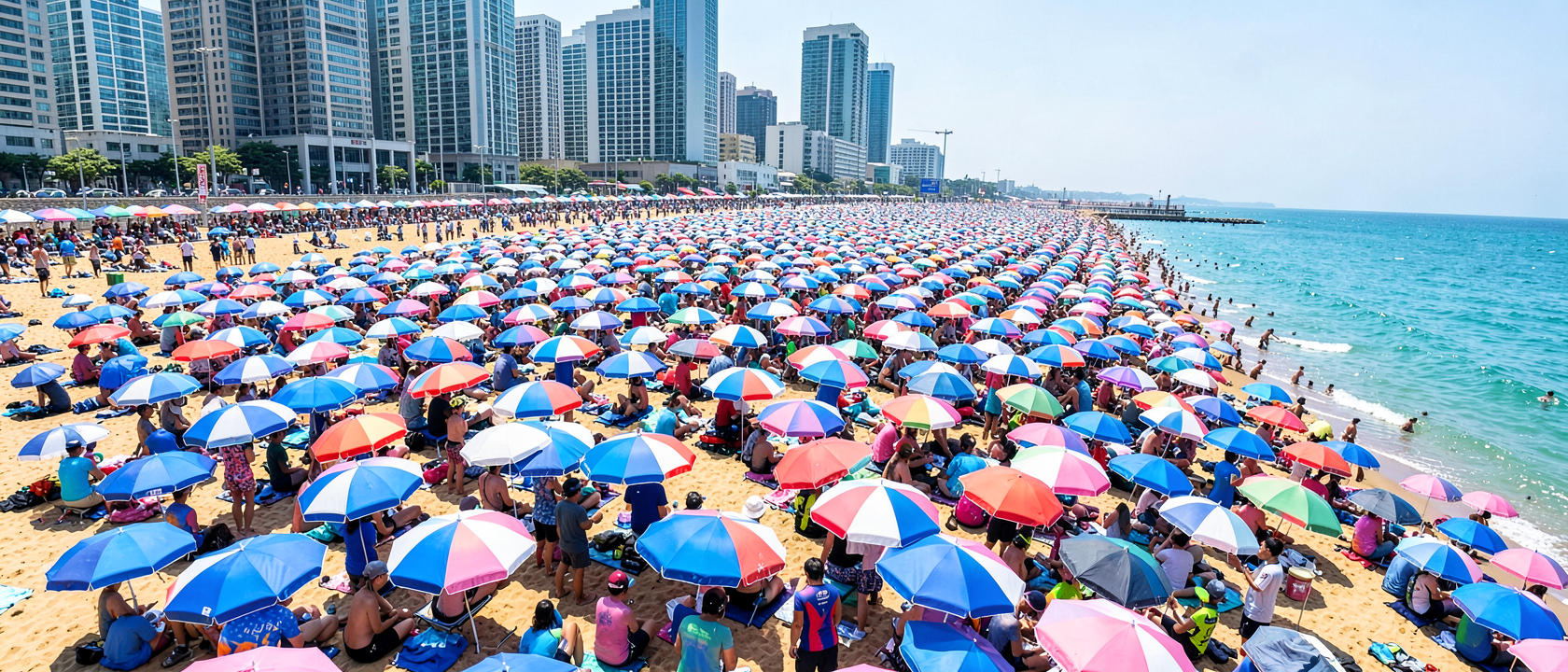
Greg Conklin, an American businessman from Michigan, arrived at Haeundae Beach on the coast of Busan, South Korea, and found something that matched no beach he had ever encountered. The strip of sand, roughly nine-tenths of a mile (1.46 km) long and about 130 feet (40 m) wide, was buried under an unbroken canopy of parasols in blue, red, white, and pink, packed so tightly the ground beneath was barely visible. According to a Neatorama report summarizing a Los Angeles Times piece by journalist John Glionna, published August 14, 2011, his reaction was straightforward bewilderment: the open, sun-warmed sand simply was not there.
Every cultural habit attached to a beach visit, spreading out, soaking up sun, having room to lie flat, was absent. Same ocean, same geography, a completely different human scene.
Nobody Is Sunbathing. So What Are They Doing?
Under and around those parasols, people are socializing, eating, dressed up, and strolling. The atmosphere runs closer to a lively public square than to any leisure ground you would find on an Australian or Californian coast.
The 2011 report noted a walkway reportedly designed to be high-heel friendly, laid directly on the sand. This detail has not been confirmed beyond that original article, so treat it as reported but unverified. Even so, if accurate, what it implies is telling: a beach where someone wears heels is a beach where people have arrived to be seen, not to get sandy. Open-water swimming, Frisbee, sunbathing are largely absent from the scene described.
Haeundae’s scale makes this striking. The beach draws over 10 million visitors per season and on its busiest days can see close to a million people at once. On August 2, 2008, it set a Guinness World Record for the largest number of beach umbrellas open simultaneously on a single beach: 7,937. Busan city estimates suggest the peak can reach around 12,000 at absolute capacity.
The Reason Hiding in Plain Sight
One piece of cultural context resolves the picture. In South Korea, pale and blemish-free skin has been the central beauty ideal for centuries, with roots in the Joseon Dynasty (1392–1897). During that period, sun-darkened skin signaled outdoor labor; fair skin signaled refinement. That association did not dissolve with industrialization, Confucian values reinforced it, and Korean television dramas and pop music continue to present luminous, unfreckled skin as a norm. Scholars note this preference developed independently in Korean, Chinese, and Japanese history, long before significant contact with European beauty standards.
The commercial weight behind this preference shows in the numbers: sun protection products account for roughly 78% of South Korea’s sun care market revenue. Between 70 and 80% of urban South Korean women aged 20 to 50 are estimated to use sunscreen daily, not just in summer, and per capita spending exceeds $25 to $30 per year, more than double the Asian average. Korean women routinely carry UV-blocking parasols on ordinary city streets. Against all of that, going to the beach specifically to stay out of the sun is no contradiction at all.
What This Story Can and Cannot Tell Us
The original portrait of Haeundae’s parasol culture comes from a Neatorama report summarizing a Los Angeles Times piece by John Glionna, published August 14, 2011. That report names no Korean beachgoers explaining their own choices. The link between the parasol canopy and a preference for pale skin is a culturally well-grounded inference drawn by outside observers, reasonable, but still an inference. The Guinness World Record and visitor figures come from verifiable sources including Busan’s city government; the high-heel walkway rests on the 2011 article alone.
Whether beach culture at Haeundae looks the same now as it did in 2011 is unknown from available sources. Full-coverage rash guards dominated Korean beach fashion for roughly a decade, though more recent reporting suggests swimwear habits have been shifting. What has not shifted is the commercial and cultural weight of sun protection in South Korea: the sunscreen market has only grown.