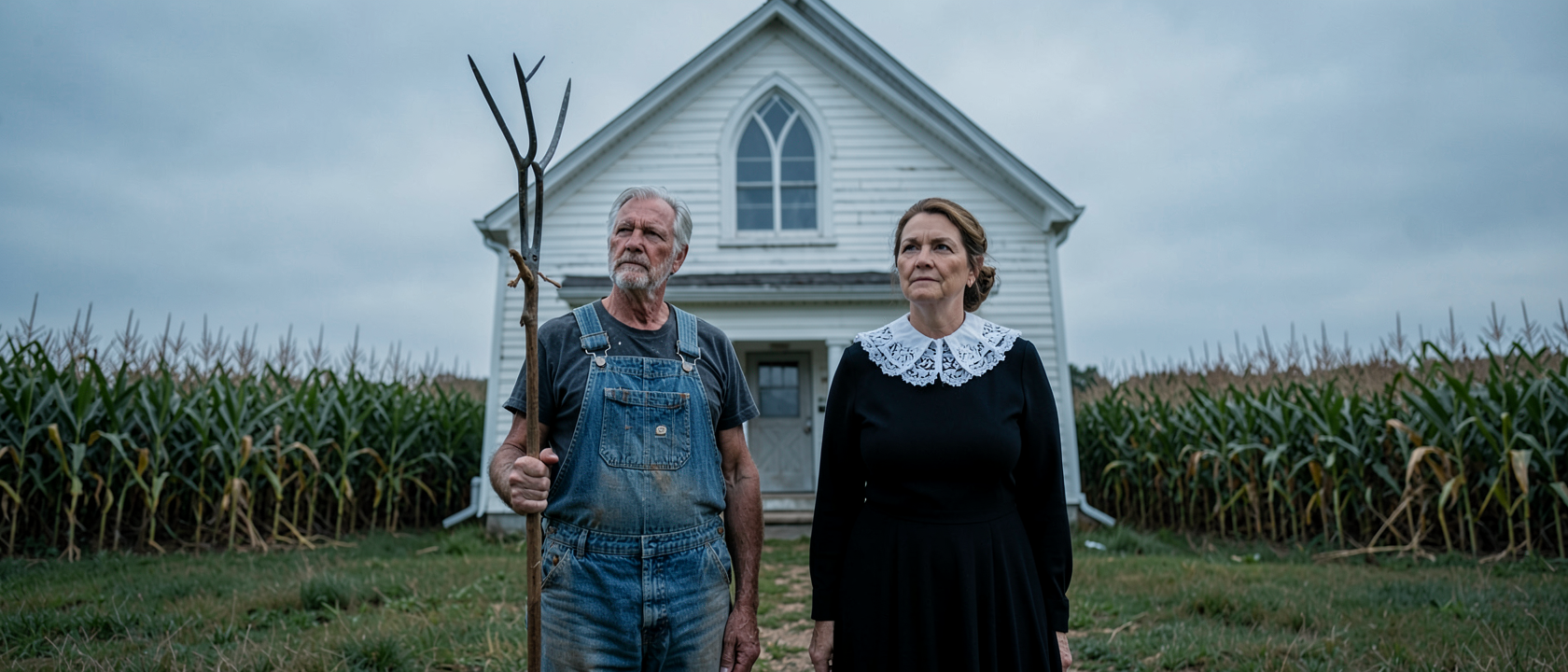
Meet the Couple That Never Was
Stare at American Gothic long enough and your mind fills in a backstory. Most people assume it’s a married couple: a stern farmer and his wife, standing in front of a quiet rural home. That’s not what Grant Wood painted, and it’s not who’s actually in the frame. The man was modeled by Dr. Byron McKeeby, Wood’s own dentist, 62 at the time. The woman beside him was Wood’s sister, Nan, then 32, standing in as his daughter, not his wife. Neither posed as themselves, and neither owned the house behind them. Decades of pop culture read them as spouses anyway, which is exactly why the painting has been reprinted, remixed, and parodied in film, television, and advertising for generations. So why does almost nobody know who’s actually standing in it?
An Unknown Man in Cedar Rapids
In 1930, Grant Wood was nobody in particular. He was in his late thirties, living with his mother in the loft of a converted carriage house in Cedar Rapids, Iowa, that doubled as his studio. He had no gallery reputation, not much money, and years spent trying styles that never quite fit. How does an artist working out of a garage loft in the Midwest end up producing an image people reference as often as the Mona Lisa? It starts with him abandoning the idea of being a different kind of painter altogether.
A House, a Style, and a Decision Made on the Spot
Between 1922 and 1928, Wood spent several stretches in Europe trying on the loose, painterly styles fashionable there. None of it felt like his voice. Back in Iowa for good, he shifted toward something sharper: crisp outlines, careful detail, portraits that look almost carved rather than painted. Then, driving through Eldon, Iowa, in 1930, he spotted a small wood-frame farmhouse with an odd feature, a narrow, pointed window straight out of Gothic church architecture, and decided on the spot to paint it. Rather than ask the family who actually lived there to pose, he recruited his dentist and his sister instead, casting them as a farmer and his grown daughter.
Mockery or Love Letter?
The painting went on public display at the Art Institute of Chicago on October 30, 1930. One judge reportedly dismissed it as a “comic valentine,” but a museum patron pushed for it anyway, and the jury awarded it the bronze medal and $300 in prize money, worth roughly $5,700 in 2025 dollars. Some accounts say the museum then paid another $300 to acquire it outright, putting the total closer to $600, or about $8,000 in 2025 dollars, though sources disagree on the exact figure. What’s certain is that it became famous fast, and nobody agreed on what it meant. Critics like Gertrude Stein and Christopher Morley read it as satire of small-town narrow-mindedness. Plenty of Iowans took it as an insult, while others were proud to see their state on the map. Wood himself always described the two figures as father and daughter, but that didn’t stop much of the public from reading them as husband and wife, a misreading that only deepened the sense that the painting was mocking a marriage that was never depicted in the first place. He never fully settled the argument over what he meant by it, either.
The Performance Behind the Overalls
Wood built a specific public image: plainspoken, unpretentious, more at home in a barn than a gallery. People close to him saw through it. Critic Janet Maslin later said friends knew Wood was gay and saw his overall-clad farm-boy act as something close to a costume. Being openly gay in that era could end a career, so the persona doubled as cover, and fame made the cover harder to hold. Strangers showed up at his home uninvited, curious about his bachelor life, and by some accounts someone tried to blackmail him over details from his past. In 1937 he painted a nude man bathing outdoors; a national exhibition pulled the work, and the Post Office banned it from the mail as obscene, a ruling that said as much about the era’s anxieties as about the picture itself.
What Fame Actually Took
The costs kept adding up. Wood married an older, previously divorced woman in 1935 in what looks like a match made for appearances, and it left him financially strained. Time magazine is said to have looked into his sexuality around this period, and by 1941 he had left his teaching post at the University of Iowa. He was diagnosed with pancreatic cancer and died in Iowa City on February 12, 1942, at age 50, one day before what would have been his 51st birthday, not quite twelve years after finishing the painting that made him famous. Being one of the most recognized names in American art hadn’t made his life easier. In several ways, it had made it harder.
Why It Still Won’t Sit Still
After Wood’s death, the painting’s fame only grew. It’s been reworked with zombies and Muppets, dropped into political cartoons, printed on magazine covers, and remixed endlessly online. Part of why it survives so many makeovers is the same thing that tortured Wood while he was alive: the gap between what he intended and what people saw. Mockery or tribute, homage or joke, he gave different answers depending on who was asking and how upset they were. That unresolved quality is exactly what makes the image so easy to project onto. And now that you know who’s actually in the frame, a dentist standing in for a farmer, a sister standing in for a daughter, a house that belonged to strangers, the next parody you scroll past probably won’t look quite the same.