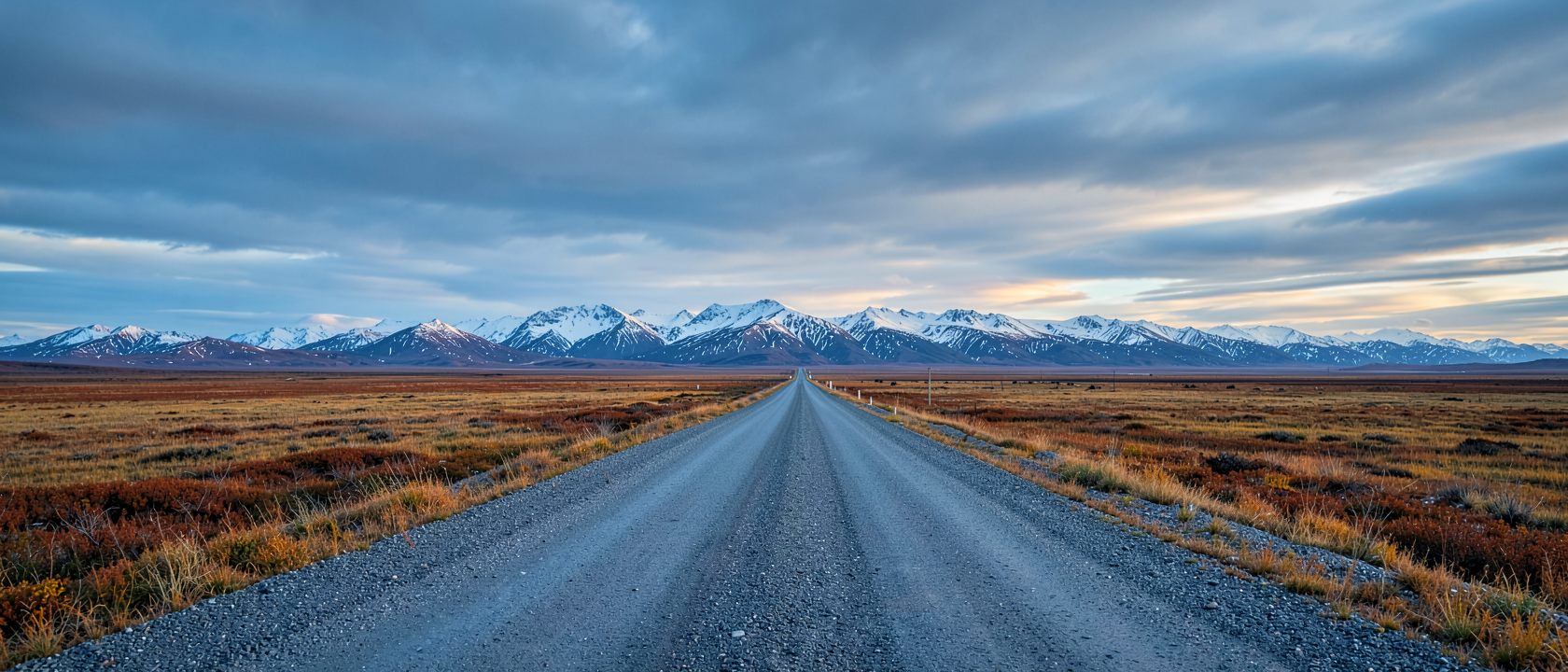
196 Cars a Day
Picture a small-town grocery store parking lot on a busy Saturday afternoon. There’s a good chance it sees more cars than pass down a certain highway in Alaska over an entire day.
That highway is the Dalton Highway, officially Alaska Route 11, a 414-mile (666 km) stretch running north from Livengood, a small community about 84 miles (135 km) north of Fairbanks, up to Deadhorse on the edge of the Arctic Ocean’s oilfields. Traffic data company Geotab puts its average daily traffic at just 196 vehicles, the lowest of any road tracked in the country.
Why Build a Highway No One Drives?
Roads this long usually connect strings of cities or towns. The Dalton Highway doesn’t fit that pattern; long stretches pass without a single gas station or diner in sight. So why keep a 414-mile highway open for so little traffic? It’s tempting to assume it’s a half-forgotten relic, kept running out of habit. That’s wrong, and the reason says something about what a traffic count actually measures.
The Number That Doesn’t Tell the Whole Story
The 196 figure comes from AADT, annual average daily traffic, the standard measure transportation departments use to decide which roads need repaving. For most roads, AADT is a reasonable stand-in for importance: busy roads matter, quiet ones don’t.
The Dalton Highway breaks that rule. Built in 1974 as a supply route for the Trans-Alaska Pipeline, which it still runs alongside for most of its length, it remains the only land route to the oil operations around Prudhoe Bay, along with scattered mines and a handful of settlements between Livengood and Deadhorse. Deadhorse itself has about 25 year-round residents, a number that can swell into the thousands when oil crews rotate through, most arriving by plane rather than by road.
That’s what the traffic count misses. Few people need this highway for everyday travel, so the number stays low. But the trucks that do use it carry fuel, equipment, and food these places have no other way to get. For scale, the busiest road in the country, I-5 through the Los Angeles–Long Beach–Santa Ana area, carried an average of 504,000 vehicles a day in 2019. The Dalton Highway was never built to compete with that kind of volume. It measures something else: how much a place depends on the traffic it does have.
Every State Has Its Quiet Road
Alaska is the extreme case, but Geotab’s research covers the least-traveled road of at least 10 miles in every state, and a pattern appears once you look past it.
In the West, the quietest roads tend to run long distances through open, dry country. North Dakota’s State Route 24 covers 211 miles (340 km) with an AADT of 242. Montana’s State Route 19, only 21 miles (34 km) long, carries 489 vehicles a day. Nevada’s State Route 360 stretches 23 miles (37 km) at an AADT of 517, and South Dakota’s State Route 73 runs 255 miles (410 km) with an AADT of 556.
Head east and the picture changes. Vermont’s quietest road, State Route 103, sits in a state where almost every road carries light traffic, but even the emptiest one there stays shorter and closer to towns than its western counterparts. The difference comes down to geography: the West has room for long roads through wide-open land, while the East’s infrastructure stays denser no matter how quiet a road becomes.
Before You Chase the Quiet Road
Curious enough to look up your own state’s emptiest road? Pack a full tank of gas, extra drinking water, and a fully charged phone, since cell coverage can vanish for long stretches out there. On a road like the Dalton Highway, where some sections run roughly 240 miles (386 km) without a gas station, a flat tire or empty tank stops being a minor inconvenience, help, if it comes, could be hours away rather than minutes.
Find Your State’s Quietest Road
Geotab’s research, gathered and reported through Atlas Obscura and Big Think, maps out the quietest road in every state, not just Alaska. Somewhere near you, there’s a road that barely shows up on a traffic report and might be doing more work than its number suggests. It’s worth checking before assuming the busiest highway nearby is the one that matters most.