The Object That Broke the Pattern
On October 19, 2017, astronomer Robert Weryk was reviewing images from the Pan-STARRS1 telescope at Haleakalā Observatory in Hawaii when he spotted something unusual: an object about 21 million miles (33 million km) from Earth, on a path matching nothing born in our solar system.
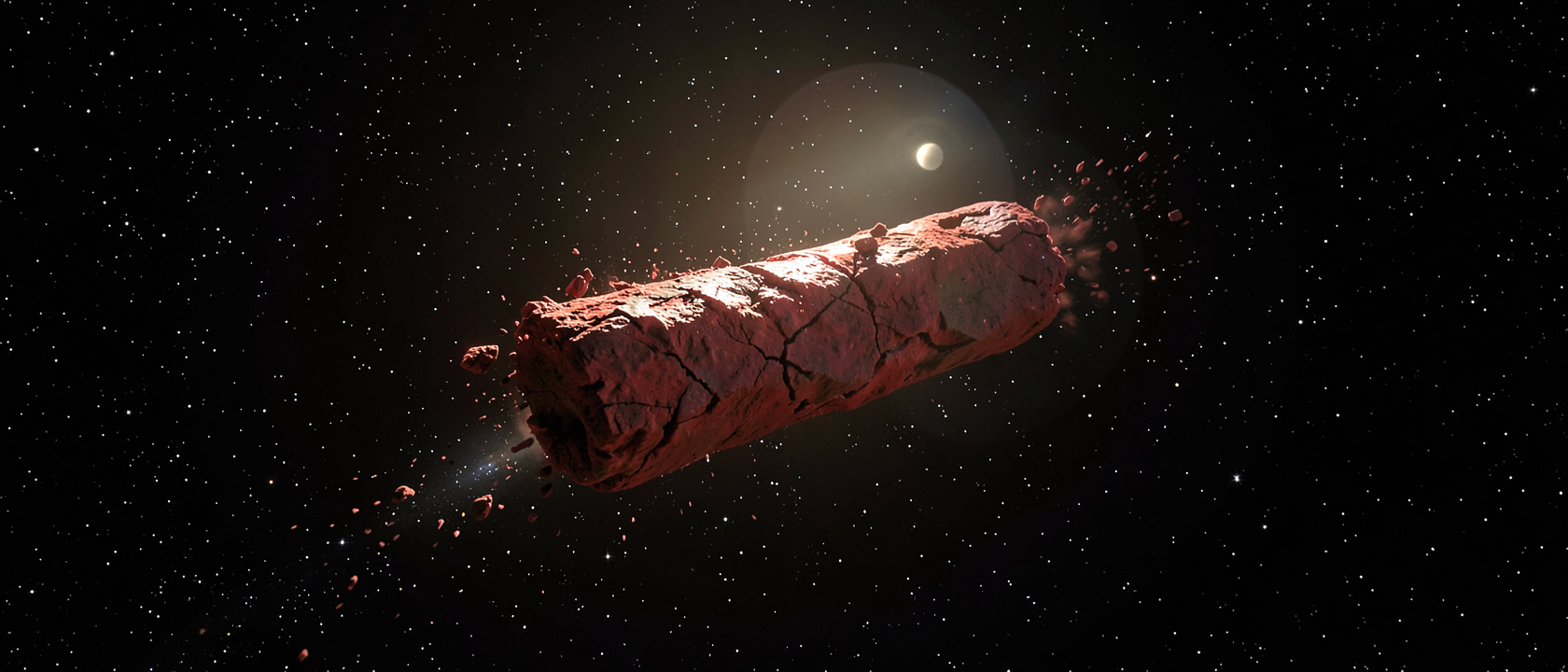
Researchers named it ‘Oumuamua, Hawaiian for “a messenger from afar arriving first.” Its brightness rose and fell by a factor of about 10 every seven hours, pointing to a body that was long, narrow, and tumbling rather than spinning cleanly, up to a quarter mile (400 m) long but only a tenth as wide, cigar-shaped and reddish. The pattern never repeated, unlike every other planet, moon, and asteroid ever tracked. It was first filed as a comet, C/2017 U1, then reclassified as an asteroid a week later, before landing on November 6, 2017, in a brand-new category: 1I/2017 U1, the solar system’s first confirmed interstellar object.
A Comet That Refuses to Act Like One
Color measurements showed ‘Oumuamua reflected light the way icy, volatile-rich comets do. At closest approach to the sun on September 9, 2017, it swept in well inside Mercury’s orbit, close enough to start boiling.
Nothing happened. No coma, no jets, no tail. Deep images found less than 2.2 pounds (1 kg) of dust within about 466 miles (750 km) of it. Chemically, this looked like a comet; behaviorally, it acted like a dead rock.
Its speed, roughly 16 miles per second (26 km/s) faster than the sun’s gravity alone could explain, ruled out anything hiding in our own solar system. This was a visitor from elsewhere, icy on paper but inert in practice.
The Jupiter Rehearsal: Shoemaker-Levy 9
In 1992, comet Shoemaker-Levy 9 passed too close to Jupiter. Gravity pulled harder on the comet’s near side than its far side, a tidal force strong enough to rip it into fragments, which slammed into Jupiter in 1994 as astronomers worldwide watched.
Astrophysicist Sean Raymond, of the Laboratoire d’astrophysique de Bordeaux, was running simulations of forming star systems to study how giant planets interact with debris disks. The same kind of shredding kept turning up on its own, quietly, as an ordinary side effect of building a solar system.
Torn Apart, Then Slowly Killed
Raymond’s simulations suggest 0.1% to 1% of planetesimals near a giant planet get torn apart this way, a small share, but disks hold enormous numbers of fragments, making the shredding routine if usually invisible.
Most torn fragments don’t get flung into interstellar space right away. Instead, they swing past their home star several more times before finally being ejected, with each pass boiling away more surface ice, the same process thought to produce “Damocloids,” known solar system objects with comet-like surfaces that no longer release gas.
Put together: a planetesimal is born icy, a giant planet shreds it, repeated close brushes with its star cook the surface dead, and what leaves the system is a fragment with icy chemistry underneath but a burnt-out, inactive crust, precisely the mismatch ‘Oumuamua showed.
Why This Story Isn’t Proven Yet
Raymond’s hypothesis explains the icy chemistry, the dead surface, and a plausible route to a chaotically tumbling fragment, but the exact mechanics linking a tidal disruption to ‘Oumuamua’s specific shape and spin haven’t been rigorously modeled. It’s a strong hypothesis, not a settled answer. Karen Meech, who helped lead the original research team, has said she still believes it’s simply a comet.
Testing this means catching another interstellar visitor or catching up to this one. Project Lyra is a proposed mission concept to chase ‘Oumuamua down, though its speed makes that a serious engineering problem. More realistically, the Vera C. Rubin Observatory (formerly the Large Synoptic Survey Telescope) is expected to find many more interstellar objects. Raymond’s model predicts dead, extinct-looking visitors should be more common than active, tailed ones, a detail that would reveal how solar systems, including our own, come apart at the seams.