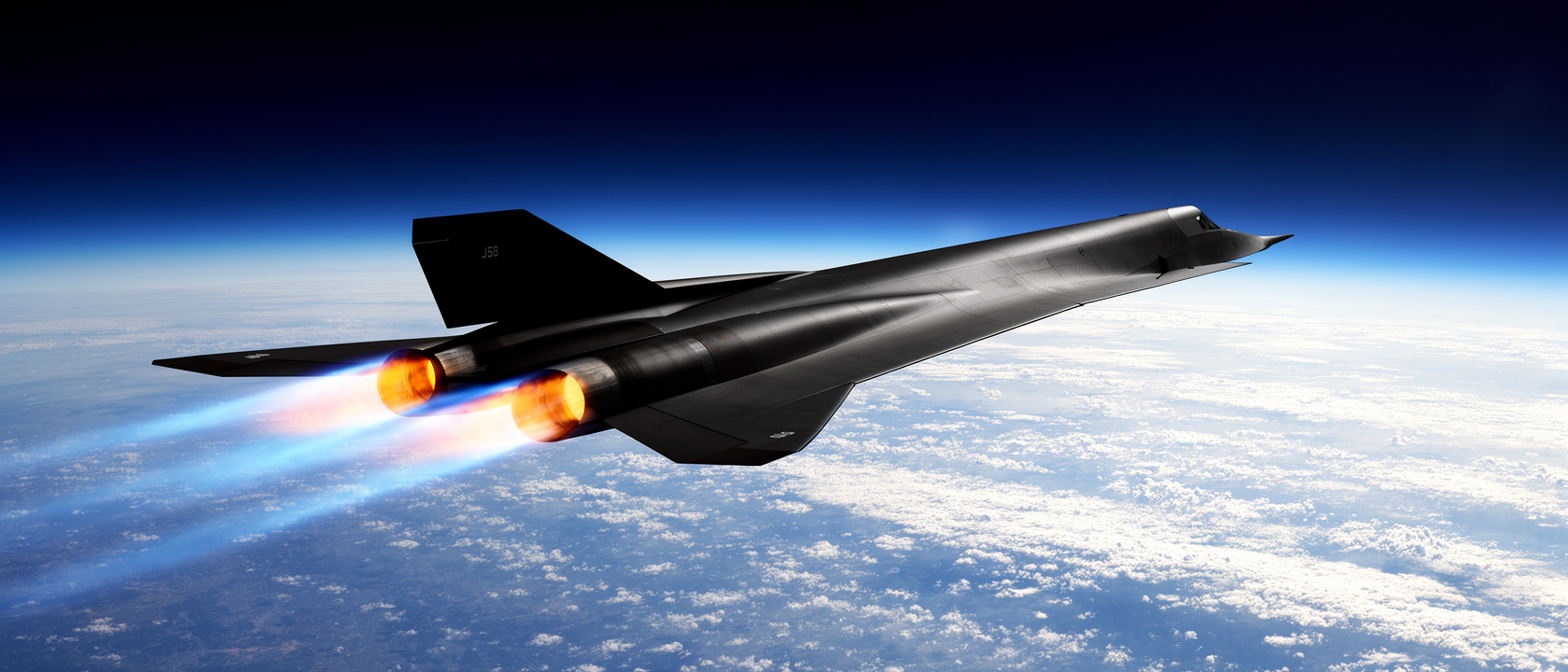
The Plane That Leaked Fuel and Still Outran Missiles
The Million-Dollar Sieve
When ground crews approached a Lockheed SR-71 Blackbird before a mission, fuel dripped from the fuselage onto the tarmac, not from a faulty seal, but seeping from the airframe itself. It looked like a defect. It was not. It was deliberate, and understanding why tells you something surprising about what happens to metal at three times the speed of sound.
Why the U-2 Was Not Enough
The SR-71’s origins trace back to the limits of its predecessor, the U-2 spy plane, designed to photograph Soviet territory from above 70,000 feet. The problem was the “coffin corner”: at extreme altitude, stall speed and structural-failure speed converge so tightly that the margin for error nearly vanishes. On May 1, 1960, CIA pilot Francis Gary Powers was shot down near Sverdlovsk by a Soviet surface-to-air missile, making the situation politically explosive. The CIA’s answer was not to fly higher but far faster. A 1958 initiative called Project GUSTO, run by CIA officer Richard Bissell, sought a successor capable of cruising at Mach 3 or beyond. Lockheed’s Skunk Works division, led by engineer Clarence “Kelly” Johnson, won the contract in late August 1959, and the aircraft they built would be constructed from an unusual material, for a reason that loops back to the fuel on the runway.
A Metal That Needs to Shrink First
Flying at Mach 3.2 above 85,000 feet generates intense frictional heat: skin temperatures at the nose reach around 800 degrees Fahrenheit, with engine cowlings running hotter still. Aluminum softens long before those temperatures, so over 90 percent of the SR-71’s airframe is titanium. The outer titanium skin panels also serve as the walls of the fuel tanks. At room temperature they were intentionally made slightly undersized and corrugated, with gaps between them, fuel seeped out on the ground because it had nowhere else to go. Once the aircraft reached operational speed, friction heated the metal, the panels expanded and flattened, pressing snugly together. The faster the plane flew, the more watertight it became.
The Titanium Irony
The United States lacked sufficient domestic titanium reserves, and the world’s largest supplier was the Soviet Union, the very country the aircraft was designed to spy on. The CIA created a network of shell companies to buy the metal from Soviet suppliers. The adversary unknowingly helped build the machine. Manufacturing produced further surprises: cadmium tools made the metal brittle and shatter, and summer welds cracked because Burbank, California’s chlorinated water supply attacked the joints. Engineers switched to titanium tools and distilled water.
Fuel That Would Not Light
Standard aviation fuel would ignite spontaneously given the heat from the aircraft’s own skin, so engineers developed JP-7, with a flash point so high that an open flame will not reliably set it alight at ground conditions. To start the engines the aircraft used triethylborane (TEB), which ignites spontaneously on contact with air. Each engine carried about 600 cubic centimeters, enough for at least 16 starts, producing a distinctive green flash, the visual signature of the Blackbird coming to life.
Not Stealth, Just Gone
Speed, not radar-absorbent coating, was the SR-71’s primary evasion mechanism. Radar systems refresh in cycles; at Mach 3.2 the aircraft moved so far between sweeps that its return registered as background noise. By the time a missile system attempted a lock, the SR-71 had already moved out of range. In its entire operational life, no SR-71 was ever shot down.
New York to London in Under Two Hours
On September 1, 1974, Major James V. Sullivan and Major Noel F. Widdifield flew an SR-71A from New York City to London in 1 hour, 54 minutes, and 56 seconds, an average of 1,806.964 miles per hour across 3,461 miles. Operating at roughly 85,000 feet, the aircraft could survey more than 100,000 square miles of Earth’s surface in a single hour. That transatlantic record has never been broken.