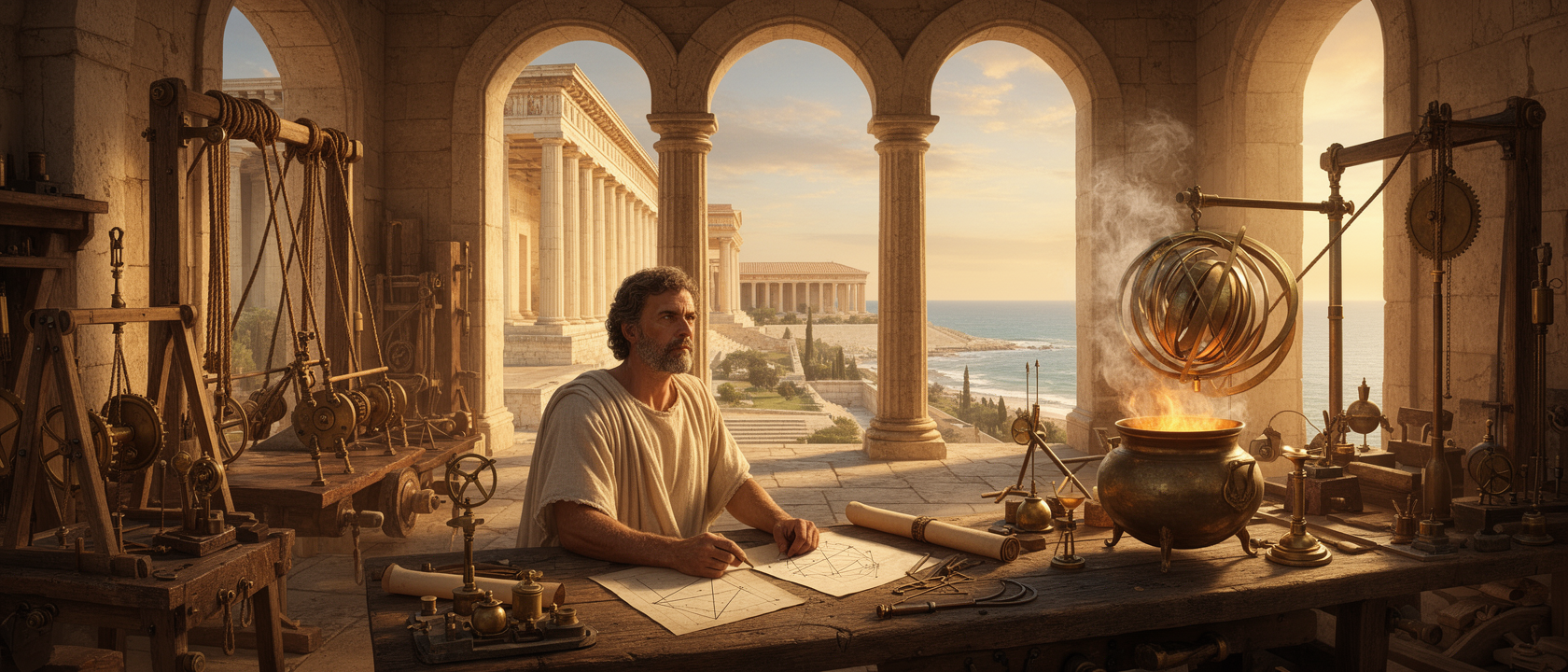
The Coin-Operated Machine in the Temple
Vending machines feel like a product of the twentieth century. Drop in a coin, a mechanism trips, and you get what you paid for. It turns out the same transaction was already happening in first-century Alexandria. Heron designed a device that accepted a 5-drachma coin, used its weight to tip a lever, opened a valve, and released a measured amount of holy water. When the coin slid off the pan, the lever reset and the flow stopped. The mechanical logic is identical to a modern machine, built from bronze roughly 2,000 years earlier.
Doors That Opened Themselves
Heron’s automatic temple doors were more dramatic. A priest lit a fire on an altar and, without anyone visibly touching anything, heavy wooden doors swung open. The mechanism was buried under the floor, entirely out of view.
The altar stood above a sealed metal vessel filled with liquid. Fire heated the vessel; expanding air pressure pushed the liquid through a pipe into a hanging bucket. As the bucket grew heavier, its weight pulled a rope-and-pulley system connected to the door pivots. When the fire died, pressure dropped, liquid drained back, the bucket lightened, and the doors shut. Heron noted that mercury could replace water, being denser. No physical remains have ever been excavated, and at least one scholarly source suggests the device may have existed as a design rather than an installed mechanism.
Programmable Theater and a Spinning Ball
Heron’s mechanical puppet theater, described in his Automata, performed the myth of King Nauplius in approximately 10 minutes. A falling weight powered it, its descent regulated by sand flowing through a reservoir. Sequences of knotted ropes triggered movements in a fixed order, historians draw a direct conceptual line from this to early programming logic, since the sequence was determined in advance by the physical arrangement, not by a human operator during the performance.
His Aeolipile was a hollow metal sphere mounted above a heated water vessel. Steam escaped through two L-shaped nozzles, spinning the ball; modern replicas reach around 1,500 RPM. As a working engine it was useless, the rotating joint leaked or created too much friction, and there was no practical way to transmit the spinning motion into useful work. The first known practical application of the same principle came roughly fifteen centuries later, when Ottoman scientist Taqi al-Din described a steam-driven roasting spit in a treatise completed in 1551.
Heron was also a working mathematician, documenting a formula for calculating a triangle’s area from its three side lengths alone. His surveying treatise, the Dioptra, describes an instrument historians compare in sophistication to a modern theodolite.
Why This Never Became an Industrial Revolution
Alexandria in the first century operated substantially on slave labor. A machine that saved effort carried no obvious commercial value where human labor was cheap and abundant. Heron’s devices were called thaumata, marvels, a category closer to theatrical curiosity than production tool. The technical knowledge existed; the economic pressure to scale it did not.
What the Centuries Left Behind
Heron’s dates are anchored to a single astronomical reference: in his Dioptra he described an eclipse scholars have identified with one occurring around March 13, 62 CE. His ethnic background remains uncertain, described variously as Greek, Hellenized Egyptian, or ambiguous. No temple door mechanism has been excavated. A fragmentary hydraulis was recovered at the ancient city of Dion in 1992 and later reconstructed. The hardware mostly vanished; the texts did not. Heron’s Pneumatica survives in over 100 manuscripts, and his Mechanica reached the modern era through an Arabic translation completed between 862 and 866 CE, still held at Leiden University Library.