The Pickiest Eaters at the Sanctuary
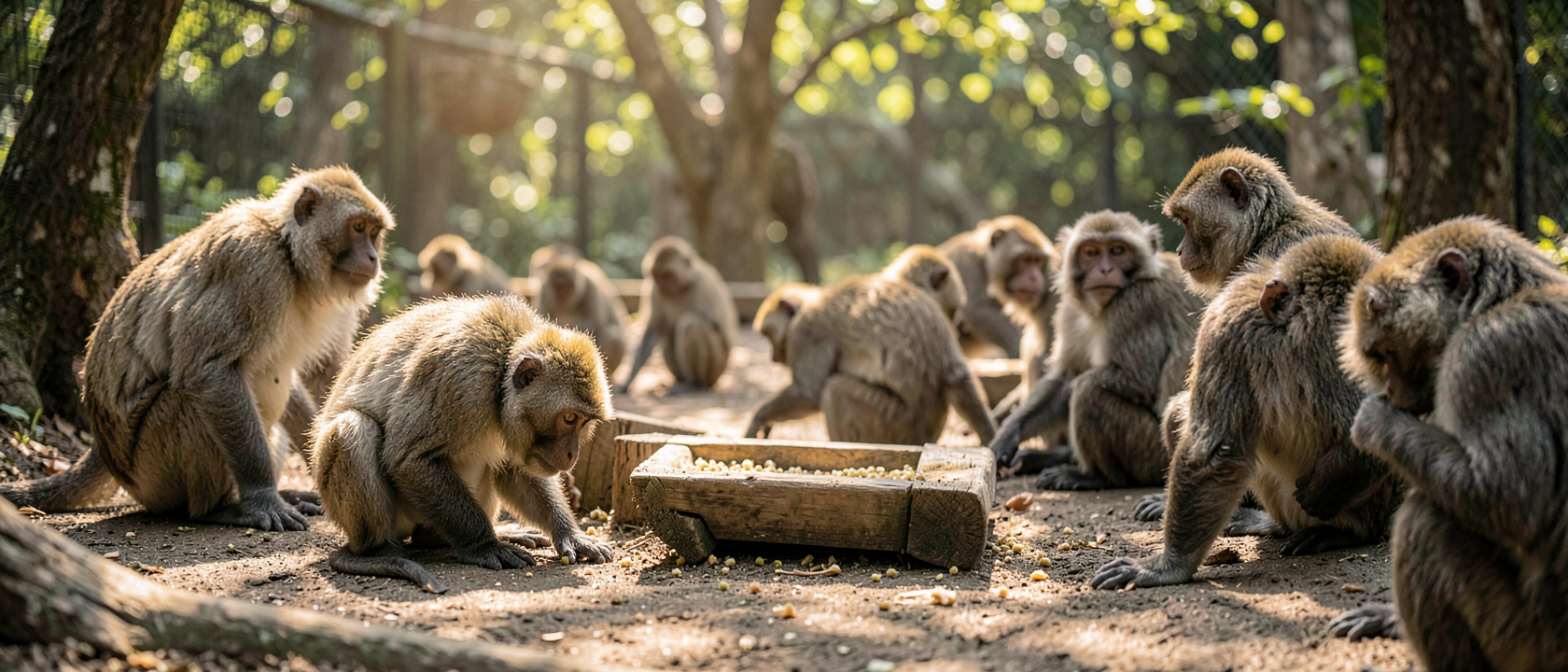
At the Born Free USA Primate Sanctuary in southern Texas, a troop of Japanese macaques traces its lineage back to 1972, when the group was relocated from Japan. Staff and researchers noticed something odd: fruit that looked smeared with feces got rejected again and again by certain macaques, while others reached for it without hesitation, an instant, visual reaction closer to reflex than choice. The wariest monkeys had all lived through a viral outbreak confirmed at the sanctuary in January 2020, caused by simian retrovirus Type II, a disease that can trigger an AIDS-like collapse of the immune system. The virus had been carried in quietly by a retired research-lab macaque that never showed a symptom.
A Virus That Doesn’t Spread That Way
Simian retrovirus Type II doesn’t travel through feces or spoiled food. It spreads through blood and saliva, mostly via bites and scratches during fights, and moves fast: an infected animal can die within three to four weeks, according to lead researcher Stephan Kaufhold. Once confirmed, staff separated the groups and brought in strict testing and quarantine, but three of the sanctuary’s four macaque groups had already been exposed; only one escaped untouched. Yet the virus’s actual transmission route offers no explanation for the fruit-rejecting behavior, since nothing about bites and scratches should make a monkey flinch at something that merely looks like droppings.
Living Through It Mattered More Than Catching It
Cognitive scientists Stephan Kaufhold and Federico Rossano, of UC San Diego, realized the outbreak had built a natural experiment: three groups had lived through the disease, one never saw a case. Their study, published in Royal Society Open Science on October 21, tested 55 sanctuary-born macaques across nearly 200 trials, each choosing between fruit on a plain wooden surface and fruit on a surface coated in real macaque feces, sealed under clear epoxy so the visual cue stayed while the smell, and any actual infection risk, disappeared.
Macaques from the untouched group ate the contaminated-looking fruit in 79% of trials, versus 47% among macaques from groups that had lived through the outbreak, regardless of whether an individual had actually caught the virus. Monkeys who had been sick and those who had simply watched groupmates sicken and die behaved the same way. “Groups have histories, and those histories show up in behavior,” Kaufhold said. “Living through the disease outbreak appears to have made those monkey groups more cautious around food that looks contaminated.” The caution tracked shared memory of loss more than actual risk. The team calls this a link rather than proof, since no one recorded how these monkeys behaved before the outbreak.
A Familiar Human Habit
Humans ran a version of the same experiment during COVID-19, minus the epoxy. People wiped down grocery bags, let mail sit untouched, and scrubbed canned goods, long after health agencies confirmed the virus spread mainly through the air. The real danger was breath and proximity; the behavior that stuck was scrubbing, because the group had just lived through months of sickness and death, and a visible, repeatable ritual felt like doing something about it. Rossano makes nearly the same point about the macaques: “Even with no knowledge of how disease is transmitted, being exposed to others getting sick and dying changes the likelihood of engaging in behaviors that potentially could lead to some form of sickness.” That pattern looks less like faulty logic than an old, shared instinct for handling a threat the body can’t fully explain.
A Clue From How the Monkeys Were Raised
A second part of the study asked where that instinct comes from. Researchers tested 54 macaques from seven species, grouped by rearing: 14 born at the sanctuary and raised by macaque mothers, 15 kept as pets and raised by humans, 19 former laboratory animals, and 6 born in zoos. The former pets ate the contaminated-looking fruit far more readily than mother-raised sanctuary monkeys, roughly twice as often by the odds calculated, even after years in macaque social groups. Kaufhold offers one possible reason: “One possibility is that these monkeys didn’t have the opportunity to learn typical avoidance behaviors from their mothers and other macaques early in life.” If that holds up, the caution looks less innate than absorbed early, by watching a mother flinch at the right moment.
Disgust Was Never Meant to Be Precise
Macaques and humans share a common ancestor from roughly 25 million years ago, and across that stretch, pathogen avoidance seems to have kept the same basic design: fast and blunt, quick to react, slow to double-check. A system built to avoid only confirmed dangers would be too slow and too easy to fool; one built to avoid anything that looks, smells, or resembles what made the group sick costs almost nothing and misses less. It’s the same reason one bad bout of food poisoning can put a person off a dish for years, long after the actual culprit was probably just one undercooked piece of chicken. Kaufhold and Rossano want to check whether a macaque introduced into a group that lived through an outbreak would pick up that same wariness just by watching the others. “Future studies could determine whether newly introduced animals adopt the behavior of a group that has experienced an outbreak,” Kaufhold said.