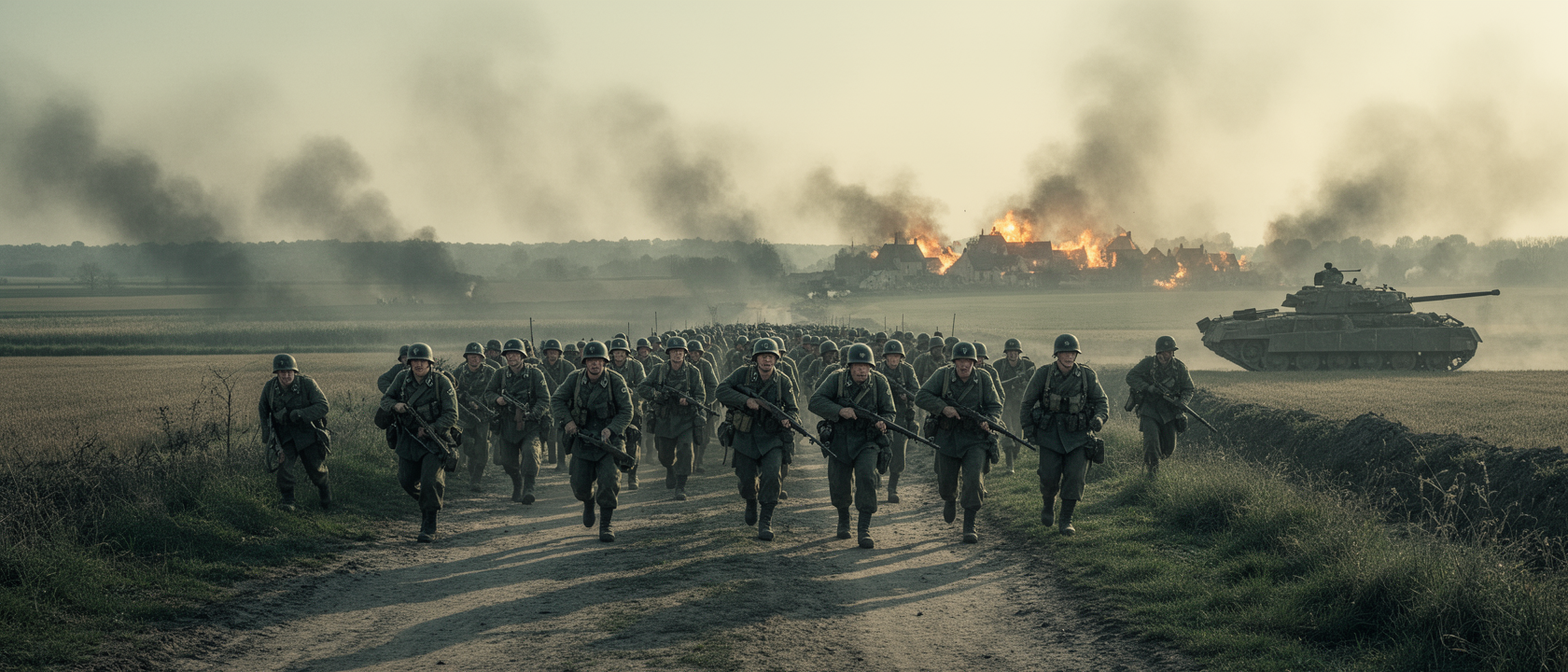
The Army That Wasn’t There
Picture the German advance through France in 1940: columns of tanks, armored half-tracks, mechanized infantry rolling across the countryside. There’s one problem with that image: most of the German army was walking. Only about one in five soldiers belonged to a motorized or mechanized division. The rest moved on foot, and the artillery was pulled by horses.
So how did that army consistently inflict roughly 50% more casualties than it suffered, regardless of whether it was attacking or defending, outnumbered or not? That’s the question military analyst Colonel Trevor Dupuy spent years trying to answer, and the answer has very little to do with trucks or tanks.
The Legal Straitjacket
Under the Treaty of Versailles, which took effect in 1920, Germany’s army was capped at 100,000 men and 4,000 officers. The Great German General Staff was ordered dissolved. Tanks, an air force, heavy artillery, submarines, all prohibited. The Inter-Allied Military Control Commission monitored compliance until 1927. From the outside, Germany looked disarmed. From the inside, it was already building workarounds.
The General Staff That Didn’t Exist
The General Staff simply changed its name, becoming the “Truppenamt”, the Troop Office. By May 1923, it had already drafted secret mobilization plans for either 18 or 35 infantry divisions. Weapons caches from World War I were hidden, and paramilitary groups provided unauthorized military training to thousands of men under the cover of political organizing.
A Training Camp in the Soviet Union
The most consequential workaround came through diplomacy. On April 16, 1922, Germany and the Soviet Union signed the Treaty of Rapallo, restoring normal relations. What the public text didn’t contain, but was arranged through secret agreement, was military cooperation. Germany needed training facilities beyond Western inspectors’ reach; the Soviet Union wanted German expertise. The arrangement produced three secret schools on Soviet soil: an aviation school at Lipetsk (spring 1926 to September 1933) that trained 120 fighter pilots, 100 observers, and 220 ground crew members; a tank school near Kazan (1929 to 1933) where future Wehrmacht commanders trained alongside Soviet officers; and a gas warfare facility in Saratov Oblast (1928 to 1931). All three closed in September 1933 as the ideological gap became too wide.
Front Companies and Phantom Submarines
The navy ran its own shadow operation. In 1922, three German shipyards founded a company in The Hague called the “Engineering Office for Shipbuilding,” designing and testing submarines in Dutch yards beyond the Control Commission’s view. A 1925 Turkish naval order gave the program legitimate cover, and in 1927 a torpedo and radio school opened in Flensburg, where 24 young officers trained using World War I-era film footage.
The Money and the Training
After Hitler took power in 1933, secret evasion gave way to open buildup. Conscription returned in March 1935, and the army expanded to 36 divisions. Military spending rose from roughly 3% to 6% of GNP between 1933 and 1935, and by one estimate climbed to around 23% by 1939 and reached approximately 61% by 1943, though figures vary considerably depending on how the calculation is made. What that spending mostly bought was training. The Shils-Janowitz study found that German soldiers’ willingness to keep fighting depended far less on political belief than on loyalty to the small group beside them, a conclusion W. Victor Madej echoed in 1978 in the Journal of Political and Military Sociology.
What “Blitzkrieg” Actually Was
The word “Blitzkrieg” appears nowhere in German military manuals as official doctrine. It was a label attached by journalists to results that had already happened. What actually explains German battlefield performance is less dramatic: two decades of rule-breaking preparation, renamed General Staffs, secret training in the Soviet Union, submarine front companies in the Netherlands, all before a single shot of the war was fired. A researcher cited in a 2021 Notre Dame press release argued that almost every tank Germany started the war with was based on engineering work done in the USSR.
The motorized columns in the newsreel footage were real. They just weren’t the reason.