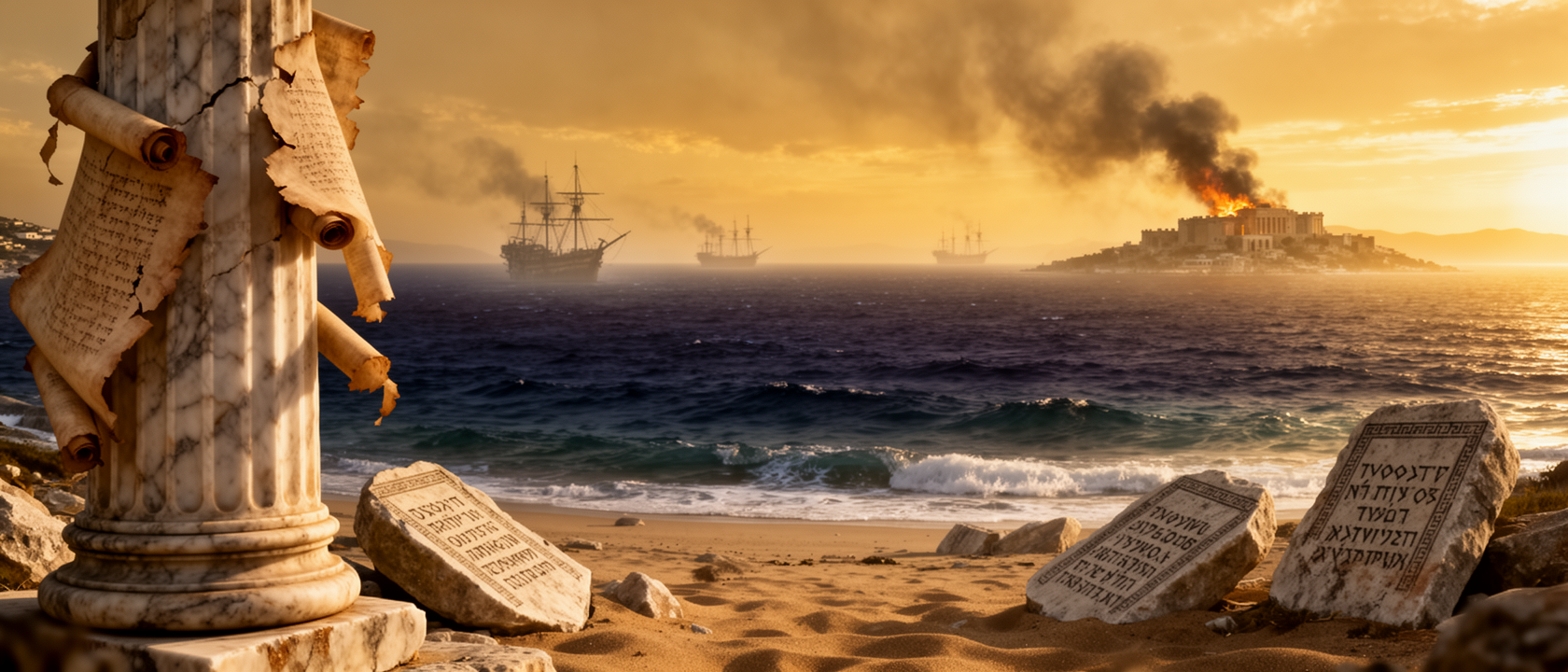
The Iliad Was Never the Whole Story
Most people picture the Trojan War through the same images: the wooden horse, Achilles in armor, the burning city, Helen. And they assume the Iliad covers all of it. It doesn’t. The poem opens during the tenth and final year of the war, mid-argument, focusing almost entirely on the rage of Achilles after a falling-out with the commander Agamemnon. It says almost nothing about how the war started, ends before Troy falls, and the Trojan Horse doesn’t appear in it at all. What feels like the complete story is actually a narrow close-up on a few weeks of a decade-long conflict.
The Lost Archive
The Iliad belonged to a much larger collection called the Epic Cycle: ancient Greek poems in dactylic hexameter (the six-beat meter that drives Greek epic verse) covering the full arc of the Trojan War, from its divine origins to the heroes’ troubled homecomings. The Trojan branch included the Cypria, the Aethiopis, the Little Iliad, the Iliupersis, the Nostoi, and the Telegony, with the Iliad and the Odyssey in the middle.
Only the Iliad and the Odyssey survived intact. Every other poem exists now as fragments and prose summaries, preserved mainly in a work called the Chrestomathy, attributed to a figure named Proclus, and in the 9th-century patriarch Photius’s Bibliotheca. Five lines of original text remain from the Aethiopis. Two lines from the Telegony. Roughly 50 lines from the Cypria’s 11 books of verse. The rest is gone.
The Cypria: What Actually Started the War
The Cypria opened with something striking: Zeus, advised by the goddess Themis, deliberately engineered the Trojan War as a solution to overpopulation on Earth. From that divine decision, the poem traced the chain of events that triggered the conflict, a wedding, a golden apple thrown by the goddess Eris, a beauty contest between Hera, Athena, and Aphrodite judged by the Trojan prince Paris on Mount Ida. Paris chose Aphrodite, who had promised him Helen of Sparta. He sailed there, was hosted by her husband Menelaus, and left with her, sending Menelaus and his brother Agamemnon to assemble a Greek coalition. The Iliad’s opening scene picks up immediately after.
The Sequels: Deaths the Iliad Doesn’t Show
The Aethiopis, attributed to Arctinus of Miletus, began where the Iliad ended. It brought Amazon warriors led by Queen Penthesilea and an Ethiopian army under Memnon, son of the goddess Eos, to Troy. Achilles killed both leaders. Shortly after, Paris shot an arrow guided by Apollo that killed Achilles. The heel wound everyone knows happens entirely outside the Iliad.
The Little Iliad, attributed to Lesches of Mytilene, covered the dispute over Achilles’ armor. Odysseus won; Ajax, devastated, lost his mind, slaughtered livestock under the delusion they were his enemies, and killed himself. This poem also explained why the Greeks needed Philoctetes, stranded on Lemnos with the bow of Hercules, and Neoptolemus, Achilles’ son, brought from Scyros. The Trojan Horse was built here, not in the Iliad.
How Anyone Kept Track of It
Before these poems were written down, the Greeks adapted their alphabet from the Phoenician script around 800 BCE, they lived entirely in performance. Professional reciters called rhapsodes, roughly “stitchers of songs,” carried the poems from city to city. One key technique was the formulaic epithet: a fixed phrase attached to a character that fit a specific metrical position. “Swift-footed Achilles.” “White-armed Hera.” These weren’t decorative; they were structural anchors helping performers hold verse together across generations.
An Open Question
Authorship of the Cycle is genuinely unresolved. The Cypria is attributed to Stasinus of Cyprus or Hegesias of Salamis, depending on the ancient source. Aristotle, in his Poetics, criticized the Cypria and the Little Iliad for episodic plots, contrasting them with the Iliad’s tighter structure, and scholars followed his lead for centuries. Modern classicists push back: judging poems you can read only in fragments is circular reasoning. Whether the Aethiopis was brilliant or mediocre, five surviving lines aren’t enough to say.