The Syringe That Isn’t
Picture a mosquito biting you. Most people imagine something close to a hypodermic needle: a thin, rigid tube drops straight into the skin, hits a vein, and draws blood. Clean, mechanical, direct. That picture is wrong in almost every detail.
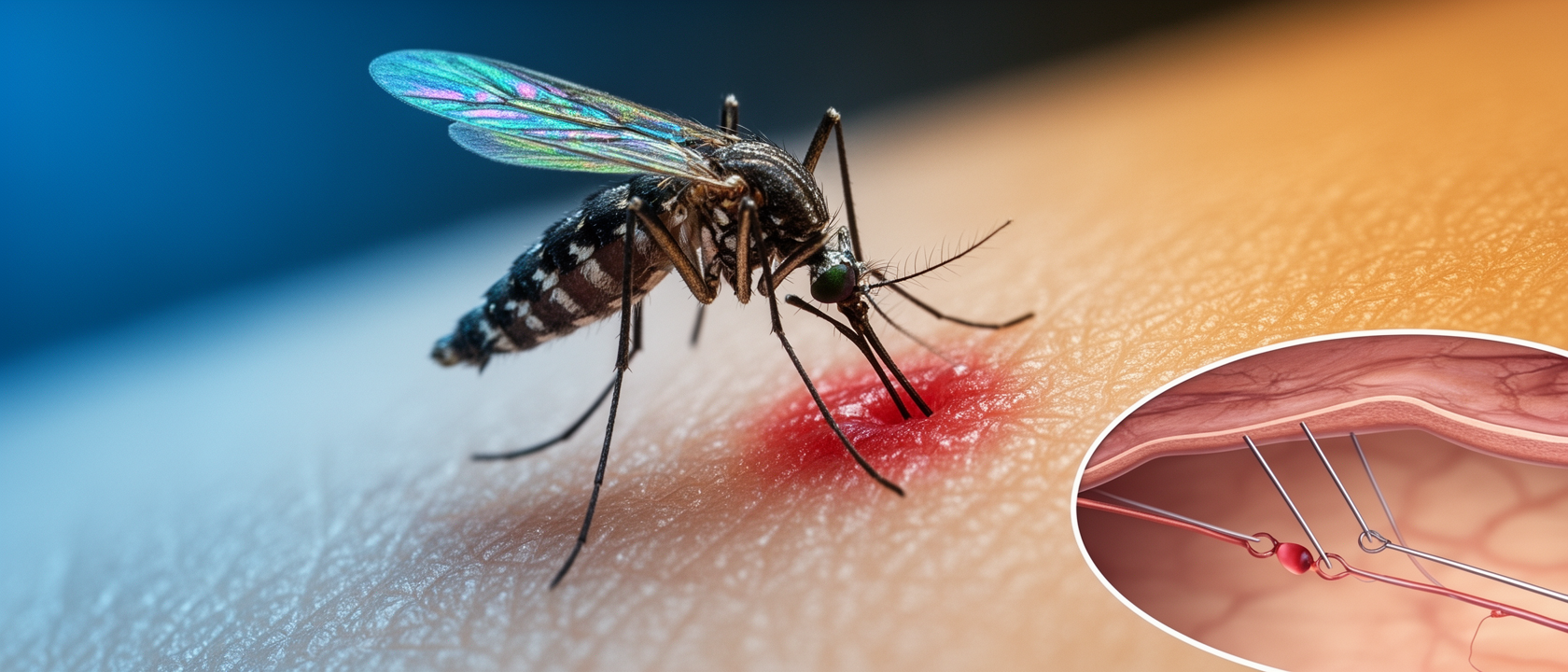
The mosquito’s mouthpart, called the proboscis, is not a single hollow tube. It is a bundle of six needle-like structures, collectively called the fascicle, wrapped in a flexible outer sheath called the labium. When the insect bites, the labium bends back and stays on the skin’s surface. What actually enters the skin is the fascicle: six specialized tools, each with a distinct job. Two of them, the maxillae, are serrated and saw through skin using alternating strokes. Two more, the mandibles, spread tissue aside to make room. A fifth structure, the labrum, forms the channel through which blood is eventually drawn up. The sixth, the hypopharynx, runs a separate lane in the opposite direction, pumping saliva into the wound.
None of that matches the syringe image. But the biggest surprise isn’t the anatomy. It’s what happens once those structures are inside the skin.
Finding a Vein in the Dark
Consider the problem the insect actually faces. The fascicle breaks the surface, but the tiny capillaries it’s after aren’t spread evenly through the skin like a grid. They’re wherever they happen to be. The odds that the probe lands directly on top of one are low.
The obvious solution would be trial and error: probe, miss, pull out, try again a few millimeters over. That approach has a serious flaw. Every time the mouthparts break the surface and withdraw, they risk triggering a response from the host. For a mosquito whose entire feeding window depends on going unnoticed, repeated punctures are a liability. There has to be a better strategy.
Microscopy footage from researchers at the Institut Pasteur in Paris, published in a 2012 PLOS paper by Valérie Choumet and colleagues, showed exactly what that strategy looks like. The species filmed was Anopheles gambiae, the malarial mosquito. What the footage revealed was not what anyone expected.
The Bend Nobody Anticipated
Once the fascicle is under the skin, it does not stay straight. The tip bends, sharply, into extreme curves, threading between skin cells rather than pushing through them, weaving and redirecting as it goes. The mosquito is not tunneling. It is steering.
The labrum, equipped with receptors that can detect blood vessels, acts as the primary probe. It navigates through the gaps between cells, bending as needed, until it locates a capillary. The insect does not need to withdraw and reinsert. From a single entry point, the flexible tip can cover a substantial area of tissue beneath the surface, hunting for its target while the host remains completely unaware.
A 2010 paper in Physical Review E described the proboscis as a natural biomicroelectromechanical system, a term used for microscale devices that combine mechanical and sensing functions. In biological terms, evolution has produced a precision-steerable probe that operates at a scale far below what the naked eye can track. The mosquito isn’t brute-forcing its way to a meal. It’s maneuvering.
More Controllable Than Anyone Assumed
James Logan, a researcher in the Department of Disease Control at the London School of Hygiene and Tropical Medicine, reviewed the Choumet footage when it was published. His response was blunt: “I was genuinely amazed to see the footage.” Logan’s research covers vector-borne diseases including malaria, dengue, and Zika, and even for someone with that depth of background, the footage was a genuine surprise.
What struck him most was the degree of active control on display. The proboscis isn’t merely flexible the way a rubber hose is flexible, the mosquito is directing it, bending it through tissue from a single puncture point without alerting the host. Part of what makes that possible is the saliva itself: among its more than 100 proteins are anesthetic compounds that mask the mechanical sensation of the mouthparts moving around inside the skin.
So you don’t feel the search at all. You notice later, when your immune system reacts to the foreign proteins in that saliva and produces the familiar red bump and itch. By then, the mosquito, specifically a female, since males feed only on nectar and plant juices, is long gone, having located a capillary without you ever registering the hunt.