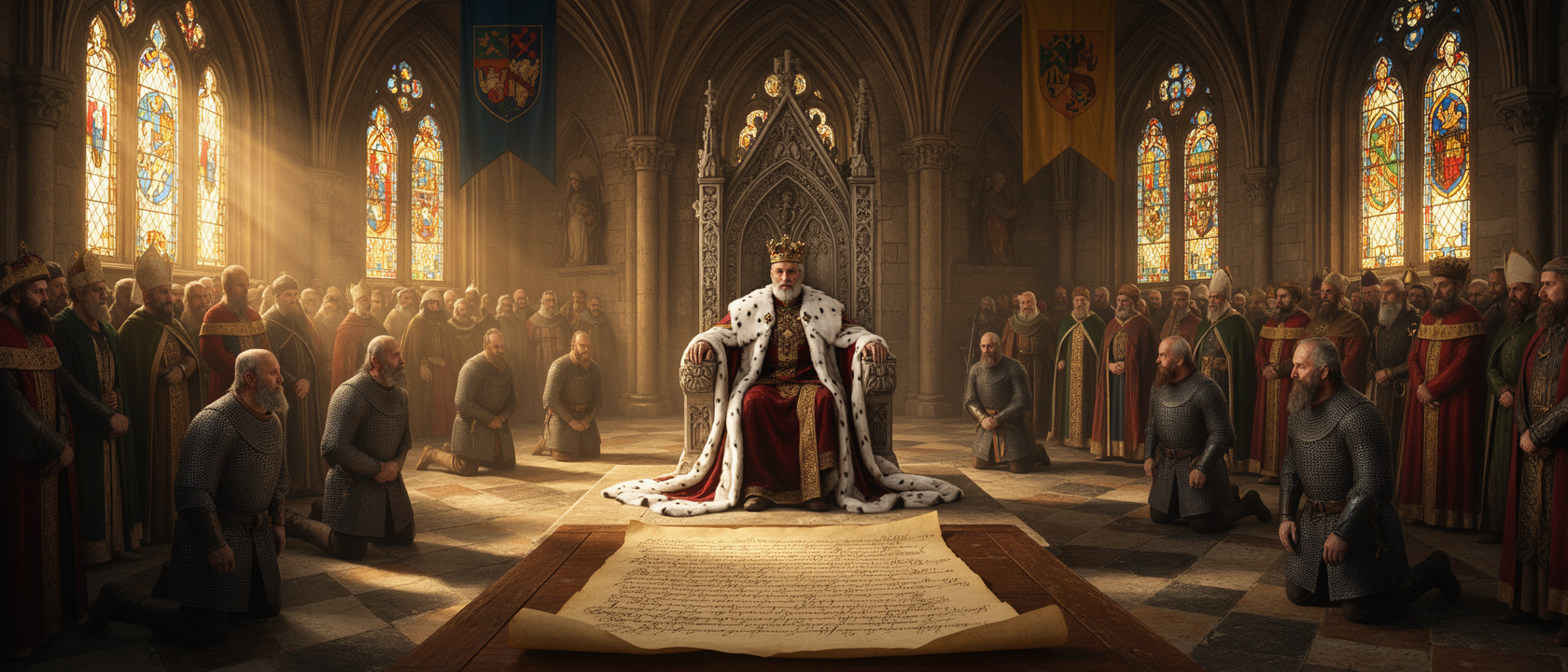
The Medieval King Had to Ask Permission, Too
The standard movie version of a medieval king needs no introduction: throne, crown, absolute authority. One wrong word and the guards are called. It makes for good drama. As history, it leaves out quite a bit.
The Middle Ages stretched from 476 AD through to 1453. Over those roughly thousand years, European monarchs held enormous power, but that power came with strings attached, and the strings were not decorative.
A Puzzle Worth Sitting With
Here is the contradiction. Medieval kings regularly claimed to rule by divine right: God’s chosen representative, outranking every bishop, baron, and peasant. If that authority was total, why did those same kings spend so much time negotiating with the nobles beneath them? Why recite oaths at coronations? Why call councils?
The answer is not philosophical. It is logistical.
The Geography of Power
Running a country in the Middle Ages was nothing like running one today. No telegraph, no reliable road network. A message to a distant lord might take days or weeks, with no guarantee it would be obeyed on arrival. This made centralized control largely impossible, giving rise to the feudal system: the king granted plots of land, called fiefs, to barons in exchange for loyalty, taxes, and military service. After the Norman Conquest of 1066, William the Conqueror distributed land to roughly 150 barons, covering approximately half of England’s territory.
The feudal contract ran both ways. A baron owed the king a fixed number of troops for a set number of days per year, and no more. He could legitimately refuse demands beyond those terms. The king had to respect the arrangement or risk losing the support he needed to govern at all. Push the nobility too hard, and the army simply walked away. Look for another source of funds, and you still needed their cooperation to collect it.
Where the Army Actually Came From
The king had no independent standing army. His fighting force was assembled from his barons’ forces, medieval England had approximately 4,500 knights, and virtually none answered directly to the crown without going through a lord first.
King John discovered this the hard way. His expensive wars against France required aggressive taxation, and the coalition he had financed was decisively beaten at the Battle of Bouvines on July 27, 1214. On June 15, 1215, John was at Runnymede putting his seal to the Magna Carta Libertatum. Its 63 clauses were pointed: no seizure of property without due process, no imprisonment without fair judicial proceedings, no new taxes without baronial and clerical consent. A committee of 25 barons was established to monitor compliance. John almost immediately sought annulment, and the Barons’ Wars followed between 1215 and 1217. But the principle had been stated plainly: the monarch was not above the law.
The Machinery That Came Before
The Magna Carta formalized pressures building for centuries. Anglo-Saxon kings had long relied on the witan, a council of nobles, bishops, and thegns advising on legislation and major decisions. The earliest recorded reference dates to around 600 AD, under King Æthelberht of Kent. After 1066, William I established the curia regis; Henry I summoned his 27 times over a 35-year reign. That frequency tells you this was a working part of governance, not an occasional formality.
Coronation oaths added further constraint. When a king swore publicly to rule with justice and mercy, that oath gave the nobility a recognized legal basis to resist tyranny. As historian Professor Joel T. Rosenthal has noted, a king who pushed too far, or filled important positions with men the nobility considered unsuitable, could expect organized opposition as a direct and predictable result.
A Few Necessary Caveats
None of this means medieval Europe was a constitutional democracy. The protections in the Magna Carta applied to the clergy and landowning elite, not to the peasants who farmed their land. The revolt that produced it was triggered by John’s treatment of his nobles after Bouvines, not by any concern for commoners.
“Absolute monarchy” as a standard medieval arrangement is also, broadly speaking, a later development and a pop-culture simplification. Real unchecked power was the exception, not the rule. John’s own reign ran from 1199 to 1216, roughly 17 years, and ended in active baronial rebellion, a French claimant invited to take his place, and the country at war with itself. Not exactly the picture of unchallenged authority that gets depicted on screen.