Wings Are Wonderful. But Can They Point at Something?
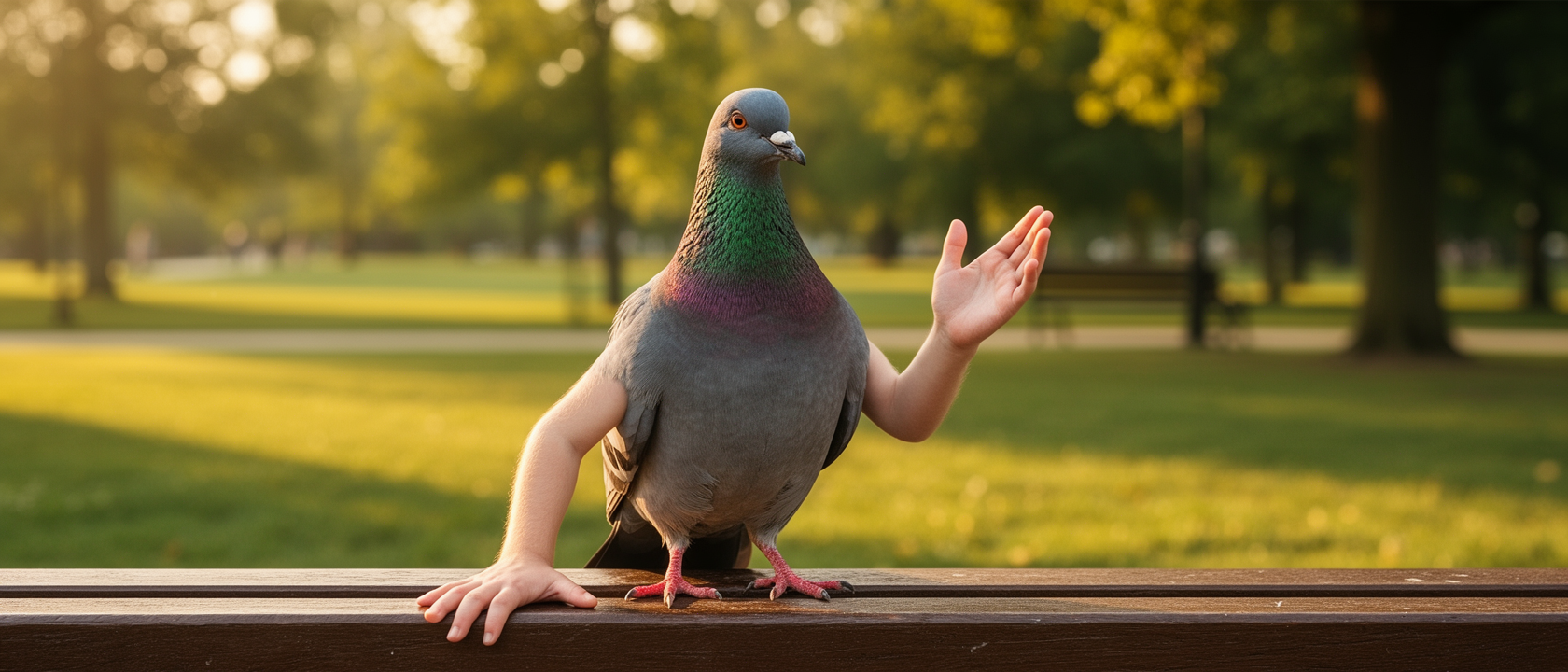
Picture a pigeon on a park bench. Now picture the same pigeon flexing a fully formed, muscular human arm, bicep tight, fingers spread wide. That image shouldn’t work. The brain snags on it, tries to file it somewhere, and comes up empty. That snag is exactly the point.
The internet meme known as “Birds With Arms” has been doing this to people since at least August 11, 2008, when a thread called “Post pictures of birds with arms” appeared on Reeelapse Forums. Something Awful hosted its own round on February 16, 2009, and two dedicated Tumblr blogs launched in May 2009. By 2012 it had reached Sad and Useless and Smosh; BoingBoing linked one of those Tumblr blogs on June 27, 2012, and Neatorama covered the phenomenon on October 3, 2016. The joke never really went away, because it never stops working.
What Makes a Wing So Different From an Arm?
At the bone level, a bird’s wing and a human arm are not as different as they look. Both are homologous structures sharing the same underlying skeleton: humerus, ulna, radius, carpals, metacarpals, and phalanges. The blueprint is nearly identical.
Evolution diverged drastically from there. In birds, most hand and finger bones are fused or reduced into a rigid, lightweight frame, leaving effectively two “fingers” and a thumb equivalent called the alula, used mainly for control during slow flight. The radius and ulna are often fused to keep the wing stiff under the stress of flight.
A human hand is built for something almost opposite. The shoulder is a ball-and-socket joint with wide range of motion; the wrist holds multiple carpal bones for precise movement; and the opposable thumb, anchored by a saddle joint, makes pinching, gripping, and pointing possible. Birds gave all of that up, a very long time ago, in exchange for flight.
The Photoshop Paradox
When a digital artist grafts human arms onto a crow, they create a specific visual collision: a creature whose forelimbs committed entirely to lift and sustained flight, suddenly burdened with limbs built for grip, manipulation, and gesture. The absurdity lands hard because the substitution is anatomically meaningful. A wing and an arm share the same ancient template yet have diverged so completely that placing one onto the other produces something the visual cortex cannot resolve.
Because birds committed their forelimbs to flight, everything else falls to the beak and feet. Penguins turned their wings into rigid flippers for swimming; ostriches use theirs for balance during a run. What no bird can do is point at something, make a fist, or hold a mug.
The Frustration That Isn’t Real (But Feels That Way)
Part of what keeps the meme alive is the satirical narrative built around it: the running joke that birds are quietly, profoundly annoyed by this trade-off, that somewhere behind those small amber eyes lives a creature that would very much like to gesture emphatically or give a thumbs-up. That is fiction, clearly, birds are not suffering from grip envy. But the joke works because the underlying biology is real.
The earliest known thread dates to August 2008, placing this corner of internet humor at nearly two decades old. The arm grafted onto a bird is built for everything the wing surrendered, and that mismatch, between what a limb was shaped to do and what it actually became, is the whole joke, and also a fairly good summary of vertebrate evolution.