The Egg That Could End a Shopping Trip
The process required real patience: crack an eggshell carefully, insert a small explosive device, glue the shell shut, slip it back into a carton. That carton would travel to a supermarket in northeastern Italy’s Veneto or Friuli-Venezia Giulia region. Someone would buy it, take it home, and reach into the fridge one ordinary morning.
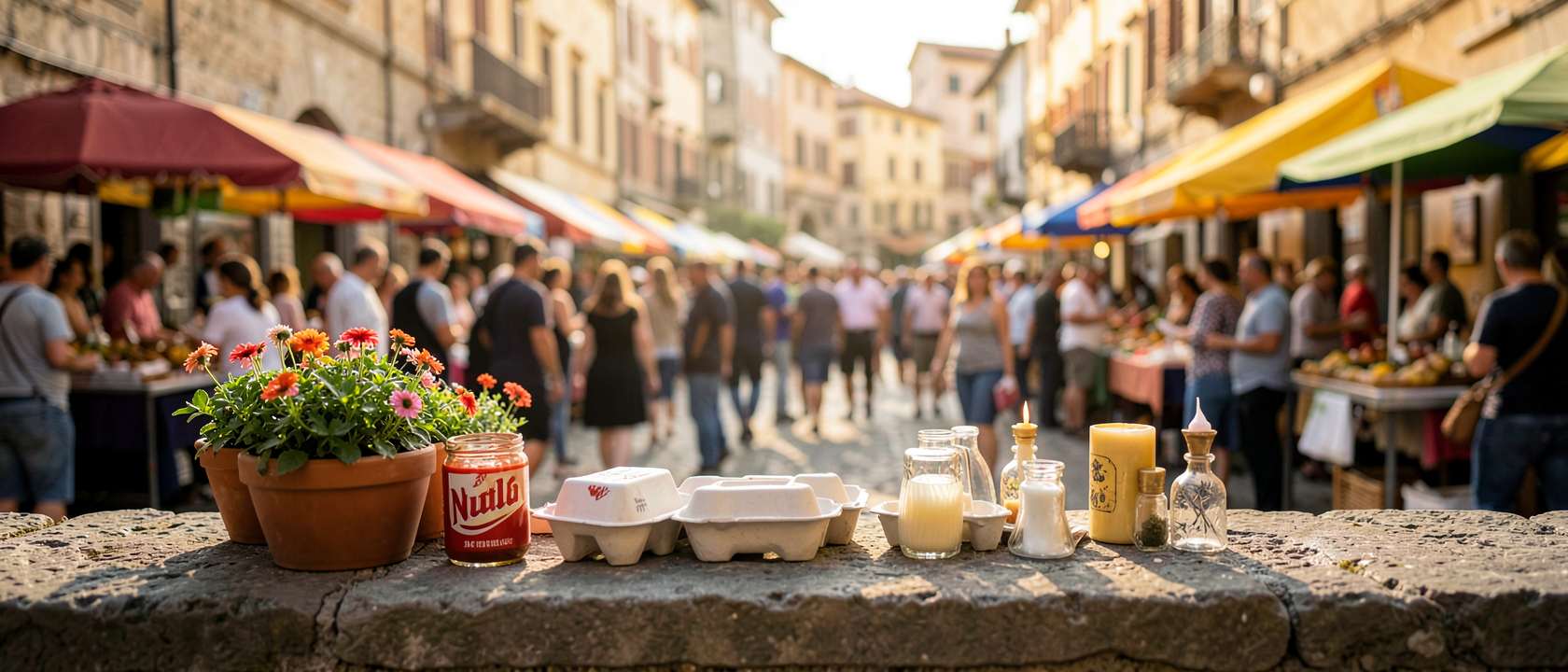
Between 1994 and 2007, more than 30 improvised explosive devices appeared across that corner of Italy, hidden inside objects nobody would hesitate to touch: Nutella jars, tubes of tomato paste and mayonnaise, candy containers, votive candles, a bubble-blowing bottle, a felt-tip pen, a bottle arranged to look like a message in a bottle. Every device was designed to detonate the moment someone picked it up. Nobody died, but more than 17 people were injured, some sources put the figure above 20, and several were hurt seriously. The first attack came on August 21, 1994, at a crowded bird festival in Sacile, near Pordenone, with roughly 50,000 people present. The perpetrator was never identified.
What the Press Called Him, and What He Never Said
Italian journalists gave the unknown perpetrator an obvious label: the Italian Unabomber, borrowed from Theodore Kaczynski, the American mathematics professor who ran a 17-year bombing campaign in the United States, killed 3 people, injured 23, and was sentenced to life in prison in 1998. Some Venetian journalists preferred “Monabomber,” from the Venetian slang word “mona,” meaning “idiot.”
Neither name fits well. Kaczynski mailed bombs to specific targets and eventually issued a lengthy political manifesto. The Italian perpetrator sent nothing across thirteen years: no letter, no demand, no claim of responsibility. That sustained silence across the entire span is one of the case’s defining peculiarities. Most prolonged bombing campaigns are, in some twisted sense, communicative. This one wasn’t.
The Craft of Miniaturization
The defining technical feature was scale. Fitting an explosive reliably inside an eggshell, a pen casing, or a candy wrapper requires patience and real mechanical skill. Investigators concluded the perpetrator was likely between 35 and 50 years old, probably familiar with the western Friuli area around Pordenone, and possessed genuine dexterity alongside working knowledge of chemistry and engineering. Some devices were also packed with nails or marbles, intended not for mass destruction but to injure one person badly, at the moment of contact with something they had no reason to distrust.
Documented Harm
Two incidents illustrate what that meant. A rigged felt-tip pen left near a riverbank exploded when a girl picked it up; she nearly lost her hand and her eyesight. A 28-year-old nurse named Massimiliano Bozzo, walking near the mouth of the River Livenza, found what appeared to be a message in a bottle. It was a bomb. He lost his thumb and sustained severe damage to several other fingers; his girlfriend, standing nearby, was cut by flying glass.
Attacks were concentrated on public holidays, crowded outdoor spaces, and locations children frequented: supermarkets, parks, beaches, carnival squares. A two-year gap from 1997 to 1999 led investigators to speculate the perpetrator was imprisoned for an unrelated offense or completing military service. That remains speculation only.
2006: The Silence That Never Explained Itself
By 2004, investigators had a main suspect: Elvo Zornitta, an aeronautical engineer from Azzano Decimo in the Pordenone area. On August 28, 2006, Italian police, assisted by the U.S. FBI, raided his home. Zornitta was charged with planting 20 of the bombs; the central evidence was a pair of scissors found in his garage, claimed to match cuts on a tin sheet recovered from a device.
The case collapsed. On March 2, 2009, a judge in Trieste dismissed the charges at the prosecutor’s request, citing lack of evidence, because the ballistic technician who handled the scissors, Ezio Zernar, had tampered with them. Zernar was convicted of evidence tampering in 2014. Zornitta received compensation; the exact amount is disputed.
The last confirmed device was located on October 28, 2007, and the attacks stopped without explanation. In October 2022, the case was reopened after journalist Marco Maisano and two victims, Francesca Girardi and Greta Momesso, pushed for a new review based on DNA and blood traces that earlier technology could not analyze. The perpetrator either died, stopped voluntarily, or moved on for reasons that remain entirely private. Investigators built a profile, identified a suspect, watched their evidence collapse from the inside, and ended up back at zero.