The Most Unlikely Game You’ve Never Heard Of
Dodgeball has been a gym-class staple for roughly a century. The bow and arrow spent most of human history as a weapon designed to kill people at a distance. In 2011, John Jackson of Waterloo, Indiana looked at both and decided to combine them.
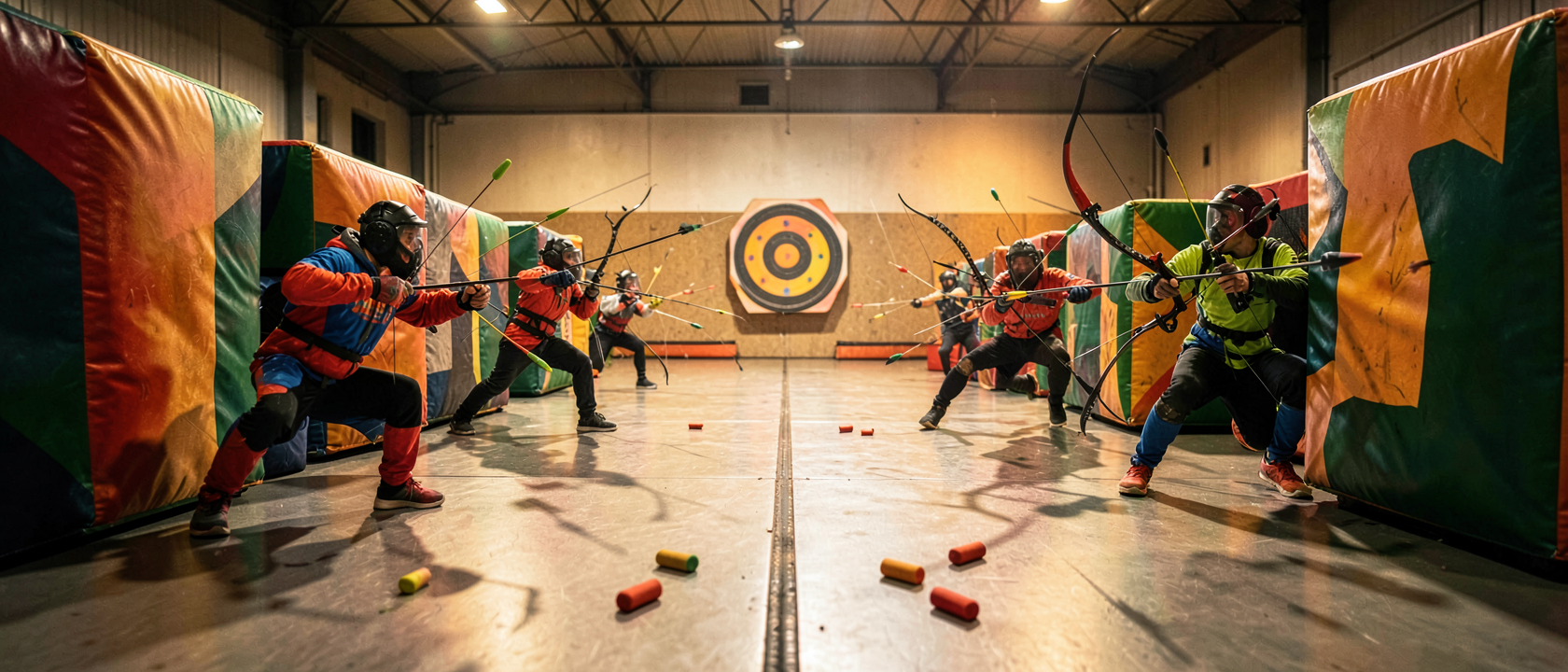
The sport he created is called Archery Tag. Two opposing teams shoot foam-tipped arrows at each other from real bows across a divided field until one side is eliminated. Games last about 8 to 10 minutes. The minimum recommended age is 7. People book it for birthday parties.
Wait, How Is That Legal?
An arrow is not a ball. Standard archery arrows carry narrow, hardened tips engineered to concentrate force into as small a point of contact as possible. So the question isn’t whether Archery Tag sounds odd, it’s whether the engineering actually handles the physics.
There’s a secondary puzzle too. Paintball already exists: competitive, projectile-based, and commercially proven since the 1980s. What does a bow give you that a paintball marker doesn’t?
It’s All in the Tip
Pressure, force per unit area at impact, is what determines how much damage a projectile does. A conventional arrowhead concentrates all energy into a tiny metal point. Jackson’s foam-tipped arrow spreads that force across a much wider surface, dropping pressure dramatically. Venues report arrows cause little to no discomfort even on bare skin; a mandatory face mask handles the remaining risk. Archery Tag bows are also capped at under 30 lb-force (13.6 kg-force) of draw weight, well below hunting or competitive archery norms.
Jackson arrived at the idea in April 2011, when he and a company engineer spotted scrap foam at a vendor’s booth, attached it to an arrow tip, and had a working 3D-printed prototype within an hour. The first game was played on June 4, 2011, at a fundraising event in Wabash, Indiana; a YouTube video followed on June 7.
Dodgeball, But Make It Medieval
Two teams of 4 to 9 players face each other across a 60 ft × 30 ft field (18.3 m × 9.1 m), divided by an 18-foot neutral zone with inflatable bunkers on both sides. At the whistle, arrows staged along the center line trigger a sprint from both teams, pure dodgeball logic. Getting hit puts you out, but if an opponent catches your arrow, you are eliminated instead. Each team has a 5-spot foam target on the sideline; knock out a disc from the opposing target, and one of your eliminated players returns.
By 2014, around 170 licensed venues ran Archery Tag across the US, UK, Netherlands, Russia, Singapore, and elsewhere. By July 2015, that had reached 350-plus licensees in 34 countries. As of 2026, the figure stands at roughly 2,800 or more licensed locations across 76 to 79 countries on six continents.
Katniss Made This Happen
Jackson invented Archery Tag about ten months before The Hunger Games opened in theaters in March 2012, he didn’t invent it to ride the wave. But when the wave arrived, it was substantial. USA Archery membership jumped from 4,185 in November 2011 to 8,589 in November 2013, a 105% increase. The Walking Dead, which premiered in October 2010 featuring archer Daryl Dixon, pulled in the same direction. Jackson responded by running target-shooting demonstrations at local Hunger Games premieres, using foam-tipped arrows as the draw.
Why a Bow Feels Different From a Gun
Marketing consultant Peter Fermoselle, speaking to The New York Times, argued that the bow and arrow feels old-fashioned in a way that lends “a little more nobility to shooting someone”, an effect a paintball marker doesn’t produce. The bow appears across centuries of mythology, Robin Hood, Odysseus, Arjuna, and requires visible physical effort: you pull the draw with your own shoulders and arms. Antiquity and visible physical effort are real parts of the appeal, distinct from the engineering that makes it safe for a seven-year-old.