The Flock That Drew Itself
The Image That Stops You Cold
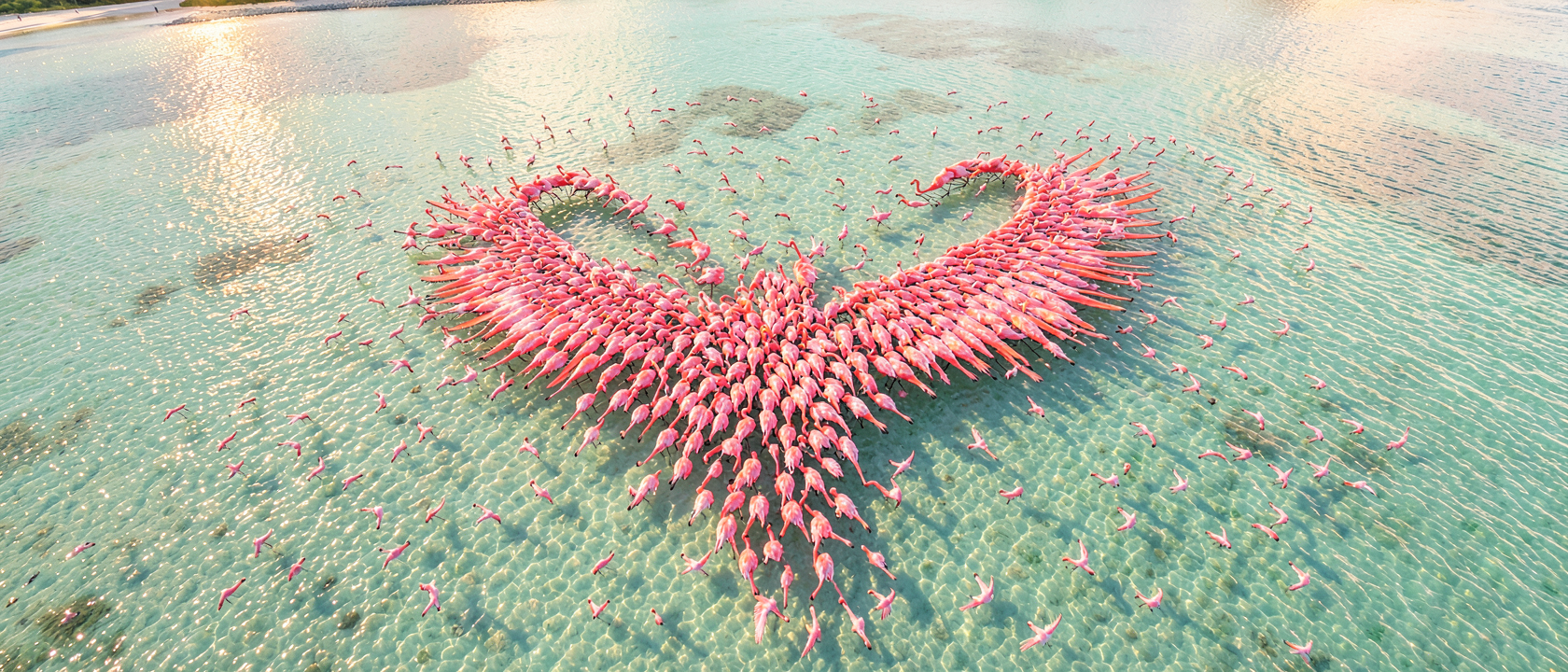
Picture an aerial photograph: dark water below, and across its surface, a mass of pink. Then your eye adjusts. The flock has a long, curved neck, a compact body, wings folded just so, the unmistakable silhouette of a flamingo, where every dot making up that silhouette is itself a flamingo.
Robert B. Haas, an aerial photographer working for National Geographic, captured this image above the Yucatán Peninsula in Mexico. It appeared in the magazine’s October 2007 issue and later in his book Through the Eyes of the Condor: An Aerial Vision of Latin America. When it spread online after being posted to Neatorama on September 25, 2008, the predictable question followed: is it real? National Geographic’s editorial standards prohibit post-processing manipulation, and Haas described the formation as spontaneous. It is real, and that, not the strangeness, is what earns it a second look.
Wait. Did That Actually Happen by Itself?
Hundreds of individual birds, each wading or feeding or jostling in the shallows, collectively arranged themselves into one of the most recognizable outlines in the animal kingdom, their own species’ outline. No coordinator, no signal, no rehearsal.
A flock of flamingos is never truly still. The birds shift constantly, filter-feeding through their upside-down bills, lifting a foot, bumping a neighbor. Whatever shape existed when Haas pressed the shutter was almost certainly gone moments later. He got one frame. There is no biological explanation on record for why this happened, not a documented behavior, not a known formation pattern. It was pure coincidence at a specific altitude, in a specific light, at a specific instant.
The Camera Made It Visible
Stand beside a lake and watch a flock of Caribbean flamingos (Phoenicopterus ruber), roughly 30,000 strong across the Yucatán’s wetlands, and you will see pink noise. Birds nearby are large and distinct; birds farther away blur into color. The group has no obvious shape from the ground.
Altitude changes everything. From a helicopter with its doors removed, the flock compresses into a flat plane until what remains is just the outline and the mass. Human vision, given a clean two-dimensional shape against a contrasting background, snaps it into a figure almost involuntarily, the ability called pareidolia. But here, unlike a face in a cloud, there really was a shape. The camera did not create it; it revealed it by removing the visual noise that had been hiding it.
What We Actually Know (And What We Don’t)
The record has real gaps. No source gives the exact number of birds, only “hundreds.” No source specifies the precise date of the photograph, only that it appeared in the October 2007 issue. The location is the Gulf of Mexico above the Yucatán Peninsula, nothing more specific. There is no account of whether Haas noticed the shape while airborne or discovered it afterward.
What is confirmed: the photograph is real, the birds are real American flamingos, the formation was spontaneous, and the image ran under editorial rules that prohibit manipulation. Everything beyond that is inference.
Accidental Art at the Edge of Science
Deliberate aerial art exists, stadium crowds form letters at a director’s signal, crop circle makers plan for days, pilots fly tight geometric formations. In every case, human intention precedes the shape. This photograph has no author in that sense. The shape that emerged had no designer: just animal behavior, geography, altitude, and the fraction of a second a shutter stayed open, each element unaware of the others.
Each Caribbean flamingo stands roughly 3.6 to 4.8 feet tall (1.1 to 1.45 meters) with a wingspan up to about 4.9 feet (1.5 meters). They are not small animals. And yet, from enough altitude, hundreds of them resolved into something that looks, to any human eye, like a single one of their own kind. Haas died on September 28, 2021, in Dallas, Texas, having spent nearly two decades looking at the Earth from above. He described this kind of image as his holy grail, the chance to capture something no one had captured before and that he was very unlikely to capture again.
That leaves a question: if this shape formed once, above a peninsula in Mexico, for a fraction of a second, unseen by anyone at ground level, how many other accidental formations have come and gone above flocks and murmurations across the world, with no camera at the right altitude to freeze them?