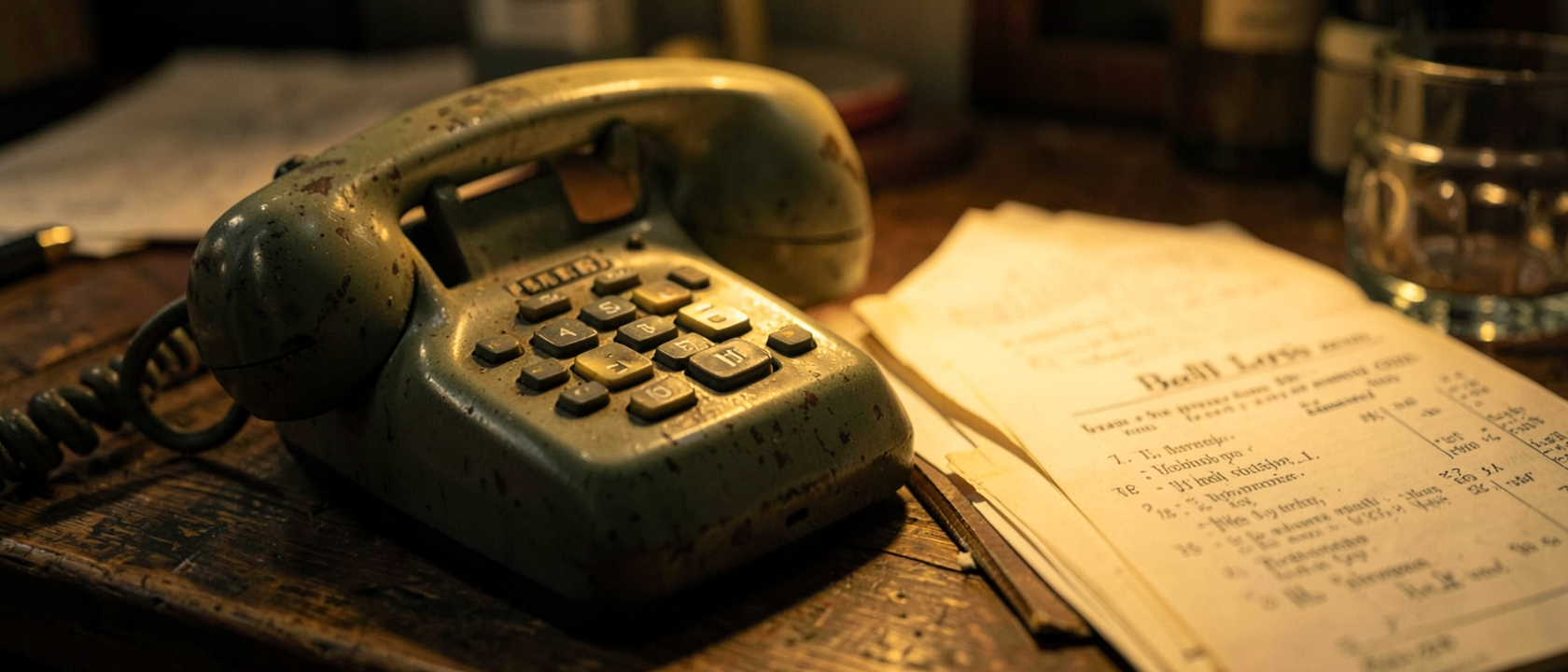
The Key You’ve Pressed a Thousand Times Has a Name Almost Nobody Knows
Pick up a telephone or glance at almost any social media post: the # symbol is everywhere. Most people call it “pound,” “hash,” or “number sign.” But Bell Labs engineers, in the era when touch-tone dialing was being invented, gave it a completely different name: octothorpe. It sounds like a genus of fern. It is, apparently, what Bell Labs, one of the twentieth century’s foremost research institutions, decided to call a key on a phone.
A Word That Existed Before Anyone Wrote It Down
The first confirmed written record of octothorpe appears in a US patent filing dated December 3, 1973, later issued as patent no. 3,920,926. By the time the word appeared in print in the magazine Telephony in 1974, per the Oxford English Dictionary, it had already been circulating verbally inside Bell Labs for years, possibly since as early as 1964. A decade of spoken life with no paper trail, suggesting this was not a formal designation handed down in a memo, but the kind of word passed around a breakroom and scrawled on a whiteboard.
So who coined it? That question has at least three competing answers and no definitive proof for any of them.
“Octo” Is Easy. “Thorpe” Is Where It Gets Interesting.
The first half is simple: trace all four lines of the # symbol from end to end and you get eight endpoints. “Octo” is Latin for eight. That part is settled.
“Thorpe” is another matter. The most widely circulated account comes from a Bell Labs employee named Ralph Carlsen, who wrote a memorandum shortly before his retirement in 1995. He described how a colleague, Don Macpherson, coined the word during a visit to instruct Bell Labs’ first client, the Mayo Clinic, in using the new telephone system. Macpherson reportedly needed an unambiguous name for the symbol on the spot and landed on octothorpe, with “thorpe” a tribute to Jim Thorpe.
Thorpe was a Sac and Fox Nation athlete from Oklahoma who won gold medals in both the pentathlon and decathlon at the 1912 Stockholm Olympics. His medals were stripped in 1913 after it emerged he had been paid to play semi-professional baseball in 1909 and 1910, violating amateurism rules. Macpherson was reportedly involved in efforts to restore those medals. On January 18, 1983, the IOC presented Thorpe’s family with replacement medals; in July 2022, the IOC named Thorpe the sole gold medalist for both events, 110 years after the fact.
The story is hard to resist, the catch is that it rests entirely on Carlsen’s memo, written decades after the events he described, with no corroborating documents.
Or Was It an Internal Joke All Along?
In 2006, Douglas Kerr of Bell Labs published a technical paper attributing the word to two colleagues, C. Schaak and Herbert T. Uthlaut, with the original spelling given as octatherp. In Kerr’s account, the word was invented as deliberate in-house absurdism: give a mundane symbol an impressively pompous name and see if it sticks. The Merriam-Webster New Book of Word Histories, published in 1991, independently supports something close to this, stating that “octotherp” arose in the 1960s among telephone engineers as internal humor. A third claimant, Howard Eby, said he and Lauren Asplund invented the word in 1964 by combining “octo” with the arbitrary syllable “therp.”
The two main accounts are not necessarily irreconcilable. Bell Labs was large enough for two groups to independently land on the same prefix with different endings. The symbol’s documented spelling variants alone hint at a messy, organic history: octothorp, octothorn, octotherp, and octatherp are all recorded.
How # Got onto the Phone, and What the * Key Was Called
The original Touch-Tone telephone system, introduced publicly on November 18, 1963, in Carnegie and Greensburg, Pennsylvania, had ten keys: digits 0 through 9. The # and * keys were added by 1968, according to the IEEE, specifically to handle computer-telephone interactions. Pressing # sends a mix of 941 Hz and 1477 Hz down the line.
The same 1973 patent named the * key sextile, a term borrowed from astronomy. Neither name caught on publicly. Western Electric, AT&T’s manufacturing arm, issued a press release that same year insisting the symbol’s name was simply “number sign.” The engineers’ vocabulary and the marketing department’s turned out not to be the same.
The Long Journey of “Pound”
The American name “pound” has its own separate history. The pound as a unit of weight gets its abbreviation “lb.” from the Latin libra pondo. Medieval scribes drawing a bar across “lb” to flag it as an abbreviation eventually produced a distinct ligature: ℔ (Unicode U+2114). Whether that ligature is the direct ancestor of the modern # is debated, but the general lineage is widely accepted.
So the # symbol carries, depending on who you ask, a Roman unit of weight, a tribute to a disqualified Olympic champion, or a deliberately meaningless syllable invented by engineers who thought it was funny, possibly all three. The word octothorpe never made it into everyday speech, but it survived long enough to appear in a patent, a dictionary, and the occasional argument about what to call a telephone key. The * key’s name, sextile, was not so lucky.