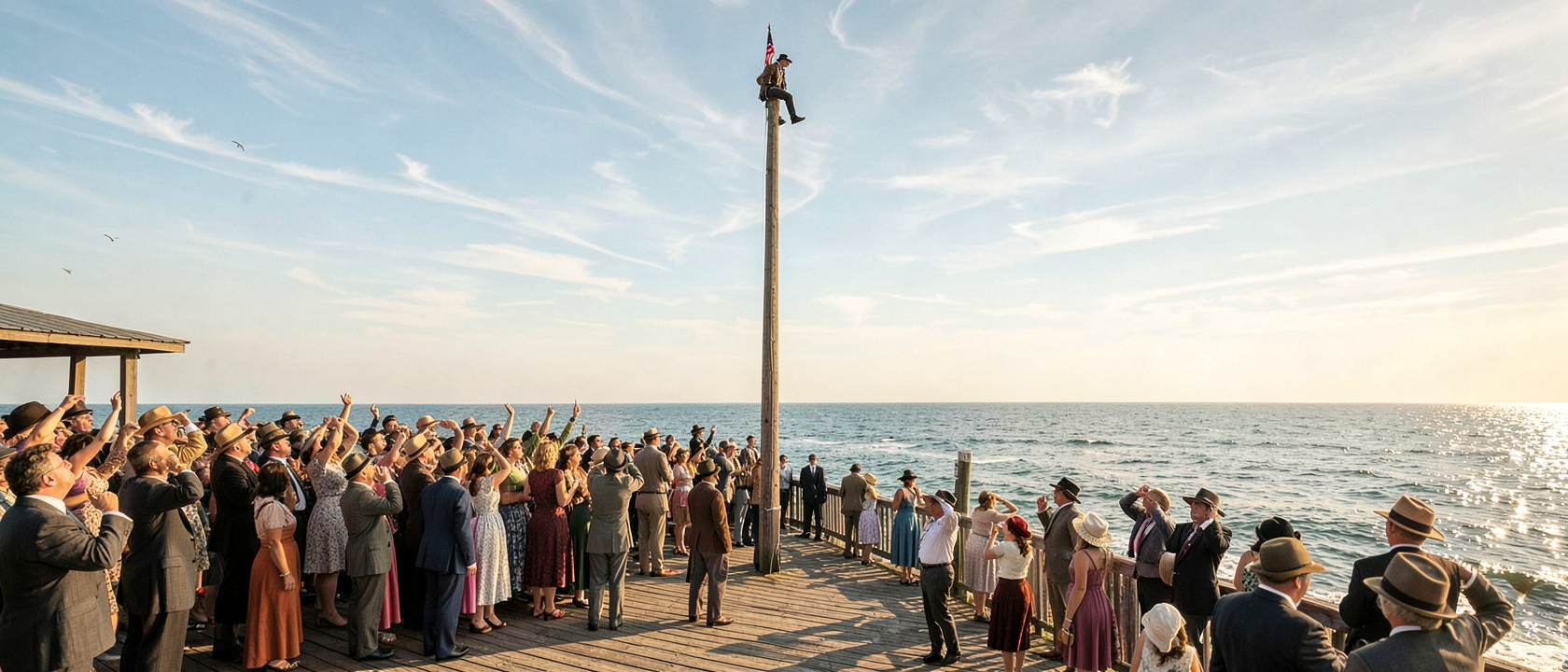
Thirteen Hours on a Pole
In January 1924, a former sailor, boxer, and stuntman named Alvin “Shipwreck” Kelly climbed to the top of a flagpole in Hollywood, California, and sat there for 13 hours and 13 minutes. No broadcast carried it to a waiting audience. By the time he climbed down, a crowd had assembled itself, drawn purely by the sight of a man refusing to descend.
Kelly called himself “the luckiest fool in the world.” Whether he went up on a dare from a friend or as a paid publicity stunt for a movie is disputed. What is not disputed is what happened next.
Why Anyone Stopped to Watch
Put yourself on a sidewalk in 1924. Somewhere above street level, a man is sitting on top of a pole, not performing tricks, not speaking, just sitting very high up and apparently intending to continue. You stop. Of course you do. The open question is irresistible: when will he come down? Will he fall? Pure suspense without a script is hard to walk away from, and each new arrival makes pausing feel reasonable to the next person.
None of this required technology. St. Simeon Stylites, a Syrian Christian hermit, began living atop a pillar northwest of Aleppo around 420 AD, eventually raising it to about 50 feet (15 meters) high. He stayed up for somewhere between 36 and 37 years, long enough to earn the original pole-sitting world record in the Guinness Book of World Records. The same impulse that sent pilgrims to Simeon’s pillar sent pedestrians to Kelly’s pole fourteen centuries later.
Kelly Noticed Something the Crowds Had Not
He recognized that he had demonstrated something repeatable: climb a pole, stay up long enough, and people will gather and keep gathering. That observation had a cash value. He charged for up-close access during his sits, then approached hotels, theaters, and department stores, each facing the same problem of getting people to a specific address. A man on a pole above your entrance solved it, because the crowd arrived pre-assembled and curious.
Over the rest of the 1920s, Kelly toured 28 cities. His seat was a cushioned platform about 13 inches (roughly 33 centimeters) wide. He sustained himself largely on coffee and cigarettes, and claimed to sleep by wedging his thumbs into holes drilled in the pole so that dangerous swaying would wake him through pain. His durations climbed: seven days and one hour in St. Louis in 1926, twelve days in Newark in June 1927, then 23 days and seven hours in Baltimore in 1929. The peak came in the summer of 1930, when he sat atop a 225-foot (about 68.6-meter) pole at Atlantic City’s Steel Pier for 49 days and one hour, 1,177 hours in total, while as many as 20,000 onlookers watched at various points.
Why the Craze Burned Itself Out
Once newspaper reports made Kelly’s income visible, hundreds tried to replicate it. The problem was structural: the moment flagpole sitting became common, the threshold for attracting attention rose sharply. A man sitting on a pole for 13 hours in 1924 was genuinely unusual; the same feat in 1928 made you one of several doing it in the same city. The only competitive response was to go higher and stay longer, and there was no way back from that.
The stock market crash of 1929 and the Depression that followed changed the national mood sharply. The appetite for prolonged physical spectacle evaporated alongside disposable income, and the crowd that stopped because the sight was unusual stopped stopping because it no longer was.
Kelly’s own story traces the arc precisely. In 1935, he tried to break his Atlantic City record with a sit in the Bronx; police shut him down after less than a day. He died in New York City on October 11, 1952, found penniless with a scrapbook of newspaper clippings tucked under his arm. A 1952 New York Times account noted that over his career he had spent a total of 20,613 hours aloft, a long time to spend on a 13-inch platform in the sky, waiting for the crowd below to keep looking up.