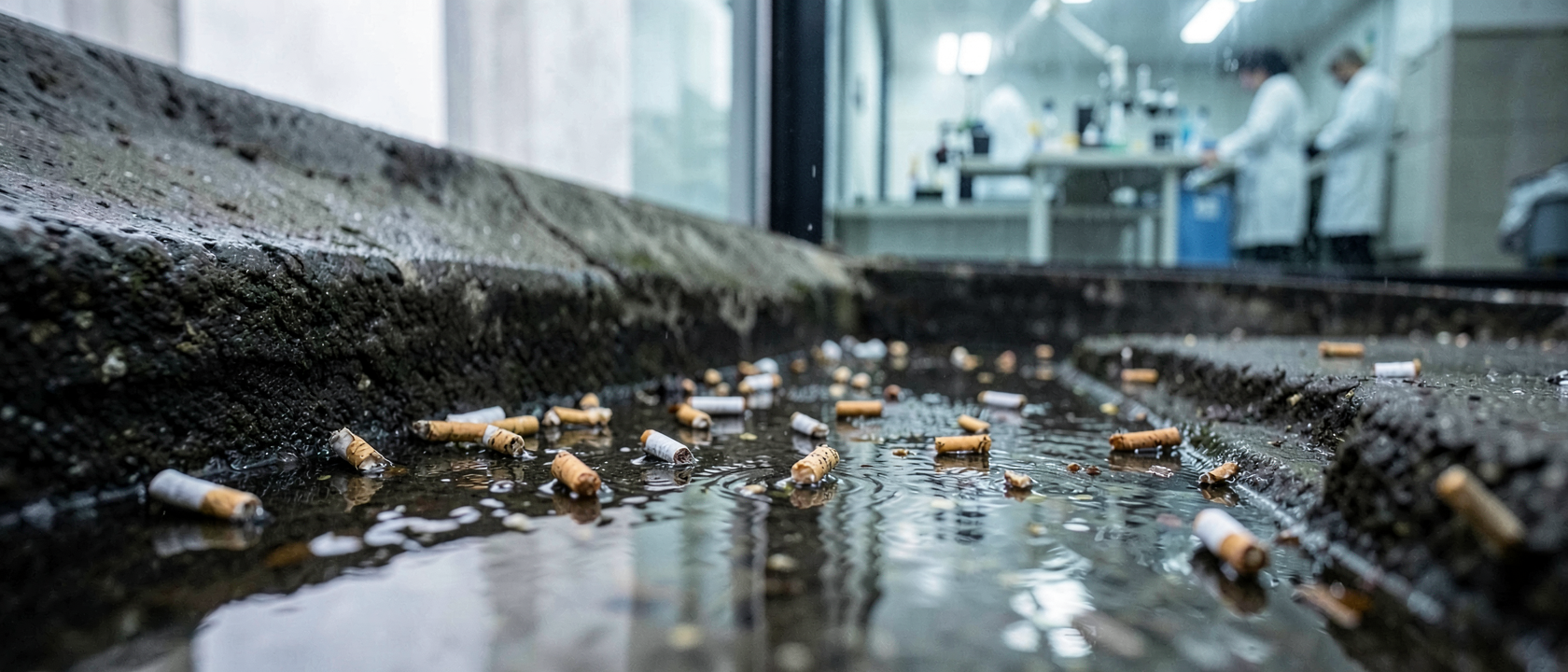
The Most Littered Object You’ve Never Really Thought About
Around 4.5 trillion cigarette butts enter the environment every year, making them the single most-littered item on Earth, ahead of plastic bags, food wrappers, and bottles. Pick one up off the sidewalk and you’re holding a short tube of cellulose acetate, a plastic, not the cotton or paper most people assume, packed with charred tobacco residue. A single butt can contaminate up to 264 gallons (1,000 liters) of water.
What’s less obvious is that this grimy object has attracted genuine, peer-reviewed scientific attention across multiple countries and decades, not just to document its harm, but to understand what it actually is as a material. The results are genuinely strange.
Why Would Anyone Study This?
A smoked cigarette butt concentrates hundreds of volatile and semi-volatile organic compounds in a small, stable package: nicotine, polycyclic aromatic hydrocarbons (PAHs), heavy metals, aromatic amines. That density of chemistry is precisely what makes butts toxic in waterways, and also what makes them potentially interesting as a material or reagent. Three separate research teams, each working in a distinct decade, looked at the same object and asked completely unrelated questions about it.
It Smells Worse Than the Smoke, And Someone Proved It
In 1985, a team at the Central Research Institute of Japan Tobacco Inc. published a study in Agricultural and Biological Chemistry analyzing the odor of cigarette butts. Katsuya Fukuhara, Takeshi Sakaki, Hirohiko Sakuma, and Shiro Sugawara smoked three tobacco varieties under controlled conditions, sealed trimmed butts in a vessel, passed helium gas through at 20 ml/min for five minutes, and fed the captured vapors into a gas chromatograph. They found a distinct cocktail of carbonyls, hydrocarbons, pyrroles, and terpenes, and confirmed this profile differs from smoke itself. The stale smell of a stubbed-out butt isn’t just “old smoke.” It’s chemically something else.
The Building Material Nobody Wanted
Cellulose acetate, the plastic in cigarette filters, biodegrades poorly. In 2010, Aeslina Abdul Kadir, Abbas Mohajerani, Felicity Roddick, and John Buckeridge at RMIT University in Australia published results in the World Academy of Science, Engineering and Technology showing that incorporating used cigarette butts into fired clay bricks reduces firing energy by approximately 10%, while producing bricks that are lighter and better insulated. Crucially, kiln firing, which can run up to 30 hours, traps metals and pollutants from the butts inside the brick matrix rather than letting them leach into soil or water, largely addressing the toxicity problem.
The Pollutant That Protects Pipelines
A 2014 study in the International Journal of Research in Engineering and Technology by researchers from Anna University, CECRI, and SRM University in India tested extracts from discarded cigarette butts as a corrosion inhibitor on J55 steel, used in oil well casings and gas production equipment. The team extracted compounds using polar solvents, then ran tests in a 15% hydrochloric acid solution. At 6% concentration and 86°F (30°C), the extract achieved an inhibition efficiency of 99%; at 221°F (105°C), that dropped to 61%, still substantial. The active compounds are primarily aromatic amines, including nicotine. The molecule responsible for much of the toxicity turned out to be the one doing the protective work.
The 1953 Patent That Just Threw Them Out the Window
All three studies assumed a cigarette butt was worth understanding. U.S. Patent 2,646,164, issued July 21, 1953, to inventor Morris Mermelstein, operated on a completely different premise: a device attached to a car’s draft window to automatically eject butts and ash out of the vehicle. No analysis, no chemistry. Just gone.
Set side by side, a 1953 ejector mechanism, a 1985 odor analysis, a 2010 brick experiment, and a 2014 corrosion test, these four objects reflect something real about how scientific attention shifts. The butt itself hasn’t changed. What changed, each time, was the question being asked about it. And a 99% corrosion inhibition efficiency is probably the most surprising answer that question has produced so far.