Art in the Ruins
Philadelphia’s Eastern State Penitentiary has the bones of a Gothic Revival castle: hulking granite walls, arched doorways, and seven cell blocks radiating from a central hub. It opened on October 25, 1829, and over the following 140-odd years held some 75,000 inmates. When the prison closed around 1971, the roof leaked, plaster fell, and trees grew until they reached cell block window height. By the time it reopened as a public historic site in 1994, the place looked like something between a cathedral and a jungle.
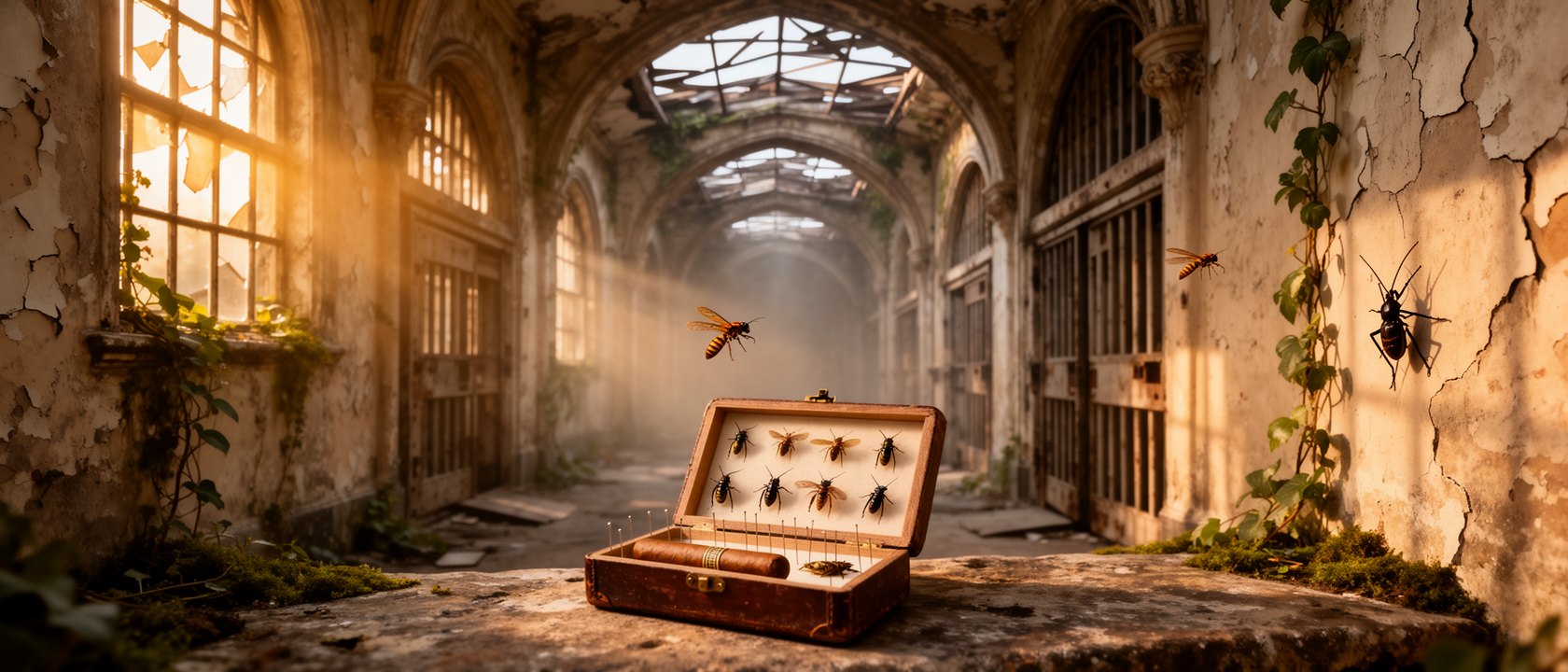
Inside Cell 25 of Cell Block 9, an exhibit called “Greg Cowper: Specimen” has occupied part of that ruin since 2011. More than 500 specimens representing more than 150 species, all caught on the prison grounds, are pinned in vintage cigar boxes and objects that once belonged to actual inmates, mounted on furniture built from salvaged cell doors. A 19th-century cabinet of curiosities is the obvious comparison, except these curiosities were trapped within the last few years, right outside the window.
The exhibit has a specific historical root. An anonymous prisoner in the 1800s quietly collected 18 species of butterflies and moths during solitary exercise in the yard. In 1889, Dr. Henry Skinner, a physician and entomology curator at the Academy of Natural Sciences, visited the man and documented the collection. Greg Cowper, an entomologist and curatorial assistant at the same institution, now part of Drexel University, picked up that thread more than a century later.
An Unexpected Guest List
The prison covers 11 acres in Philadelphia’s Fairmount neighborhood. After closure, vines crept across the flagstones, trees shot up, the place turned visibly green. In a patch of Pennsylvania vegetation, you would expect Pennsylvania insects.
But most of what Cowper catches are not from here. The dominant insects on the grounds are invasive species that arrived in the United States in recent decades, two confirmed examples being the Japanese burrowing cricket and the European paper wasp. Native species, present in the region for thousands of years, are conspicuously underrepresented. A site that looks like reclaimed wilderness is actually a foothold for ecological outsiders.
The “Urban Island” Effect
Cowper describes Eastern State as an “island” within the city, any habitat patch isolated from similar patches, no water required. The perimeter walls stand 30 feet (9.1 m) high, extend 10 feet (3.05 m) below ground, and measure about 12 feet thick at the base. They are a genuine physical filter, creating conditions most urban green spaces lack.
The second piece is what Cowper calls a “disturbed environment”: a habitat significantly altered by human activity and left to sort itself out. Crumbling plaster, waterlogged floors, and collapsed sections produce a chaotic, unstable landscape. Native insects often require specific plant communities, particular soil chemistry, and microclimates built over long stretches of undisturbed time, none of which a decaying ruin reliably offers. Invasive species, being generalists, tolerate disruption, colonize new sites quickly, and face less competition in ecologically unbalanced places.
Quantifying the Invasion
The collection runs deeper than the Cell 25 display. A 2013 Philadelphia Inquirer report cited more than 10,000 total specimens collected and more than 400 species identified from the grounds. Cowper collects using at least three trap types alongside a butterfly net, visiting every week or two, and across all of it, invasive species dominate.
The roughly two decades between the prison’s closure and its 1994 public reopening were years of near-total abandonment. The ecological character of the site formed during that isolation, shaped by which species could handle the conditions rather than which historically belonged there. Eastern State is kept in deliberate managed decay, so those conditions are not going away. A mummified cat and a mourning dove have also turned up during Cowper’s work, reminders that the site’s physical enclosure is matched by an ecological one.