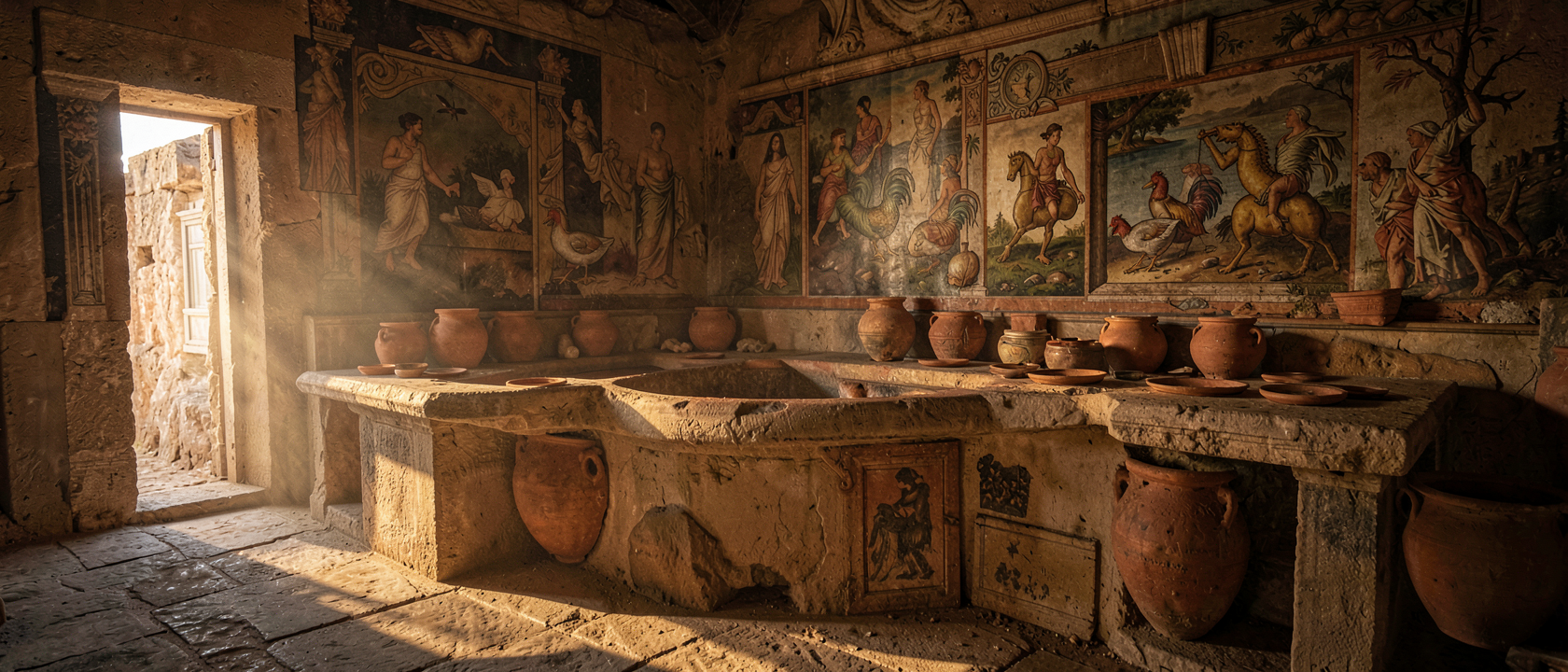
Two Ducks, Painted in the Exact Spot You’d Order
Pompeii has given archaeologists thousands of small windows into Roman daily life, but few are as oddly specific as a street-corner snack counter in the city’s Regio V district, on the western edge of its long-unexcavated northeastern section. The shop is a thermopolium, essentially a Roman fast-food counter built right into the sidewalk, where you’d lean over and order something hot without ever sitting down.
The counter is painted, and among the images is a still life of two dead mallard ducks, their colors still visible after the eruption of Mount Vesuvius buried the city in AD 79. They sit right at eye level for anyone standing at the counter to order. Set into the counter just below them was a storage jar. Inside it: actual duck bones.
The Jar Wasn’t Built to Cook. So Why Was There Food In It?
That jar is a dolium, a large built-in container Romans normally used for dry goods, wine, or oil, not for cooking. Yet this one held bones from duck, pig, goat, and fish, all mixed together with land snail shells.
Storage jars aren’t stockpots. Finding four different animals mixed inside one, instead of grain or oil, raises a real question about what was happening at this particular counter.
For Customers Who Couldn’t Read, the Wall Did the Talking
Archaeologists have a theory that turns the painted ducks from decoration into function. Many ordinary Romans buying street food couldn’t read, so a sign made of words would have told them nothing. A painting works instantly.
The duck fresco sits right above the jar where duck bones turned up, so researchers suggest it may have worked as a picture-menu: paint the duck where the duck is. It’s a hypothesis, not a confirmed fact, but it reframes this wall art. Instead of decoration, it starts to look like signage, closer to a photo on a restaurant menu than art for its own sake.
Butcher’s Scraps, or a Pot of Soup for the Whole Street?
Why four kinds of bone ended up together in a storage jar is still an open question, and archaeologists weigh two explanations, neither proven.
One: since dolia weren’t built for cooking, the bones might simply be waste, scraps from butchering or food prep tossed in for disposal, or leftovers customers left behind after eating.
Two: the shop stood a short distance from a cistern, a fountain, and a water-distribution tower in the square out front. Easy access to water is exactly what large-batch broth-making would need, which makes a soup operation genuinely plausible, even without proof.
Even Cicero Complained About the Smell
Ancient writers back up the idea that Rome had a real culture of communal stew-houses. Cicero, in his 1st-century-BC speech “Against Piso,” complained about the reek coming out of Roman tavern culture. Athenaeus, writing in the 3rd century, described shared meals built around broth with chunks of meat in it.
And the historian Dio Cassius, writing in the 2nd century, recorded that Emperor Claudius went as far as restricting tavern operations and banning the sale of boiled meat. Nobody legislates against a habit that doesn’t exist. Together, these accounts turn one jar of bones into part of a documented, citywide pattern, not a one-off.
Four Animals in One Pot Was Actually Unusual
It’s tempting to conclude that Pompeiians regularly ate a stew of duck, pig, goat, and fish together. The evidence doesn’t quite support that leap.
Surviving Roman recipe collections, like those attributed to Apicius, rarely combine that many meats in a single dish. Outside a few exceptions, mixing four animals into one pot would have counted as unusual even by Roman standards. This particular jar may capture something out of the ordinary, a special order or whatever happened to be on hand that day, rather than an everyday lunch special.
What’s left, nearly two thousand years later, is a painted duck and a jar of real duck bones, sitting exactly where someone once stood to order.