The Art of the Self-Arrest
Police work gets romanticized as a battle of wits, the shrewd investigator running down the cunning fugitive. But a surprising number of cases require almost no detective work at all, because the person responsible essentially does it for them.
Consider the robbers who stormed behind the counter at a pizza restaurant and grabbed the bag they had spotted. Inside: pizza dough. No cash, no valuables. Or the shoplifter who, while stealing from a store, filled out a job application there during the same visit, using their real name and address. Police did not need a forensics team. They needed a filing cabinet.
These are not embellishments. They represent a distinct category of failure: the self-arrest, where ineptitude does the arresting officer’s job.
The Planning Paradox
There is a genuine puzzle at the center of these cases. A person decides to commit a crime, which requires agency, some planning, and the nerve to act, and then something goes wrong in a way that should have been obvious before anyone moved a muscle.
The Dunning-Kruger effect, named after psychologists David Dunning and Justin Kruger following their 1999 study, describes a pattern in which people with limited competence tend to overestimate their own ability. A person planning a robbery might feel certain they have thought of everything, precisely because they have not thought enough to see the gaps. The pizza dough case fits exactly: the assumption that a bag behind a counter must contain money is the kind of confident-but-unfounded reasoning the effect predicts.
In Watsonville, California, a man walked into a bank, claimed to have a bomb, and demanded $2,000 to cover his friend’s rent. The bank manager suggested he fill out a loan application while she looked into it. He agreed. While he wrote down his details, she called 911. By the time police arrived, he had effectively handed over everything investigators would have needed anyway.
The Situational Blind Spot
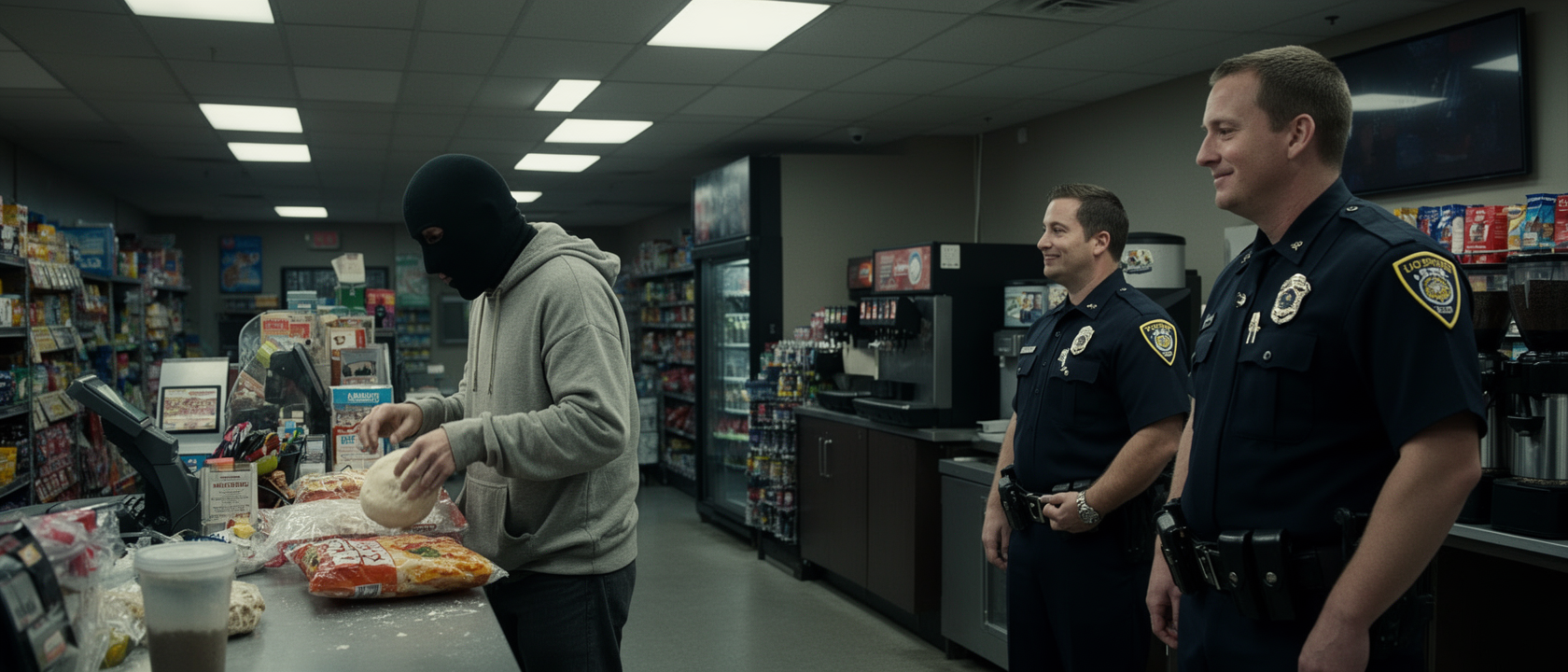
One account describes a man who cut to the front of the line at a Starbucks to rob it. Standing in that queue, in full uniform, were two police officers. He was arrested immediately. When adrenaline takes over, attention narrows, the brain locks onto the target and stops processing the broader environment, missing large, obvious, uniformed things.
A marijuana grower encountered a subtler version when someone stole one of his cannabis plants and he called the police. Officers arrived and left with the four plants remaining on the premises. He had summoned exactly the people most capable of making his situation worse.
The Accidental Informant
Sometimes the failure comes after the act. Michelle Perrino allegedly set fire to a file cabinet at her workplace. When coworkers discussed the incident, she mentioned that the fire had started in the file cabinet before investigators had released that detail publicly. That slip was enough to draw suspicion directly to her.
The ego-driven version is more direct. A professional shoplifter who reportedly resold stolen goods online agreed to discuss the operation on the television program Dr. Phil. Police and prosecutors watched the episode. The arrest followed. A Wendy’s robber showed the same impulse even more boldly: after stealing $586, he reportedly called the restaurant to complain the amount was too small and to warn staff to have more on hand next time. The call gave investigators what they needed.
The Aftermath Collapse
Even when a crime is completed, the minutes after can be where everything unravels. Jane Murray reportedly robbed a bank and returned to her getaway car, only to find she had locked the keys inside. She broke the window to get in. During a carjacking, Raymond Lewis Shepard’s firearm reportedly slipped and landed in the victim’s lap.
Robert Edward Tyrrell Jr. 29, of Villa Rica, Georgia, took his mother Billie Jo Tyrrell hostage on June 30, 2010, for over six hours after demanding she do his ironing and becoming irate when she told him she could not get the iron to work. He took her keys and cell phones to stop her from leaving. She found a spare key, drove to a police station, and he was charged with aggravated assault and false imprisonment, according to the Carroll County Sheriff’s Office. Of all the things he had controlled for, a second set of keys had not made the list.