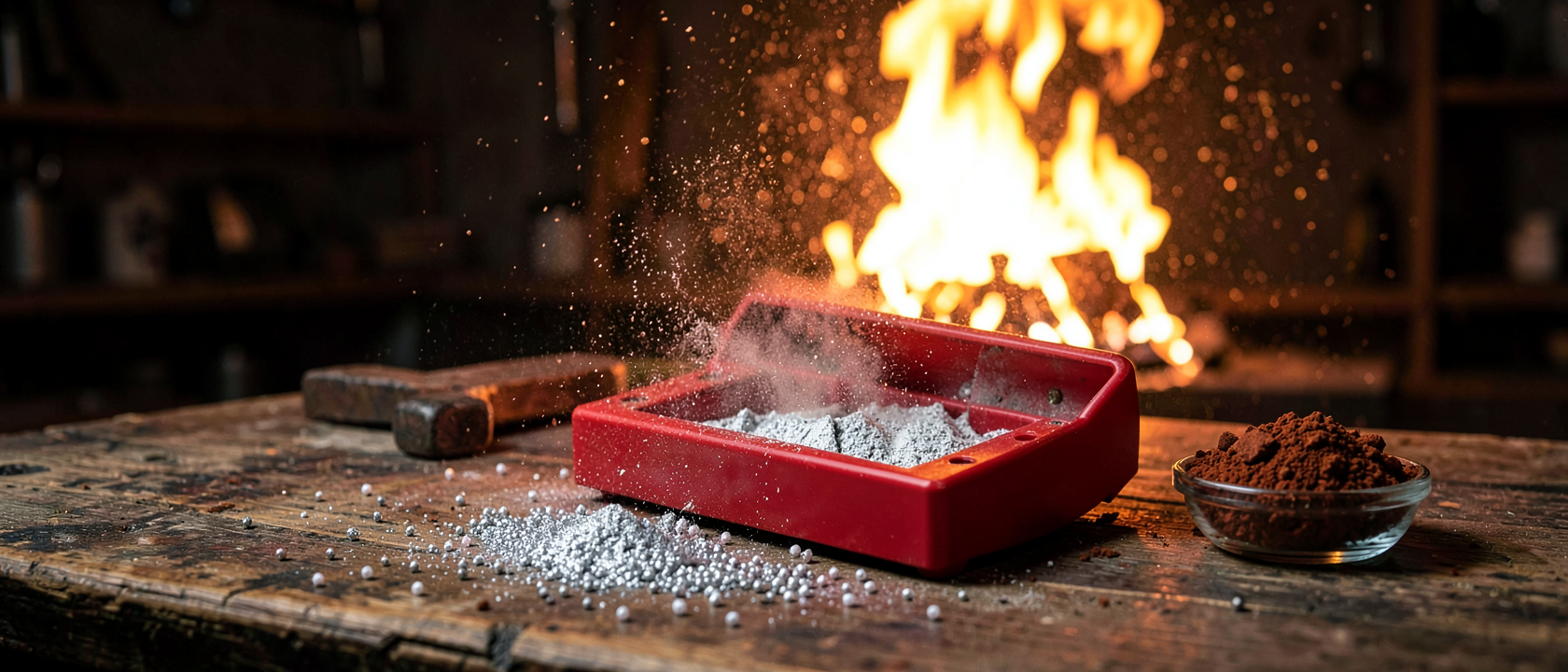
Not Ink. Not Magic. Metal.
Most people assume an Etch-A-Sketch works with pigment or dye. It doesn’t. The screen is coated on its inner surface with extremely fine aluminum powder, mixed with small polystyrene beads that help the powder flow and settle. When you twist the knobs, a stylus moves across the back of the glass, pushing powder aside and exposing clear glass beneath. The line you see is the absence of powder, not the presence of anything. Shake the toy, and electrostatic charge pulls the powder back against the glass.
André Cassagnes, a French electrician, landed on this idea in 1955 after noticing how electrostatic charge kept aluminum powder clinging to glass. He called his prototype “L’Ecran Magique”, the Magic Screen. The Ohio Art Company paid $25,000 for the license, renamed it the Etch-A-Sketch, and put it on store shelves in 1960. More than 100 million have sold since.
Thermite Is Also Aluminum Powder, Plus One Thing
Thermite, first described by German chemist Hans Goldschmidt in 1895, combines aluminum powder with iron oxide, ordinary rust, at roughly one part aluminum to three parts iron oxide by mass. When ignited, aluminum strips oxygen from the iron oxide, producing aluminum oxide, molten iron, and temperatures between 3,992 and 4,352 °F (2,200–2,400 °C), hot enough to liquefy the iron produced. The reaction is used for welding in confined locations, such as rail tracks.
Around April 2016 this connection began circulating widely online, raising the obvious question: is there a thermite ingredient sitting in a child’s toybox?
Same Element, Completely Different Situation
The aluminum inside an Etch-A-Sketch is chemically the same as the aluminum used in thermite, that part holds up. But thermite requires an oxidizer; without one, there is nothing to supply the oxygen the aluminum needs to react with. Having flour in the kitchen is not the same as having bread.
There is a second complication: the powder is not pure aluminum. It comes out mixed with polystyrene beads, which are plastic, play no role in thermite chemistry, and dilute any mixture you try to assemble.
Experiments have tested this directly. YouTuber CodysLab, in a video posted on April 19, 2016, titled “Thermite From An Etch A Sketch; Yes It Can Be Done!” showed it was possible, but only after adding iron oxide and addressing the contamination problem. The aluminum can serve as the fuel component; you still have to supply the missing half of the reaction yourself.
The first-season finale of the AMC series Breaking Bad shows Walter White breaking open several Etch-A-Sketches and burning through a door lock with the powder. The chemistry is directionally right, but one analysis calculated the scene would have required between 184 and 200 Etch-A-Sketches to collect enough aluminum for a reaction on that scale.
The Powder Is Still Worth Taking Seriously
Fine aluminum dust has its own hazards independent of thermite. A powder exposes far more surface area to air than a solid block of the same mass, and surface area is where reactions happen, which is why industrial handling of aluminum dust carries strict protocols around ignition sources. Opening an Etch-A-Sketch also poses a real inhalation risk; fine metallic particles drawn into the lungs cause genuine harm. The toy is safe as designed and sold. Its interior is a different matter.
Aluminum also oxidizes on its surface, forming a thin skin of aluminum oxide that slows further reaction, the same property that makes it so useful as a structural material, and part of why extracting reactive powder from the toy, separating it from plastic beads, and expecting it to behave like laboratory-grade thermite fuel is a much longer road than the question usually suggests.