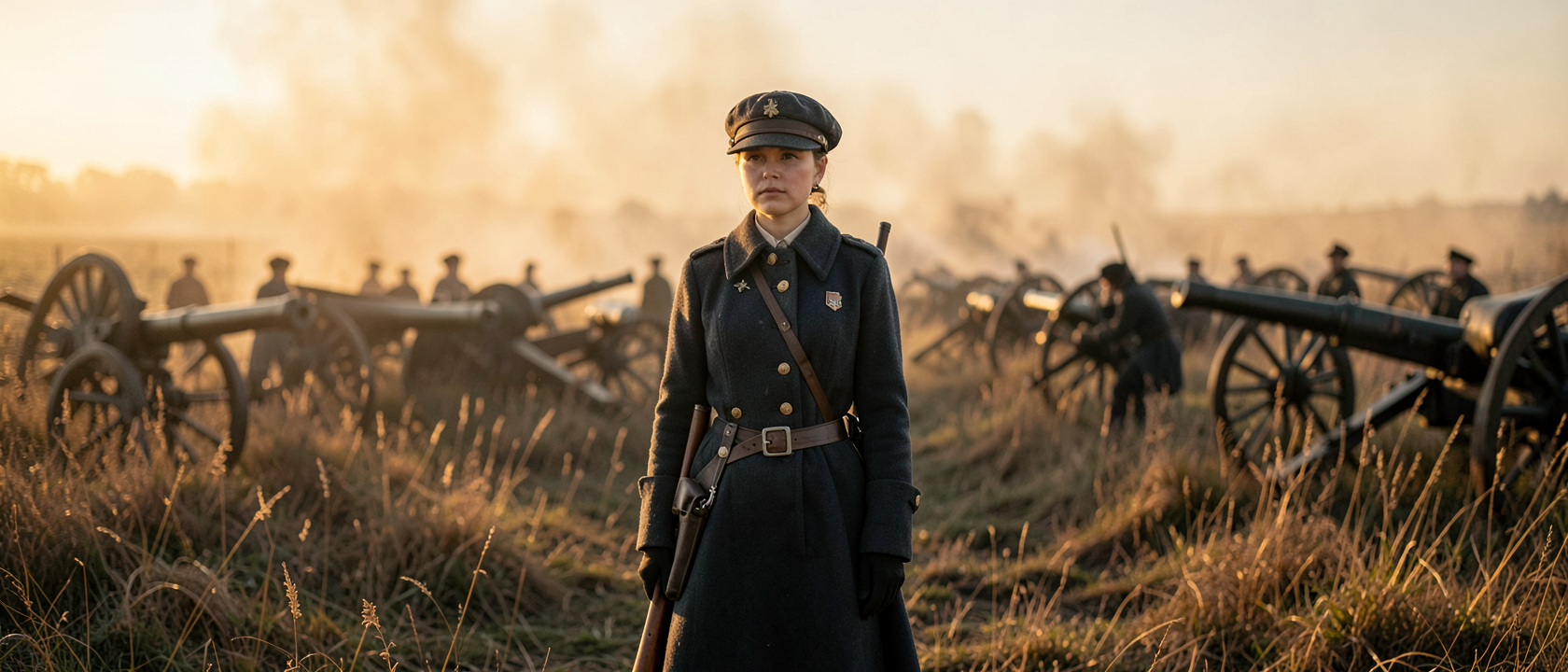
She Wanted a Musket, Not a Parasol
J.R. Hardman came to Civil War reenactment with a specific ambition: to portray a soldier. Not a camp follower, not a period-dressed nurse, not a civilian in a hoop skirt watching from a distance. She wanted to march, carry a musket, and stand in formation.
What she found, repeatedly, was a redirect. The groups she approached steered women toward civilian roles. It was rarely hostile, just consistent. And in a hobby built around historical accuracy, that consistency carried its own quiet irony: the people most committed to getting the details right were deciding, without much examination, which details counted.
The Rules Depend on Who You Ask
Civil War reenactment has no central authority. Individual units write their own rules, and those rules vary considerably, some treat every uniform button as near-sacred; others weigh community participation more heavily. A few allow women in military roles only if a real woman soldier is documented in that regiment’s historical counterpart.
The legal landscape has been tested. In August 1989, Lauren Cook Burgess was barred from a living history event at Antietam National Battlefield Park while dressed as a Confederate soldier. She sued the National Park Service for sex discrimination, and in 1993 U.S. District Judge Royce C. Lamberth ruled that categorically barring women from portraying male soldiers constituted unconstitutional sex discrimination. Private groups, however, remain free to set their own standards.
The Group That Said Yes Had One Condition
Hardman did eventually find a unit willing to accept her as a soldier. The condition: she would dress and present as male. That condition, however, is not much of a concession when read against the historical record, because between 400 and 1,000 women disguised themselves as men and served as soldiers in the Civil War, fighting on both Union and Confederate sides. Historians have positively identified approximately 400 of them; the true number is almost certainly higher, since those never discovered left no record by definition. Both armies formally forbade women from enlisting, so the women who did it used the only method available: bound chests, cut hair, a male name, and a signature on an enlistment form. Hardman’s “workaround” was the documented historical method, reproduced almost exactly.
Why They Did It: Wages, Love, and Conviction
Historians DeAnne Blanton and Lauren Cook Wike co-authored the 2003 book They Fought Like Demons: Women Soldiers in the Civil War, documenting three main motivations. The first was proximity to family, a husband or brother had enlisted, and the woman closest to him found a way to go too. The second was economic: a Union soldier earned $13 a month while a maid in New York could expect $4 to $7, making enlistment straightforward financial sense for some. The third was ideological conviction, acted on the same way men acted on it.
Jennie Hodgers enlisted as Albert D.J. Cashier at age 21 and fought in more than 40 engagements. Sarah Rosetta Wakeman served as Private Lyons Wakeman in the 153rd New York Volunteer Infantry, died of disease at 21, and was buried under her male alias, her biological sex never discovered. Sarah Emma Edmonds served as soldier, nurse, and spy under the name Frank Thompson.
Reenactress: When the Loop Closes
Hardman spent three years and $10,000 developing a feature-length documentary on this parallel. Titled Reenactress, it follows two overlapping stories: women who disguised themselves as men to fight in the Civil War, and women and trans men who cross-dress to portray soldiers at modern reenactments. A Kickstarter campaign drew 263 backers pledging a combined $27,530.
Units that turned Hardman away in the name of historical accuracy were, in that sense, less faithful to the record than the unit that admitted her on the condition she dress as the women she was honoring actually did. She went on to take part in more than 25 reenactment events, serving as an artillery soldier with the 6th New York and as an infantry soldier with the 53rd Georgia. Some units apply a “fifteen-yard rule”: if a participant’s female gender can be determined at 15 yards (about 14 meters) or less, they may be asked to leave the field. Blending in completely served the same purpose it had for the women she was honoring, except those women faced consequences measured in discharge, imprisonment, or death.